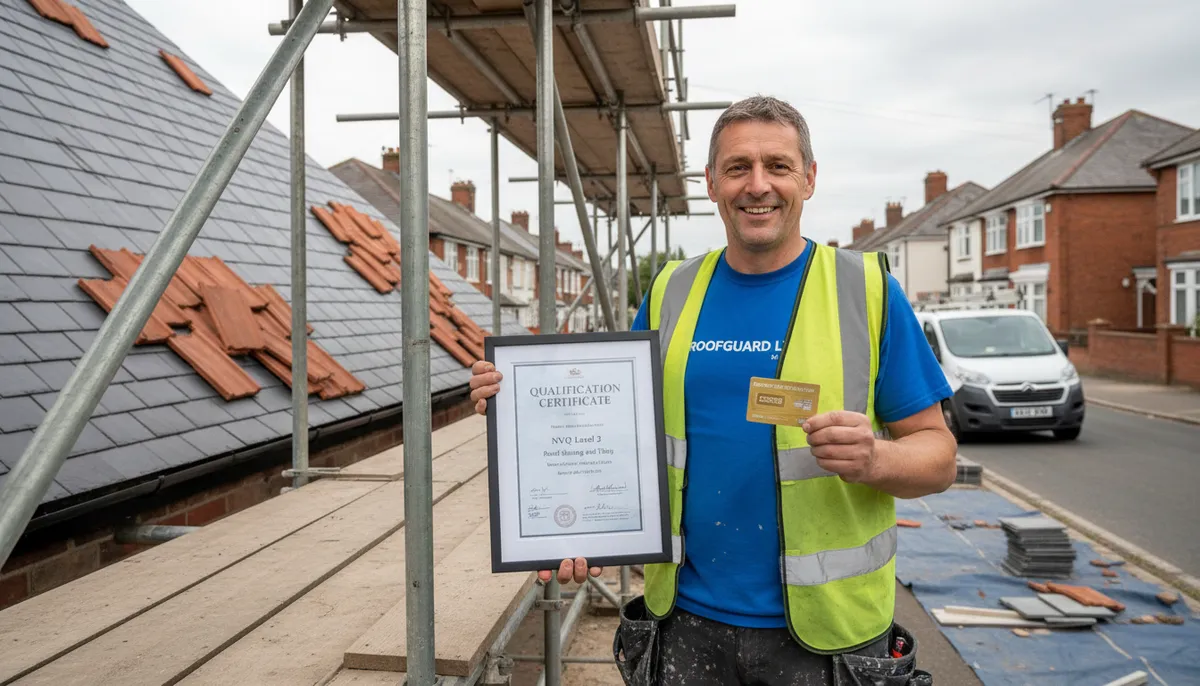
There’s no legal requirement to hold a qualification before you start working on roofs — but without one, you can’t get a CSCS Blue card, you’ll be turned away from most commercial sites, and many domestic clients won’t trust you with their property. In practice, NVQ Level 2 in Roofing Occupations is the standard the industry recognises.
This guide covers every qualification relevant to UK roofers: the NVQ pathway, CSCS cards, specialist disciplines, safety tickets, and what it all costs.
Key Takeaways
- NVQ Level 2 in Roofing Occupations (City & Guilds 6569) is the core qualification for roofers in England — it leads to a CSCS Blue (Skilled Worker) card
- The CSCS Health, Safety & Environment (HS&E) test is required for every CSCS card — the test fee is £22.50 online or £26 paper-based in 2026
- A CSCS Blue card costs £36 per card and is valid for five years
- The National Federation of Roofing Contractors (NFRC) runs the most widely recognised NVQ assessment service in the UK
- Working at Height Regulations 2005 apply to all roofing work — there’s no exemption, even for residential jobs
- The Level 2 Roofer Apprenticeship Standard is the fastest funded route into the trade, typically lasting two years
Do Roofers Have to Be Qualified?
No UK law requires roofers to hold a formal qualification. But in practice, most routes into paid work require one.
CSCS cards: The Construction Skills Certification Scheme (CSCS) card is expected on virtually every commercial construction site in the UK. A Blue Skilled Worker card requires NVQ Level 2 as a minimum. Without it, you’ll be refused site access.
Domestic clients: Homeowners increasingly ask to see proof of competence, particularly for larger jobs like full re-roofs or flat roof replacements. NFRC membership — which requires qualified operatives — is a common trust signal.
Insurance: Some public liability insurers apply exclusions or load premiums for unqualified roofers, particularly for commercial or high-rise work.
Trade directories: Checkatrade and MyBuilder don’t require roofing-specific qualifications to list, but carrying CSCS or NFRC credentials strengthens your profile and can be a filter clients use.
So while there’s no legal must-have, a qualification opens doors that are otherwise closed.
Entry Routes
Route 1: Apprenticeship
The Level 2 Roofer Apprenticeship Standard is the primary funded route. It typically lasts two years and combines on-the-job learning with off-the-job training at a college or training provider.
According to the UK government’s apprenticeship funding rules, employers with a payroll under £3 million have 95% of training costs covered by the government — the employer covers 5%, and you earn a wage throughout. There’s no upper age limit for apprentices.
At the end of the apprenticeship, you’ll hold the NVQ Level 2 Diploma in Roofing Occupations and qualify for a CSCS Blue card.
Route 2: Direct Entry + NVQ Assessment
Many roofers enter the trade as labourers and build experience before pursuing their NVQ. The NFRC’s NVQ Assessment Service lets experienced roofers demonstrate competence without sitting a full college course. An NVQ assessor observes you on real jobs and signs off your portfolio of evidence.
This route suits tradespeople who’ve been working on roofs for years without formal qualifications. You’ll need to document your experience and pass the CITB HS&E test before applying for your CSCS card.
The NVQ Qualification Pathway
| Step | Qualification | Who Provides It | Typical Cost |
|---|---|---|---|
| 1 | CITB Health, Safety & Environment Test | CITB-accredited test centres | £22.50–£26 |
| 2 | NVQ Level 2 Diploma in Roofing Occupations | City & Guilds (6569), assessed through NFRC or approved centres | £500–£1,500 |
| 3 | CSCS Blue (Skilled Worker) Card | CSCS via online application | £36 per card (5 years) |
| 4 | NVQ Level 3 in Roofing (optional) | City & Guilds, for supervisory roles | £600–£2,000 |
| 5 | CSCS Gold (Advanced Craft) Card | CSCS, requires NVQ Level 3 | £36 per card (5 years) |
Source: CSCS published card fees 2026; CITB published test fees 2026; NFRC NVQ Assessment Service.
The NVQ Level 2 covers the knowledge, skills, and behaviours needed for your specific roofing discipline. There are several specialisms within the qualification — you’ll be assessed in the area you actually work in.
Specialist Disciplines
Roofing isn’t a single trade. The NVQ Level 2 includes different pathways depending on your specialism:
| Specialism | What It Covers |
|---|---|
| Roof Tiling (Plain & Profiled) | Clay and concrete plain tiles, interlocking tiles, hip and ridge work |
| Slating | Natural and fibre cement slates, batten and counter-batten systems |
| Felt Flat Roofing | Torch-on felt, cold-applied systems, built-up felt roofing |
| Mastic Asphalt Flat Roofing | Hot-applied asphalt to BS 8218, ponding and falls |
| Leadwork | Flashings, valleys, dormer cheeks, soakers — to BS EN 12588 |
| Sheeting & Cladding | Metal roofing and wall cladding, standing seam systems |
If you work across more than one discipline, you can hold multiple units within your NVQ. The NFRC assessment service covers all main roofing disciplines.
CSCS Cards for Roofers
The CSCS card colour tells a site manager your qualification level at a glance:
| Card Colour | What It Means | Requirements |
|---|---|---|
| Red (Trainee) | In training, studying for NVQ Level 2 | Enrolled on an apprenticeship or NVQ course |
| Blue (Skilled Worker) | Fully qualified roofer | NVQ Level 2 + CITB HS&E test |
| Gold (Advanced Craft) | Supervisory or advanced skills | NVQ Level 3 + CITB HS&E test |
| Black (Manager) | Site management role | Relevant management qualification |
All CSCS cards cost £36 per card and are valid for five years. The CITB HS&E test certificate is valid for two years — if yours has expired, you’ll need to retake it before renewing. Cards are applied for online at cscs.uk.com.
Safety Tickets for Roofers
Roofing is one of the higher-risk construction trades for falls from height. Beyond the NVQ, most commercial clients and main contractors expect operatives to carry relevant safety cards.
Working at Height Regulations 2005: These apply to all roofing work with no exemption for domestic jobs. Competence is demonstrated through your NVQ qualification, but many contractors ask for evidence of fall-arrest training and working-at-height PPE, particularly for steeper pitches.
PASMA: The Prefabricated Access Suppliers’ and Manufacturers’ Association certification covers safe use of mobile scaffolding towers. A PASMA course typically takes one day and costs £120–£180. Most flat roofers and anyone working on commercial projects will be expected to hold one.
IPAF: The International Powered Access Federation card covers operation of mobile elevated work platforms (MEWPs) — cherry pickers, scissor lifts. Required on sites where MEWPs are used. One-day course, typically £150–£250.
Manual Handling: A basic manual handling certificate is inexpensive and widely required. It’s often included in a site safety induction but worth holding as a standalone card.
NFRC Membership
The National Federation of Roofing Contractors is the UK’s main trade body for the roofing sector. Contractors join as member firms, and membership requires that all operative staff hold or are working towards the relevant NVQ qualification.
NFRC membership gives clients a third-party assurance that you’re qualified and insured. The logo carries weight with domestic clients, letting agents, and local authority procurement teams. Membership fees are based on turnover and start from around £300–£500 per year for sole traders.
The NFRC also runs the NVQ Assessment Service, making them the most practical single point of contact for roofers who want to qualify through the on-site evidence route rather than a full college course.
How Long Does It Take?
| Route | Time to NVQ Level 2 + CSCS Blue Card |
|---|---|
| Apprenticeship | Typically 2 years |
| Adult learner (college + NVQ) | 1–2 years depending on available hours |
| Experienced roofer (NFRC assessment) | 6–12 months for portfolio and assessments |
The CITB HS&E test can be booked and sat within days. The NVQ assessment — whether through college or on-site — is the bottleneck. Allow time for observations to be scheduled, portfolio evidence to be reviewed, and paperwork to be processed.
Building Your Roofing Business
Getting qualified is the foundation. Growing a roofing business takes the same qualities that make a good roofer: reliability, turning up when you said you would, and doing the job properly.
One of the most practical steps once you’re ready to grow is having a professional website. Most homeowners search online before getting a roofer round to quote, and without a website you’re invisible to them. Digital Tradies builds websites for roofers from £49/month with no upfront cost and sites live in three days. If you’re building a business you’re proud of, it’s worth getting a website that reflects your work.
You might also find these useful:
Frequently Asked Questions
What qualifications do you need to be a roofer in the UK? There’s no legal requirement, but the industry standard is NVQ Level 2 in Roofing Occupations (City & Guilds 6569). This qualification leads to a CSCS Blue Skilled Worker card, which is required on most commercial construction sites. Without it, you won’t be able to work on most housebuilder sites or large commercial contracts.
How long does it take to qualify as a roofer? Via a Level 2 Roofer Apprenticeship, it typically takes two years. Experienced roofers going through the NFRC NVQ Assessment Service can qualify in six to twelve months, depending on assessment availability and how quickly the portfolio of evidence is completed.
Do roofers have to be qualified to work in the UK? No — there’s no UK law requiring roofers to hold a formal qualification. But without NVQ Level 2, you can’t get a CSCS Blue card, which means you’ll be refused access to most commercial construction sites. Many domestic clients also ask to see CSCS or NFRC credentials before signing off on larger jobs.
What is a CSCS card and do roofers need one? A CSCS (Construction Skills Certification Scheme) card proves your qualification level to site managers. Qualified roofers with NVQ Level 2 carry a Blue Skilled Worker card. Cards cost £36 and are valid for five years. You’ll also need to pass the CITB Health, Safety & Environment test (£22.50 online) before applying.
Do roofers need PASMA or IPAF cards? Not by law, but both are expected by most main contractors on commercial sites. PASMA covers mobile scaffolding towers, IPAF covers powered access platforms. Both courses take one day and cost between £120 and £250. If you’re doing purely domestic work you may not need them — but they significantly broaden the commercial work you can take on.