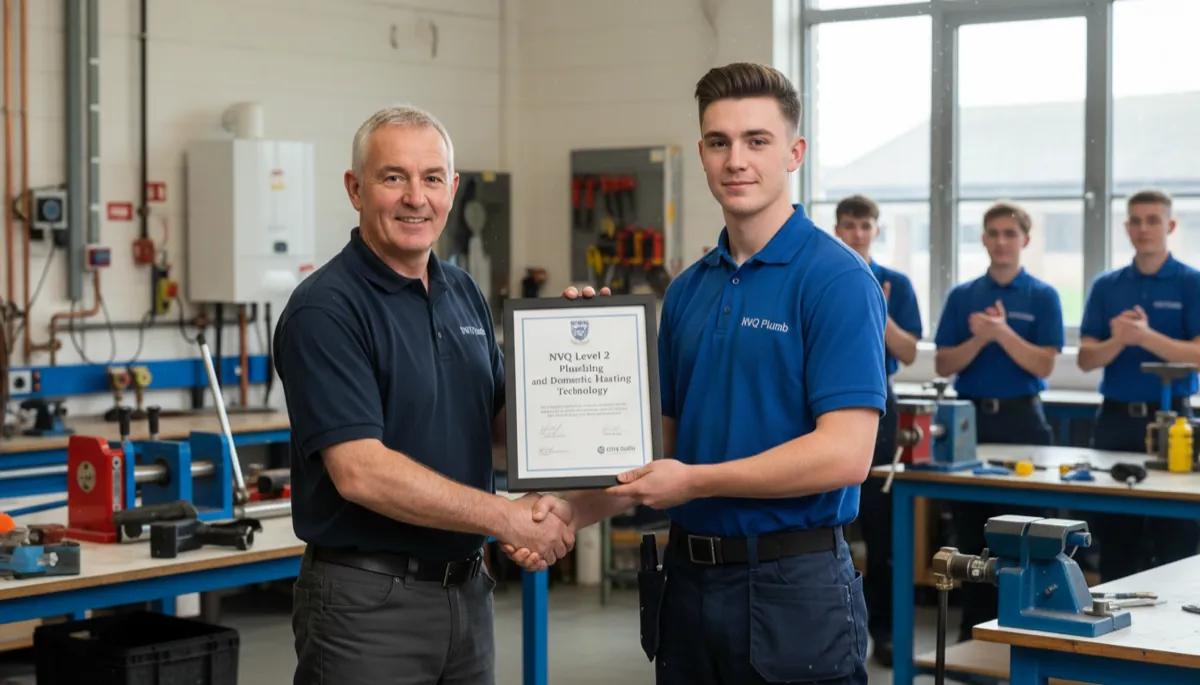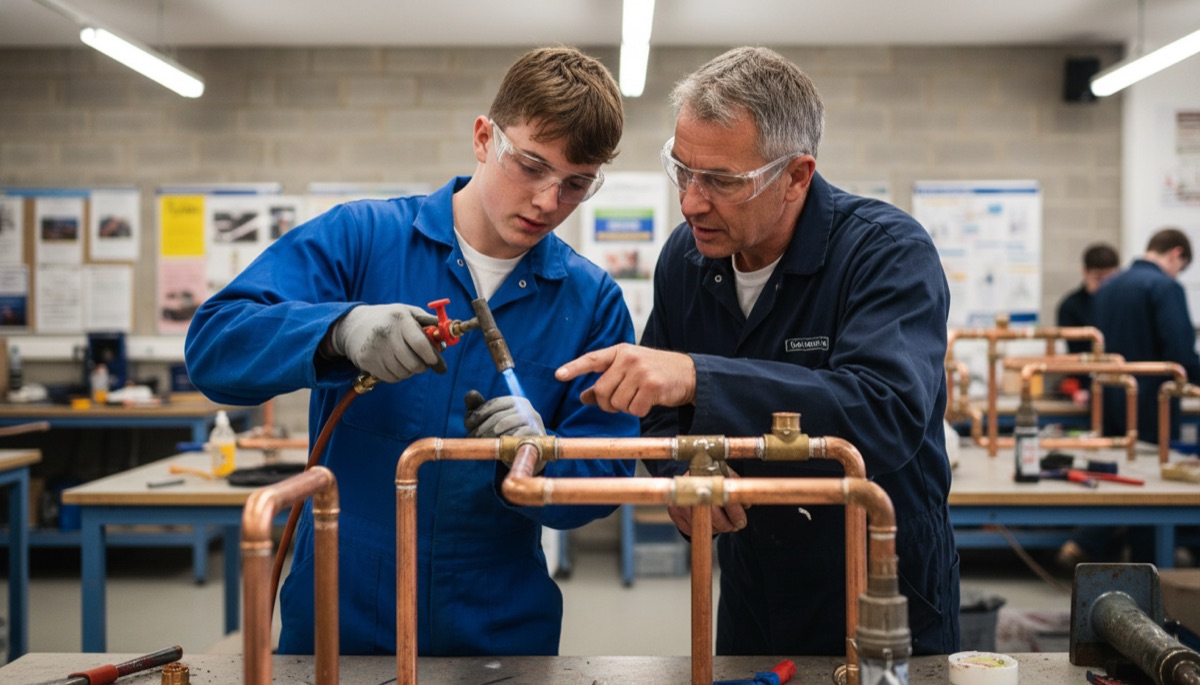
A plumbing apprenticeship in the UK typically lasts four years. You work for a plumbing firm most days, attend college one or two days per week, and get paid throughout. At the end, you hold a Level 3 qualification recognised across the industry — the foundation for working unsupervised, taking on your own jobs, and eventually going self-employed.
This guide covers the apprenticeship route specifically: what the standard involves, what the daily reality looks like, what you’ll earn year by year, and how to actually land a placement. If you want a broader overview of all routes into the trade, read our how to become a plumber guide.
Key Takeaways
- Duration: 48 months (the apprenticeship standard is Level 3, equivalent to A-level)
- Pay: starts at £7.55–£9/hour in year one; most firms raise it significantly by years three and four
- College: one to two days per week — covering theory, regulations, and technical assessments
- End Point Assessment: a synoptic practical test you sit once your employer and training provider sign you off as ready
- Age: there’s no upper age limit — people start plumbing apprenticeships in their 30s and 40s and complete them successfully
The Apprenticeship Standard You’ll Work Toward
The formal name is the Plumbing and Domestic Heating Technician Level 3 Apprenticeship Standard, managed by the Institute for Apprenticeships and Technical Education (IfATE). According to the Find Apprenticeship Training service on GOV.UK, the government funds up to £22,000 per apprentice through the apprenticeship levy system — which is why employers are often willing to take on apprentices even though it takes time and resource to train them.
Over the four years, you’ll typically work toward these qualifications in sequence:
| Stage | Qualification | Timing |
|---|---|---|
| Years 1–2 | Level 2 Diploma in Plumbing and Domestic Heating Technology | First two years |
| Years 2–4 | Level 3 Diploma in Plumbing and Domestic Heating Technology | Final two years |
| Throughout | NVQ Level 3 in Plumbing portfolio (on-site evidence) | Ongoing |
| Final stage | End Point Assessment — synoptic practical test | Last few months |
Awarding bodies include City & Guilds and EAL (Excellence, Achievement & Learning). Both are widely recognised. Which one your college uses depends on their registration, not on you.
The Chartered Institute of Plumbing and Heating Engineering (CIPHE) has a significant role in the industry — some employers are CIPHE-registered, and membership can be a useful credential once you qualify.
What the Day-to-Day Looks Like
Most weeks follow the same pattern: four days working on-site with your employer, one day at college.
On-site work varies based on what your employer specialises in. You might spend a week on a new-build housing site fitting hot and cold water systems, then switch to domestic service work (boiler repairs, bathroom fittings, blocked drains) the following week. That variety is built into the NVQ — you need evidence across different types of plumbing work, so a decent employer will expose you to a range of jobs.
In the early months, you’ll mostly watch and assist. By year two, you’ll be doing most of the physical work yourself with your supervisor checking in. By year three, many apprentices are running straightforward jobs independently while a qualified plumber is on site.
College days cover the theory side: plumbing science, building regulations, water regulations, drainage systems, heating systems, and health and safety. According to the Education and Skills Funding Agency (ESFA), at least 20% of your total working hours must be spent on off-the-job training — this is a legal requirement of every apprenticeship, not optional.
You’ll also build an NVQ portfolio throughout. This is a record of the work you’ve completed, evidence that you’ve met the competencies required, and assessments carried out by your NVQ assessor (usually a visiting assessor from your training provider).
Plumber Apprentice Pay by Year
The legal minimum apprentice rate in 2025/26 is £7.55 per hour, set by the government’s National Minimum Wage for apprentices. Most plumbing employers pay above this, particularly once you’re adding real value to jobs.
Many firms follow the JIB-PMES (Joint Industry Board for Plumbing and Mechanical Engineering Services) recommended pay scales. For context on what qualified plumbers earn, see our plumber hourly rate guide, which set apprentice rates as a percentage of the qualified adult rate:
| Year | JIB-PMES Recommended Rate | Approximate Weekly Pay (40 hrs) |
|---|---|---|
| Year 1 | ~40% of adult rate | £320–£390/week |
| Year 2 | ~55% of adult rate | £440–£530/week |
| Year 3 | ~70% of adult rate | £550–£650/week |
| Year 4 | ~90% of adult rate | £700–£790/week |
These are recommendations — some employers follow them, some don’t. London and South East firms typically pay more than the national average. Always check what a specific employer offers before accepting a placement. According to the apprenticeships.gov.uk portal, starting salaries for plumbing apprentices can reach up to £20,000/year at some firms.
How to Find a Plumbing Apprenticeship
Three routes consistently produce results:
1. GOV.UK Find an Apprenticeship portal
The official service at find-apprenticeship.service.gov.uk lists live vacancies from registered employers across England. Filter by trade and location. It’s updated continuously and is the most complete public source. Scotland, Wales, and Northern Ireland have separate portals through their devolved training agencies.
2. Contact firms directly Many small plumbing and heating businesses never advertise on the government portal. They take on apprentices through word of mouth or when someone shows up and asks. A short, professional email or letter to local plumbing firms — or even calling in person — can get results where the portal can’t.
3. Your local Further Education college Colleges that run plumbing courses often have employer relationships and can connect you with firms looking for apprentices. They have a direct interest in placing students because it fills their course numbers.
CIPHE also lists member employers on its website, and many are open to taking on apprentices.
What Employers Look For
Plumbing firms aren’t looking for people with technical knowledge — you can’t be expected to know that yet. They’re looking for:
- Reliability. Show up when you say you will. That’s genuinely 80% of it at the start.
- A driving licence or willingness to learn. Most plumbing work requires travelling between sites. Many employers need you to drive within the first year or two.
- Maths at GCSE level. Not because the maths is hard, but because you need to be comfortable with measurements, calculations, and reading plans.
- Some awareness of the trade. If you’ve done any plumbing-related work (helping a parent, doing work experience, watching tutorials seriously), mention it. It shows genuine interest.
A short cover letter that’s actually specific to the firm — rather than a generic template — makes a noticeable difference when most applicants send the same thing.
Age and Entry Requirements
There’s no upper age limit for apprenticeships. The government’s apprenticeship funding rules changed several years ago, and adults of any age can now complete a funded apprenticeship. People in their 30s, 40s, and occasionally 50s do complete plumbing apprenticeships.
Minimum entry requirements are usually:
- GCSE Maths at grade 3 (formerly grade D) or above
- GCSE English at grade 3 or above
- Minimum age of 16
Some employers prefer 17 or 18, partly for practical insurance reasons around driving and site access. But there’s no official restriction.
If you’re older and changing careers, be clear about it with employers. Many see it as an advantage — maturity, work ethic, and reliability are more valuable than a 16-year-old’s enthusiasm in many cases.
What Happens at the End: The End Point Assessment
In the final few months of your apprenticeship, your employer and training provider will assess whether you’re ready for the End Point Assessment (EPA). This isn’t something you book yourself — they trigger the process once they’re confident you’re ready.
The EPA for the Plumbing and Domestic Heating Technician standard has two components:
| Component | What It Involves |
|---|---|
| Knowledge test | A written or online assessment covering plumbing theory, regulations, and technical knowledge |
| Synoptic practical assessment | A practical timed test where you install, commission, or fault-find on a plumbing rig under assessment conditions |
Both components are marked by an independent End Point Assessment Organisation (EPAO). Your grade — pass, merit, or distinction — goes on your qualification certificate.
Once you’ve passed, you hold a Level 3 in Plumbing and Domestic Heating Technology. From there, you can apply for your JIB-PMES card (the plumbing equivalent of a trade card confirming your qualifications), go self-employed, or progress to [Gas Safe registration](/blog/gas-safe-registration-explained/) by completing ACS gas qualifications separately.
Frequently Asked Questions
Is it hard to get an apprenticeship in plumbing? It’s competitive, particularly in larger cities where there are more applicants per vacancy. That said, there’s a genuine shortage of qualified plumbers in the UK, and many firms struggle to find committed apprentices. Applying to small local firms directly — rather than only using the government portal — significantly increases your chances.
How long does a plumbing apprenticeship take? The standard duration is 48 months (four years). Some apprentices complete it in slightly less time if they progress quickly and their employer puts them forward for End Point Assessment early. It’s rarely shorter than three and a half years in practice.
How much do apprentice plumbers earn in the UK? The legal minimum is £7.55/hour in 2025/26, but most firms pay above this. Following JIB-PMES guidance, year-one apprentices typically earn around £320–£390 per week, rising to £700–£790 per week by year four. Actual pay depends heavily on the employer and region.
Is 25 too old for a plumbing apprenticeship? No. There’s no upper age limit, and 25 is well within normal range for a career-change apprenticeship. Many employers value the attitude and reliability that older apprentices bring. Your biggest challenge isn’t your age — it’s finding an employer willing to commit to a four-year placement, which applies equally at any age.
A plumbing apprenticeship is one of the better career investments available in the UK trades. You earn while you learn, come out with a portable qualification, and enter a trade where the long-term demand for skilled workers is consistently strong.
Once you’re qualified and building your own client base, a professional website helps you look the part and get found by people searching for plumbers in your area. If you’re at that stage, Digital Tradies builds websites for plumbers from £49/month with no upfront cost — typically live within three working days.