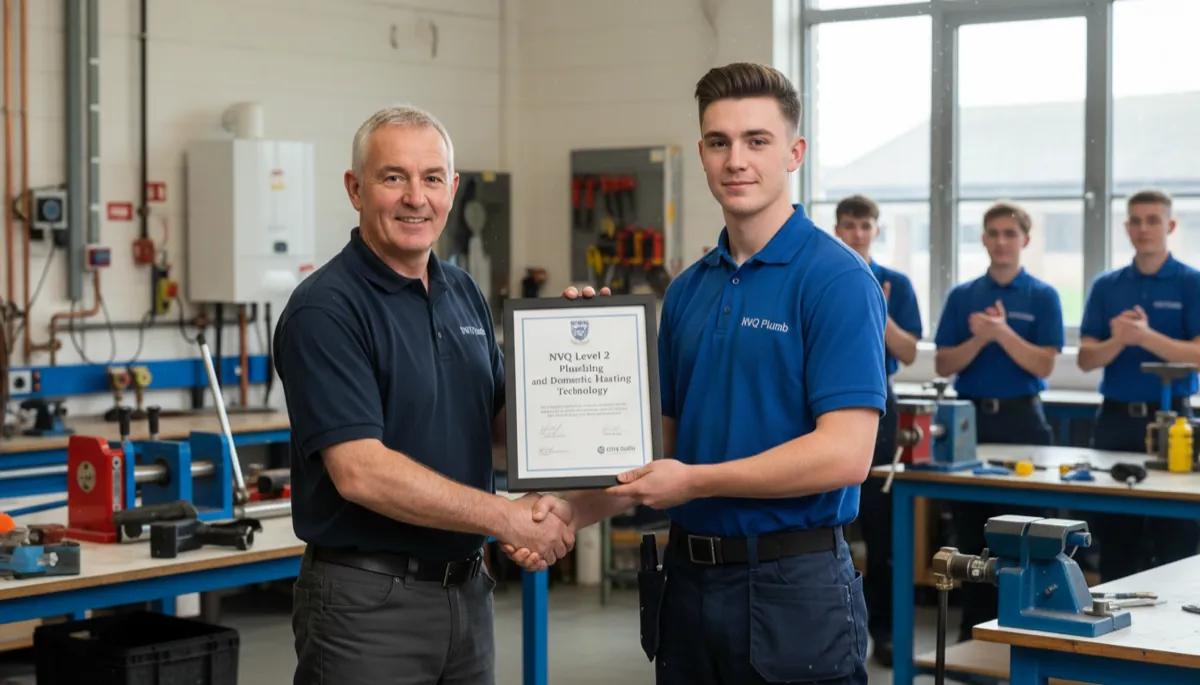
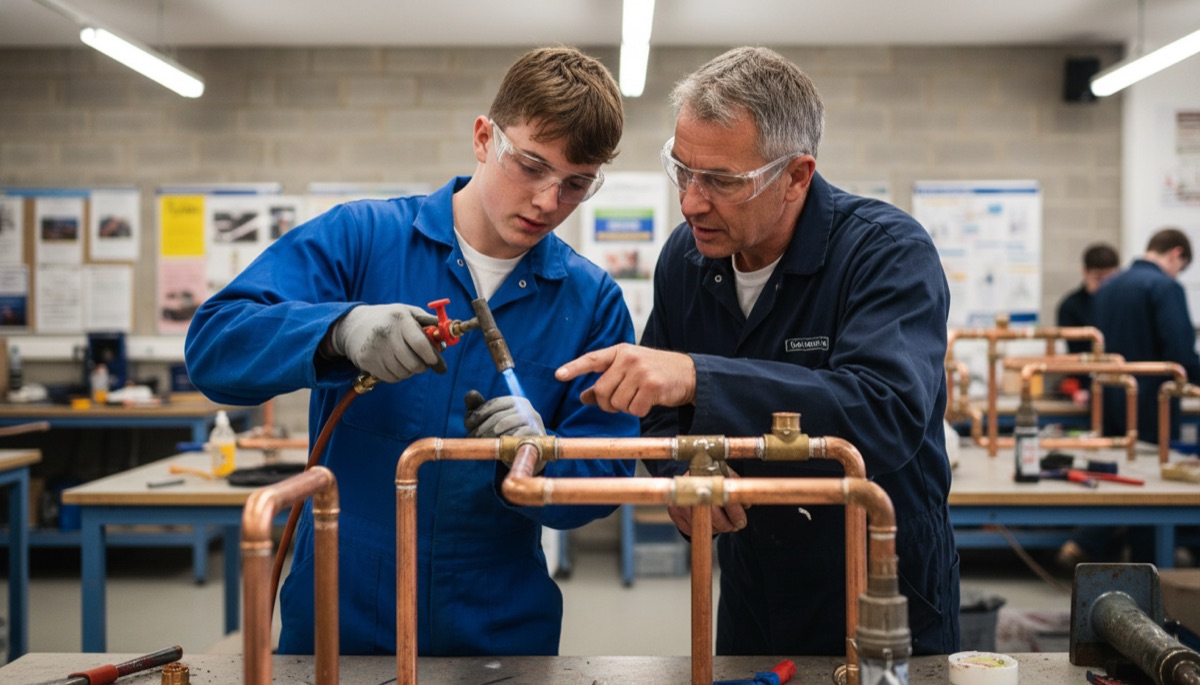
An NVQ in plumbing isn’t a course you sit — it’s a qualification you earn by demonstrating competence on real jobs, with an assessor watching and signing off your work. Level 2 covers basic systems and gets you working unsupervised; Level 3 proves you can handle complex installations and is the level you need to run your own business. If you’re confused about what the levels mean, which awarding body to go with, or whether the Assessment Only Route applies to you, this guide has the answers.
Key Takeaways
- NVQ stands for National Vocational Qualification — it’s assessed in the workplace, not in a classroom
- Level 2 covers cold and hot water, drainage, and basic heating; Level 3 adds pressurised systems, complex heating, and commercial work
- The main awarding bodies are City & Guilds, EAL, and BPEC — all are equally recognised; which one you get depends on your training provider
- If you’ve been working as a plumber for years without formal qualifications, the Assessment Only Route (AOR) lets you gain an NVQ without going back to college
- Level 3 is what self-employed plumbers, trade insurers, and most lead generation platforms (Checkatrade, MyBuilder) expect
What Is an NVQ?
An NVQ — National Vocational Qualification — is a competence-based qualification. That means it’s not awarded based on written exams but on evidence that you can do the job in real working conditions.
You build a portfolio. An assessor visits your jobs, observes you working, and checks that you meet the required standards for each unit. When every unit is signed off, you’re awarded the NVQ.
This makes NVQs different from training qualifications like City & Guilds Diplomas, which are theory-based and assessed in college. You typically work toward both in parallel during an apprenticeship — the Diploma gives you the knowledge, the NVQ proves you can apply it.
According to the Regulated Qualifications Framework (RQF), managed by Ofqual, NVQs for plumbing sit at Level 2 and Level 3 on an 8-level scale. Both levels are in Plumbing and Domestic Heating Technology.
NVQ Level 2 vs Level 3: What Each Covers
| NVQ Level 2 | NVQ Level 3 | |
|---|---|---|
| Focus | Core plumbing fundamentals | Complex and commercial work |
| Cold water systems | Yes | Yes (more complex) |
| Hot water systems | Basic | Pressurised, unvented |
| Drainage | Basic above-ground | Above and below-ground |
| Heating systems | Introductory | Full central heating, controls |
| Commercial plumbing | No | Yes |
| Pressurised systems | No | Yes |
| Typical duration | 2 years (within apprenticeship) | 2 more years, or 1–2 years standalone |
| Employment outcome | Qualified plumber, supervised work | Unsupervised, self-employment, business ownership |
Level 2 In Practice
Level 2 proves you can handle routine plumbing work to industry standards. A Level 2 plumber can install hot and cold water systems, fit basic drainage, and carry out maintenance on standard domestic plumbing. You can work unsupervised on this type of work, but many contractors and domestic clients will still ask about Level 3.
For apprentices, Level 2 is usually completed in the first two years of a four-year programme. It’s a stepping stone, not a destination.
Level 3 In Practice
Level 3 is the full trade qualification. It demonstrates that you can carry out complex work including pressurised and unvented systems, whole-house heating installations, and commercial plumbing. It’s what insurers, lead gen platforms, and larger contractors expect.
The Institute for Apprenticeships and Technical Education (IfATE) sets the Plumbing and Domestic Heating Technician standard at Level 3 — so the apprenticeship targets Level 3 as the end qualification, not Level 2.
Awarding Bodies: City & Guilds, EAL, and BPEC
Three main awarding bodies issue plumbing NVQs in the UK. All three are recognised by Ofqual and accepted equally across the industry. The one you end up with depends on which training provider your college or employer uses.
| Awarding Body | Full Name | NVQ Qualification Title |
|---|---|---|
| City & Guilds | City and Guilds of London Institute | NVQ Level 2/3 in Plumbing and Domestic Heating Technology |
| EAL | Excellence, Achievement & Learning | NVQ Level 2/3 in Plumbing and Domestic Heating Technology |
| BPEC | Building & Plumbing Engineering Council | NVQ Level 2/3 in Plumbing and Domestic Heating Technology |
City & Guilds is the most widely known name, but there’s no practical difference between the three when presenting qualifications to clients, insurers, or contractors.
How Much Does a Plumbing NVQ Cost?
NVQ costs vary depending on whether you’re in an apprenticeship (where costs are covered) or arranging assessment independently.
| Route | Approximate Cost |
|---|---|
| Apprenticeship (government-funded) | £0 to you — levy funds cover up to £22,000 per apprentice (source: GOV.UK Find Apprenticeship Training) |
| College course with NVQ assessment included | £3,000–£8,000 total for Level 2 and 3 combined |
| Assessment Only Route (AOR) — see below | £500–£1,500 for the NVQ assessment element |
These are UK averages. Costs vary between providers and regions, so it’s worth getting quotes from two or three colleges or assessment centres.
The Assessment Only Route (AOR)
The Assessment Only Route is how experienced plumbers gain formal NVQ recognition without going back to college for training. If you’ve been working in plumbing for three or more years and can demonstrate the required competencies through your existing job history and evidence, you can apply for AOR assessment directly.
How it works:
- You gather evidence — site photos, job records, references from employers or clients
- An assessor reviews your portfolio
- The assessor observes you carrying out live work
- Units are signed off based on your demonstrated competence
- Once all units are complete, you’re awarded the NVQ
AOR is particularly useful for:
- Plumbers who trained abroad and want UK recognised qualifications
- Mature workers who entered plumbing without completing an apprenticeship
- Anyone with substantial site experience who’s been working without formal certification
According to the Construction Industry Training Board (CITB), the AOR is a recognised route under the apprenticeship and qualification frameworks — it’s not a shortcut or a lesser qualification. The NVQ you receive is identical to one earned through an apprenticeship.
Typical AOR assessment costs for plumbing NVQ Level 3 run from £500 to £1,500 depending on the assessment centre and how much evidence gathering is required.
NVQ and the CSCS Card
Holding an NVQ Level 3 in Plumbing is one of the primary routes to the CSCS Blue Card — the Skilled Worker card you need to access most construction sites. Without the right CSCS card, you’ll be turned away from large-scale commercial and public sector work.
The Chartered Institute of Plumbing and Heating Engineering (CIPHE) also recognises NVQ Level 3 as the basis for associate membership — useful if you want professional credentials for marketing to domestic clients.
For a full breakdown of all the certifications that build on your NVQ — Gas Safe, G3, CSCS — see our plumber qualifications guide.
What Comes Next After Your NVQ?
An NVQ Level 3 in plumbing opens the door to most self-employed work, but certain job types need additional certifications on top.
| Job Type | Extra Certification Required |
|---|---|
| Any gas work | Gas Safe registration + ACS gas qualifications (legally required under the Gas Safety (Installation and Use) Regulations 1998) |
| Unvented hot water systems | G3 certification (Building Regulations requirement) |
| Oil-fired heating | OFTEC registration |
| Construction site access | CSCS Blue Card |
You can start working self-employed with your NVQ Level 3 in cold water, hot water, and drainage — just not gas until you have the ACS qualifications and Gas Safe registration.
If you’re thinking about going self-employed after qualifying, a professional online presence makes a real difference to how quickly you win customers. Plumbers with their own website — even a simple one — consistently outperform those relying solely on word of mouth or lead gen platforms. Digital Tradies builds websites for tradespeople from £49/month with no upfront cost, live in three days.
Frequently Asked Questions
Is NVQ Level 2 enough to become self-employed as a plumber? Technically yes — there’s no law requiring a specific NVQ level to trade as a self-employed plumber on cold water and drainage work. In practice, clients and many trade insurers expect Level 3. It’s better to complete Level 3 before going out on your own.
How long does it take to complete a plumbing NVQ? Within an apprenticeship, Level 2 takes roughly two years and Level 3 another two years. Standalone, via a college programme with integrated assessment, you can complete both levels in two to three years part-time. The Assessment Only Route is faster — typically a few months — if you already have the experience.
Can I do a plumbing NVQ without an employer? For the standard route, you need a workplace where an assessor can observe you — so yes, you need somewhere to work. If you’re self-employed with your own clients, that counts. The AOR route also works for self-employed plumbers providing evidence of their completed jobs.
What’s the difference between a City & Guilds Diploma and an NVQ? The City & Guilds Diploma (e.g., the 6189 in Plumbing and Domestic Heating Technology) is a knowledge-based qualification taught and assessed in college. The NVQ is a competence-based qualification assessed in the workplace. Both are typically pursued together during an apprenticeship, and both are required for the End Point Assessment.
Do I need an NVQ to join a competent person scheme? Most competent person schemes for gas work (like CORGI HomePlan) or heating (like OFTEC or HETAS) have their own technical tests and don’t require a specific NVQ. However, the NVQ Level 3 is good foundation evidence of competence that most schemes will ask about during their vetting process.
For more on routes into plumbing and how long the whole journey takes, read our how to become a plumber guide. If you’re further into your career and thinking about going self-employed, see our plumber apprenticeship guide for detail on what the formal qualification pathway looks like end to end.