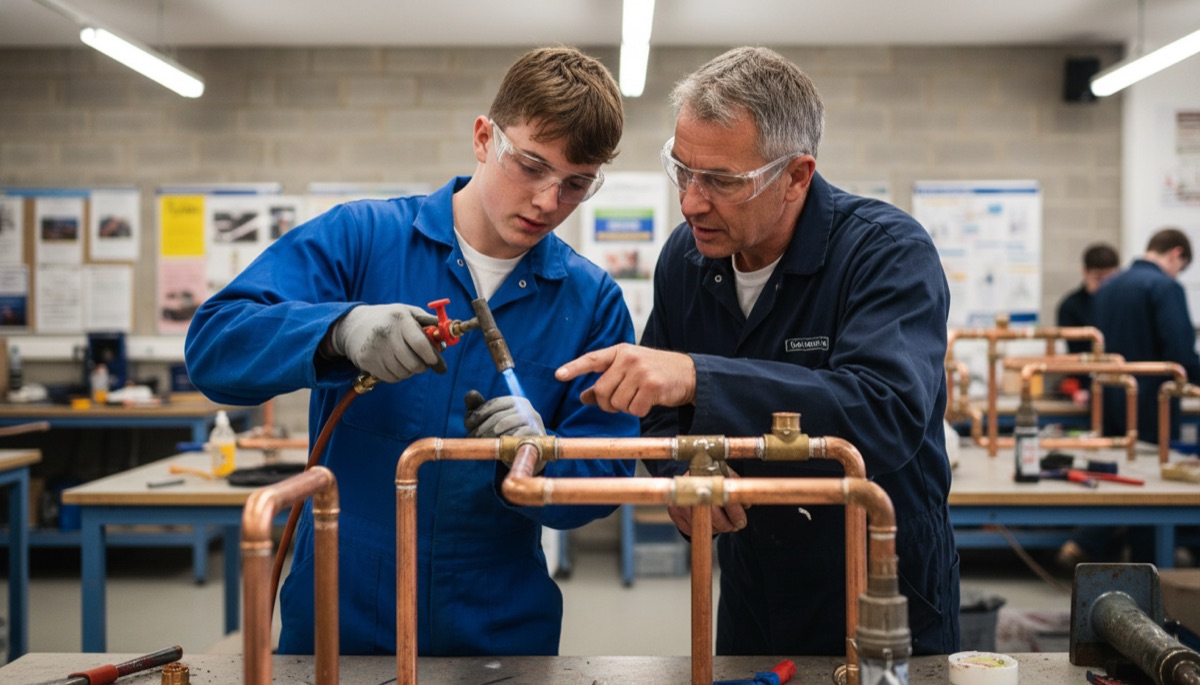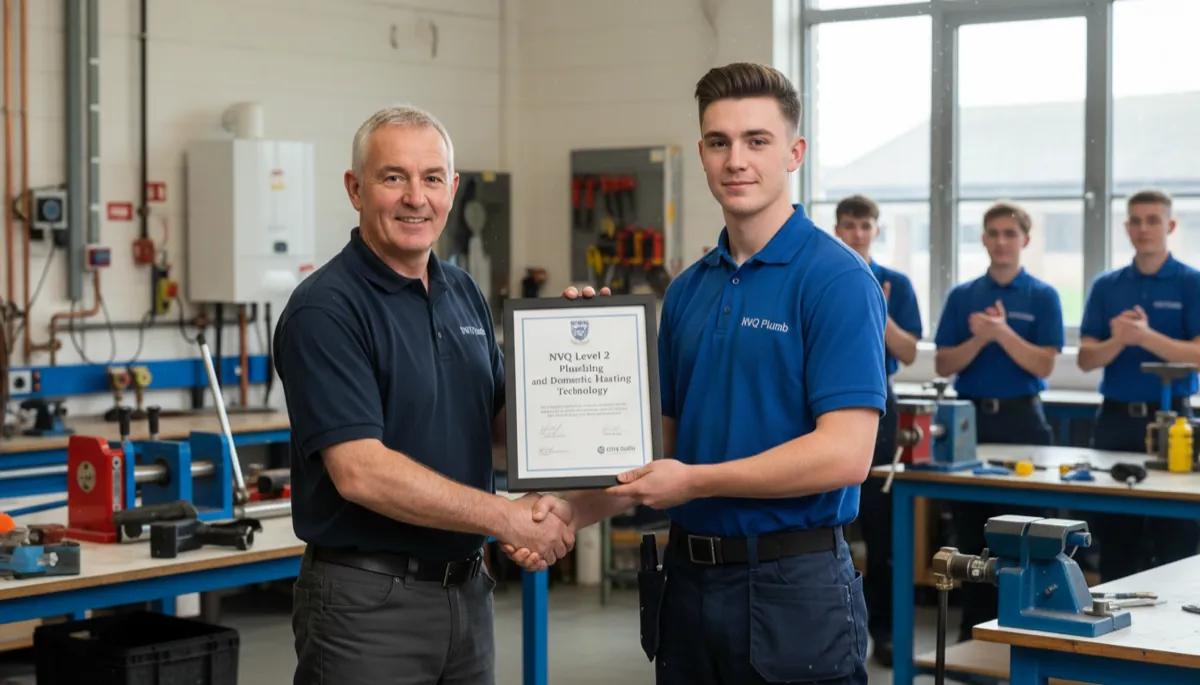
There’s no single licence you need to call yourself a plumber in the UK — but that doesn’t mean qualifications don’t matter. The core NVQ Level 3 in Plumbing and Domestic Heating Technology is the industry standard that lets you work unsupervised and run your own business. On top of that, specific types of work — gas, unvented hot water, oil heating — each require separate certifications that are either legally required or expected by building insurers.
This guide runs through every qualification that matters to a UK plumber, which ones are legally required, and what each one actually lets you do.
Key Takeaways
- There’s no legal requirement to hold any qualification just to work as a plumber on cold water or basic heating systems — but gas work and unvented hot water have strict legal restrictions
- NVQ Level 3 in Plumbing and Domestic Heating Technology is the industry standard; Level 2 is an intermediate step
- [Gas Safe registration](/blog/gas-safe-registration-explained/) is a legal requirement under the Gas Safety (Installation and Use) Regulations 1998 — you cannot legally work on gas appliances without it
- G3 certification is required by Building Regulations before you can install or work on unvented hot water cylinders
- CSCS Blue Card is effectively required to access most construction sites, though it’s not a legal mandate
Plumber Qualifications at a Glance
| Qualification | Issuing Body | Required For | Legally Mandatory? |
|---|---|---|---|
| NVQ Level 2 Plumbing | City & Guilds / EAL | Basic qualified status | No, but industry standard |
| NVQ Level 3 Plumbing | City & Guilds / EAL | Running your own business, complex installs | No, but expected by insurers |
| Gas Safe Registration | Gas Safe Register | Any gas appliance work | Yes |
| ACS Gas Qualifications | BPEC / City & Guilds | Individual gas appliance categories | Yes (per category) |
| G3 Unvented Hot Water | Various approved bodies | Unvented cylinders and thermal stores | Yes |
| OFTEC Registration | OFTEC | Oil-fired appliance installation and servicing | Strongly recommended |
| CSCS Blue Card | CSCS | Work on most construction sites | No, but effectively required |
| CIPHE Membership | CIPHE | Professional recognition | No |
NVQ Level 2 vs Level 3: What’s the Difference?
Both qualifications are in Plumbing and Domestic Heating Technology, issued by awarding bodies City & Guilds (the most common) or EAL (Excellence, Achievement & Learning). They’re not standalone courses you book for a few weeks — they’re competence-based qualifications that require you to demonstrate practical skills over time.
NVQ Level 2 covers the fundamentals: hot and cold water systems, drainage, basic heating circuits. It signals that you’re a competent plumber who can carry out standard work. For someone in an apprenticeship, Level 2 is typically completed in the first two years.
NVQ Level 3 goes further: complex heating systems, commercial plumbing, pressurised systems, and an NVQ portfolio demonstrating competence across a broader range of work. This is what insurers and domestic clients expect from a self-employed plumber. Employers hiring qualified plumbers will generally expect Level 3 as a minimum.
According to the Institute for Apprenticeships and Technical Education (IfATE), the standard Plumbing and Domestic Heating Technician apprenticeship targets Level 3 — a four-year programme that combines on-site work with college training.
Is Level 2 enough to go self-employed? Technically yes — but in practice, clients, lead generation platforms (Checkatrade, MyBuilder), and most trade insurers expect Level 3 evidence or equivalent.
Gas Safe Registration and ACS Qualifications
Gas work sits in a different legal category. Under the Gas Safety (Installation and Use) Regulations 1998, it’s illegal to carry out gas work unless you’re registered with the Gas Safe Register (HSE-approved). Homeowners can be fined for using an unregistered engineer, and unregistered engineers face unlimited fines or up to six months in prison.
To join the Gas Safe Register, you first need to pass the relevant ACS (Accredited Certification Scheme) assessments. These are category-specific:
| ACS Category | Covers |
|---|---|
| CCN1 | Core domestic gas — required for all Gas Safe registration |
| CENWAT | Central heating and hot water systems |
| CKR1 | Gas cookers and hobs |
| MET1 | Gas meters |
| HTR1 | Decorative fuel effect fires |
Most domestic plumbers start with CCN1 + CENWAT. The Gas Safe Register annual fee for a sole trader with one person ranges from around £141 to £175 per year (2026 rates), depending on which categories you hold.
Renewal and requalification: ACS certificates don’t expire automatically, but Gas Safe registration itself is renewed annually with a reassessment of competence.
G3: Unvented Hot Water Systems
Any plumber who installs or services unvented hot water systems (pressurised cylinders like Megaflo, Heatrae Sadia, and similar) must hold a G3 qualification. This isn’t discretionary — it’s a requirement under Building Regulations Approved Document G.
The G3 course covers stored hot water temperatures, safety devices (temperature and pressure relief valves, expansion vessels), and the risks of thermal store failure. Most providers deliver it as a one- to two-day course. Approved training centres include BPEC, Logic4Training, and IGAS.
Unvented systems are increasingly standard in new builds and mid-range bathroom refits. A plumber without G3 certification effectively can’t take on a large portion of domestic bathroom and heating work.
CSCS Card for Plumbers
The Construction Skills Certification Scheme (CSCS) Blue Card — for Skilled Workers — is required to access most UK construction sites. Developers, contractors, and principal contractors typically won’t let tradespeople on site without a valid CSCS card.
To get a Blue Card as a plumber, you need:
- A relevant NVQ Level 2 or Level 3 qualification
- A pass in the CITB Health, Safety and Environment (HS&E) test (a 45-minute multiple-choice test)
The HS&E test costs £22.50 (2026 rate) and can be booked at any CITB-approved test centre. The CSCS card itself costs £36 and is valid for five years.
If you work solely on domestic properties and never touch commercial or new-build sites, you may never need a CSCS card. But for any plumber taking on larger contracts or multi-trade projects, it’s a standard requirement.
OFTEC Registration for Oil Heating
Plumbers who work on oil-fired boilers and appliances are expected to hold OFTEC registration. It’s not a statutory requirement in the same way as Gas Safe, but Building Regulations require that certain oil appliance work be either carried out by a registered engineer or notified to the local authority — which in practice means OFTEC is the standard route.
Registration requires passing OFTEC competence assessments. Annual fees are broadly similar to Gas Safe registration.
CIPHE Professional Membership
The Chartered Institute of Plumbing and Heating Engineering (CIPHE) is the professional body for the UK plumbing industry. Membership isn’t required to work as a plumber, but it signals professional standing to clients and employers.
CIPHE membership levels include Affiliate, Member (MCIPHE), and the higher-tier Chartered Plumbing and Heating Engineer (LCGI) route. Holding a CIPHE membership can help when tendering for higher-value domestic or commercial contracts.
Frequently Asked Questions
Do you need qualifications to be a plumber in the UK? There’s no law requiring a qualification to do basic plumbing work like fitting a tap or replacing pipework on cold water systems. But gas work requires Gas Safe registration (which requires ACS gas qualifications), and unvented hot water installs require G3 certification. For practical purposes, an NVQ Level 3 is what insurers, clients, and platforms like Checkatrade expect.
What is the difference between Level 2 and Level 3 plumbing? NVQ Level 2 covers core plumbing skills — basic hot and cold water systems, drainage, simple heating. Level 3 covers more complex systems, is the entry point for most commercial work, and is what insurers typically require for self-employed plumbers taking on full bathroom or heating installs.
How long does it take to get a plumbing qualification? The standard apprenticeship route takes four years to reach NVQ Level 3. Fast-track college courses can deliver Level 2 in around eight to twelve weeks, though this doesn’t include the NVQ competence portfolio. Getting Gas Safe registered after your core qualification typically requires a further few months of ACS assessment preparation.
Can I get plumbing qualifications as an adult career changer? Yes. There’s no age limit on any plumbing qualification. Fast-track courses at BPEC-approved providers and college-based programmes accommodate adult learners. Some plumbers complete Level 2 quickly through a fast-track route and build their Level 3 NVQ portfolio while working for a plumbing firm. See the how to become a plumber guide for a route comparison.
What qualifications do I need to run my own plumbing business? You’ll need NVQ Level 3 as a baseline, Gas Safe registration if you plan to do any gas work, G3 if you’ll fit unvented cylinders, and appropriate public liability insurance. A CSCS card is needed for any site work. Most self-employed plumbers also benefit from a CIPHE membership as a signal of professionalism.
Building a Profile That Wins Work
Qualifications prove you can do the job — but they won’t bring the phone calls in by themselves. Most tradespeople who grow their plumbing business combine strong qualifications with an online presence that’s easy to find: a professional website with their Gas Safe number displayed, Google reviews, and a clear list of services.
If you’re setting up or upgrading your online presence, Digital Tradies builds professional websites for plumbers from £49/month with no upfront cost — live in three days, with hosting and ongoing support included. It’s a straightforward way to put your qualifications and experience in front of people searching for plumbers in your area.
For a broader guide to growing your plumbing business, see how to get more plumbing work.