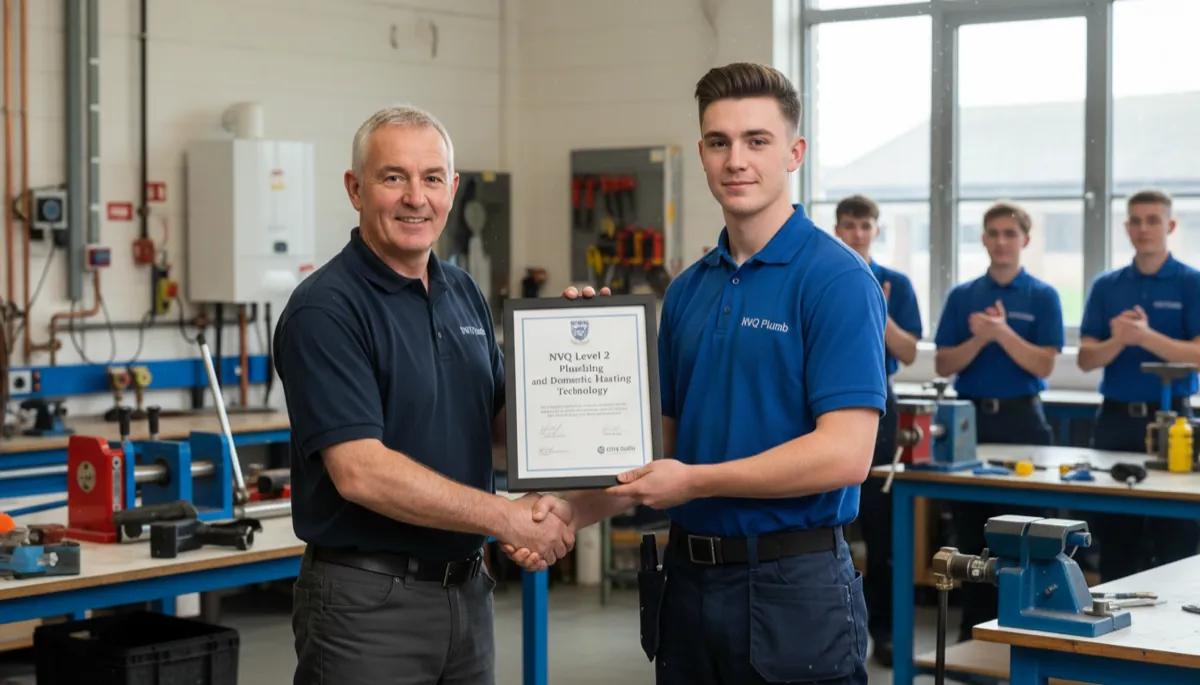
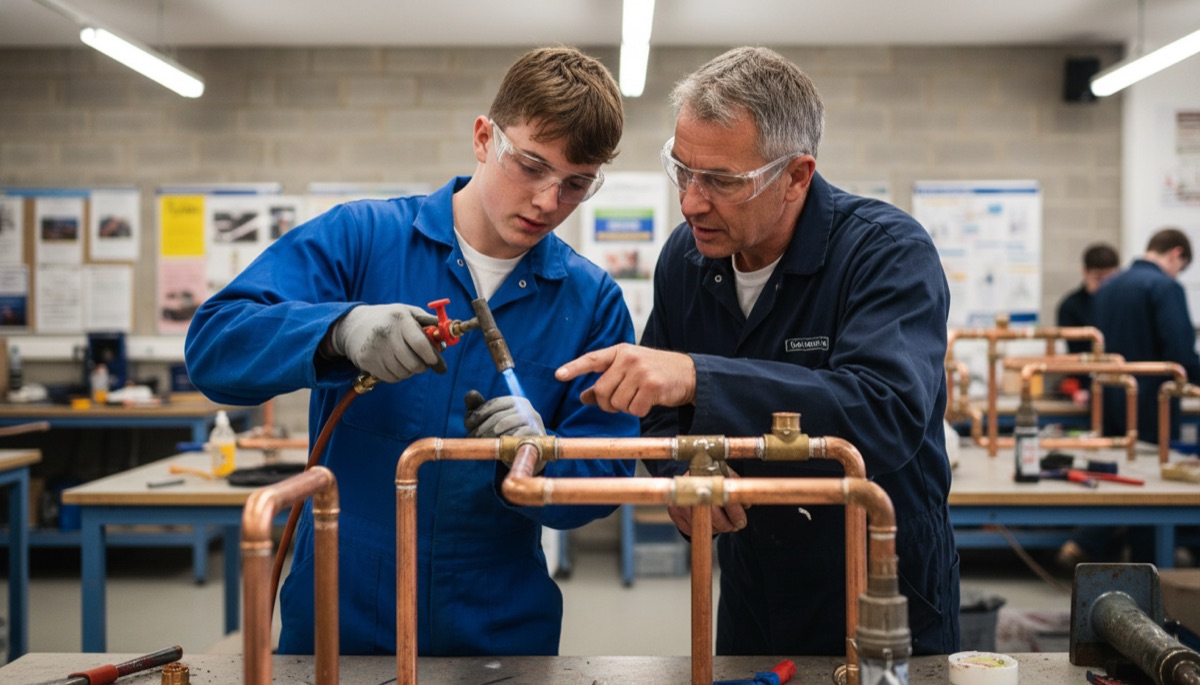
Becoming a plumber in the UK takes between one and four years depending on which route you take. The two main paths are an apprenticeship (which pays you while you learn) and a college-based programme (which you typically fund yourself). Either route leads to an NVQ Level 2 or Level 3 in Plumbing and Domestic Heating — the industry standard qualifications that let you work unsupervised and eventually run your own business.
This guide walks through each route, what it costs, what you’ll earn, and whether it’s realistic to retrain later in life.
Key Takeaways
- There are three realistic routes: apprenticeship, college/full-time study, or fast-track short courses (the last is not a standalone qualification)
- An NVQ Level 2 lets you work as a qualified plumber; NVQ Level 3 is what you need to run your own business and take on complex jobs
- [Gas Safe registration](/blog/gas-safe-registration-explained/) is separate — you’ll need ACS gas qualifications before you can legally touch gas appliances
- Training costs range from £3,000 to £12,000+ depending on the route and provider
- Qualified self-employed plumbers in the UK earn between £35,000 and £55,000 per year, with London rates pushing higher
- There’s no upper age limit — plenty of people retrain as plumbers in their 30s, 40s, and beyond
The Three Routes Into Plumbing
| Route | Duration | Cost | Pays While Training? | Outcome |
|---|---|---|---|---|
| Apprenticeship | 3–4 years | Mostly government-funded | Yes (apprentice wage) | NVQ Level 2 + 3 |
| College full-time | 1–2 years | £3,000–£6,000 | No | NVQ Level 2 (or Level 3) |
| Fast-track courses | 8–16 weeks | £2,000–£12,000+ | No | City & Guilds diploma only |
Apprenticeship Route
An apprenticeship is the most structured path — and the only one where someone pays you to learn. You work alongside a qualified plumber or plumbing company, attend college one or two days a week, and come out with an NVQ Level 2 and Level 3.
Most plumbing apprenticeships last three to four years. The government funds the training costs through the apprenticeship levy, so employers aren’t out of pocket for your education — which makes it easier to find placements.
The minimum apprenticeship wage in 2026 is £7.55 per hour for apprentices under 19 or in their first year. Most employers pay more, particularly once you’re in your second or third year and are a productive part of the team.
To find a plumbing apprenticeship:
- Search
find-apprenticeship.service.gov.uk— this is the official government portal - Contact plumbing firms directly — many small plumbing businesses aren’t listed on the portal but do take apprentices
- Ask your local college if they have employer partnerships
The main qualification bodies are City & Guilds and EAL (Excellence, Achievement & Learning). Both offer recognised Level 2 and Level 3 Diplomas in Plumbing and Domestic Heating Technology.
College or Full-Time Study
If you can’t find an apprenticeship placement, you can study plumbing at college on a full-time basis. This typically takes one to two years for Level 2 and another year for Level 3 if you choose to progress.
You’ll study the same technical content as an apprentice — pipework, drainage, hot and cold water systems, heating systems — but you won’t have on-site experience built in. Most employers expect college-trained plumbers to do some additional work experience before they’ll hire them unsupervised.
Fees vary by college. The government’s 16–19 Education and Training budget covers costs for students under 19. Adults pay more — typically £3,000–£6,000 per year for a full-time plumbing programme.
Fast-Track Courses
Short courses from providers like SkillsTG and Logic4Training compress core plumbing skills into 8–16 weeks. The City & Guilds Level 2 Diploma in Plumbing Studies is the most common output, and costs typically run between £2,000 and £12,000 depending on the provider and depth of course.
Be clear on what a fast-track course does and doesn’t give you. The Level 2 Diploma is a legitimate qualification — but it’s not the same as the NVQ Level 2 that comes from a full apprenticeship or two-year college programme. Most employers and commercial clients expect an NVQ, not just a short-course diploma.
Fast-track courses are best used as a complement to the NVQ route, not a replacement. They’re also useful for career changers who want to assess whether they’ll enjoy the trade before committing to a multi-year programme.
What Qualifications Do You Actually Need?
| Qualification | What It Covers | When You Need It |
|---|---|---|
| NVQ Level 2 in Plumbing & Domestic Heating | Core plumbing skills — pipes, hot/cold water, sanitation | To work as a qualified plumber |
| NVQ Level 3 in Plumbing & Domestic Heating | Advanced systems, heating, managing work | To run your own business or supervise others |
| CSCS Card | Site safety competency | Required for any commercial construction site |
| ACS Gas Qualifications (CCN1, CENWAT etc.) | Gas appliance installation and servicing | To work on gas appliances legally |
| Gas Safe Registration | Legal registration for gas work | Mandatory before doing any gas work — fines and criminal charges apply if you skip this |
| WRAS Certificate | Water supply regulations | For work involving mains water connections |
On Gas Safe Registration
Gas work sits in a completely different regulatory category from general plumbing. The Gas Safe Register is the UK’s official list of businesses and engineers who are legally allowed to work on gas appliances. Unregistered gas work is a criminal offence under the Gas Safety (Installation and Use) Regulations 1998.
To get on the Gas Safe Register, you need to pass ACS (Accredited Certification Scheme) assessments. The core unit is CCN1 (core domestic gas safety). From there, you add appliance-specific units — for example, CENWAT covers central heating and hot water, HTR1 covers gas space heaters, CKR1 covers gas cookers.
ACS assessments are carried out at approved centres. Expect to pay £300–£500 per unit at assessment centres, with preparation courses costing extra. Most plumbers seeking Gas Safe registration complete the core CCN1 unit plus two or three appliance units.
What Does Plumber Training Cost?
| Route | Typical Cost |
|---|---|
| Apprenticeship | Government-funded (you earn wages throughout) |
| College (under 19) | Free or heavily subsidised |
| College (adult, full-time) | £3,000–£6,000 per year |
| Fast-track Level 2 course | £2,000–£12,000 |
| ACS gas qualifications (per unit) | £300–£500 per assessment unit |
| Gas Safe Registration (annual) | £50–£120 per year (registration fee) |
| CSCS Card | £36 (test fee) + £47.50 (card) |
According to the UK government’s Skills for Growth scheme, adults in England may be eligible for a Skills Bootcamp or Advanced Learner Loan to offset college costs. Check gov.uk/further-education-skills for current funding options.
What Do Plumbers Earn?
According to the Office for National Statistics (ONS) 2024 Annual Survey of Hours and Earnings, the median annual salary for plumbers and heating engineers in the UK is around £34,000–£38,000 for employed workers. Self-employed plumbers typically earn more, because they keep the margin between their charge-out rate and their costs.
Self-employed plumber earnings depend heavily on how many hours you work and what you charge. According to Checkatrade’s 2025 pricing data, the UK average hourly rate for a plumber is around £50/hour. At 40 billable hours per week (which accounts for travel, admin, and unbillable time), that’s roughly £100,000 in turnover — but take off materials, insurance, van costs, tax, and National Insurance, and net earnings for a busy sole trader typically fall between £40,000 and £60,000 per year.
London rates push higher. Plumbers in the capital regularly charge £70–£90/hour.
Can You Retrain as a Plumber at 30, 40 or Beyond?
There’s no upper age limit for training as a plumber. The National Careers Service confirms this — and in practice, plenty of people make the switch in their 30s and 40s. Plumbing values practical ability and reliability over youth.
A few things to consider if you’re retraining later:
- Apprenticeships are available to adults — there’s no age cap on apprenticeships in England, Scotland, or Wales. Employers may have preferences, but the route is open.
- Your existing skills transfer — builders, electricians, and DIY-experienced people often find they pick up the practical side faster. Problem-solving, client communication, and time management are already there.
- Fast-track is realistic — a shorter college route or fast-track course works well for career changers who can’t afford three years of apprentice wages. You’ll need more on-the-job experience afterward, but it’s a faster route to employment.
- Financing is available — Advanced Learner Loans for over-19s cover Level 3 qualifications at college. Repayment is income-contingent, similar to student loans.
Frequently Asked Questions
How long does it take to become a plumber in the UK? It typically takes 3–4 years via an apprenticeship, or 1–2 years via a college-based programme. Fast-track courses are available in 8–16 weeks, but they give you a diploma rather than a full NVQ — you’ll still need practical experience before most employers will hire you independently.
Can I become a plumber at 40? Yes. There’s no age limit. Many people retrain in their 30s and 40s — adult apprenticeships are available, and fast-track courses suit career changers who want a quicker route. Older trainees often progress faster in the commercial and business skills side of running a plumbing firm.
Is it hard to train as a plumber? The practical skills take time to develop — soldering copper, working with plastic push-fit systems, understanding drainage falls and pressure testing all need practice. The theoretical side covers water regulations, building regulations, and system design. It’s not unusually hard, but it does require consistent hands-on practice rather than book learning alone.
Can you become a plumber in 5 days? No. Short-course providers sometimes advertise intensive programmes, but no 5-day course will qualify you to work as a plumber. You can learn specific skills — like fitting a bathroom suite — but without an NVQ and appropriate experience, you won’t be hireable as a qualified plumber.
Do you need GCSE qualifications to become a plumber? For an apprenticeship, most employers and colleges ask for GCSEs in maths and English at grade 4 (C) or above, or equivalent Level 1 qualifications. For adult entry via college, requirements vary — some providers accept relevant work experience instead.
What Comes After Qualifying?
Most newly qualified plumbers start as employees to build site experience. After two to four years of employed work, many go self-employed — and that’s where earnings jump.
Running your own plumbing business means sorting your own public liability insurance, registering with Gas Safe (if you do gas work), getting a CSCS card for commercial sites, and managing your own bookings and invoicing. It’s a bigger commitment, but the income is proportionally higher.
A professional website is one of the first things that separates busy self-employed plumbers from those who rely on word of mouth alone. At Digital Tradies, we build websites for plumbers from £49/month — no upfront cost, live in 3 days. Get started.
Internal links: Plumber hourly rate UK | SEO for plumbers | Do plumbers need a website? | Plumber web design