UK electrician certification can feel like alphabet soup — NVQ, C&G, ECS, AM2, 2391, Part P, NICEIC. Each one means something different, and knowing which ones you need (and in what order) saves you money and time. This guide cuts through the confusion.
Whether you’re training, recently qualified, or running your own electrical business, here’s exactly which certifications matter and what they do.
Key Takeaways
- The NVQ Level 3 in Electrical Installation is the core trade qualification — you need this to apply for an ECS Gold Card
- The ECS Gold Card is the industry-standard card proving you’re a qualified electrician — most main contractors and housing developers require it on site
- The 18th Edition (BS 7671) is a mandatory update for any practising electrician — it’s not a career qualification but a requirement to keep your ECS card and join any approved contractor scheme
- To carry out domestic electrical work legally without notifying Building Control on every job, you must join a Competent Person Scheme such as NICEIC or NAPIT
- The 2391-52 (Inspection and Testing) is not required to qualify, but it’s essential if you want to carry out EICRs, which are a major source of ongoing work — landlords in England must have one every 5 years
The UK Electrician Certification Pathway at a Glance
| Stage | Certification | What It Proves | Typical Cost |
|---|---|---|---|
| Training | City & Guilds 2365 Level 2 | Core electrical knowledge | £2,000–£4,000 |
| Training | City & Guilds 2365 Level 3 | Advanced electrical work | £2,000–£4,000 |
| Practical assessment | NVQ Level 3 in Electrical Installation | Workplace competence | £500–£1,500 |
| Final assessment | AM2 | Independently assessed practical ability | £350–£500 |
| Industry card | ECS Gold Card | Recognised proof of qualification | £30/year |
| Regulations update | 18th Edition (BS 7671) | Current wiring regs knowledge | £400–£600 |
| Self-certification | NICEIC / NAPIT membership | Legal right to self-certify work | £300–£600/year |
| Inspection work | City & Guilds 2391-52 | Competency to inspect and test | £600–£1,200 |
City & Guilds 2365: The Training Qualification
City & Guilds is the dominant awarding body for electrical training in the UK, with over 1 million certifications issued annually according to City & Guilds’ published data.
The 2365 Diploma runs at two levels:
Level 2 covers the fundamentals: wiring theory, circuit types, safe isolation, and basic installation. This is the entry point for anyone new to the trade.
Level 3 covers more complex work: three-phase systems, earthing arrangements, inspection and testing basics, and commercial installations. You need Level 3 before you can sit the AM2.
Full-time, the two levels take about 18 months combined. Part-time (which most adult learners choose) typically takes two to three years. Some colleges offer intensive accelerated routes, but these tend to cover the theory rather than build the practical hours you’ll need for your NVQ.
NVQ Level 3: The Workplace Competence Qualification
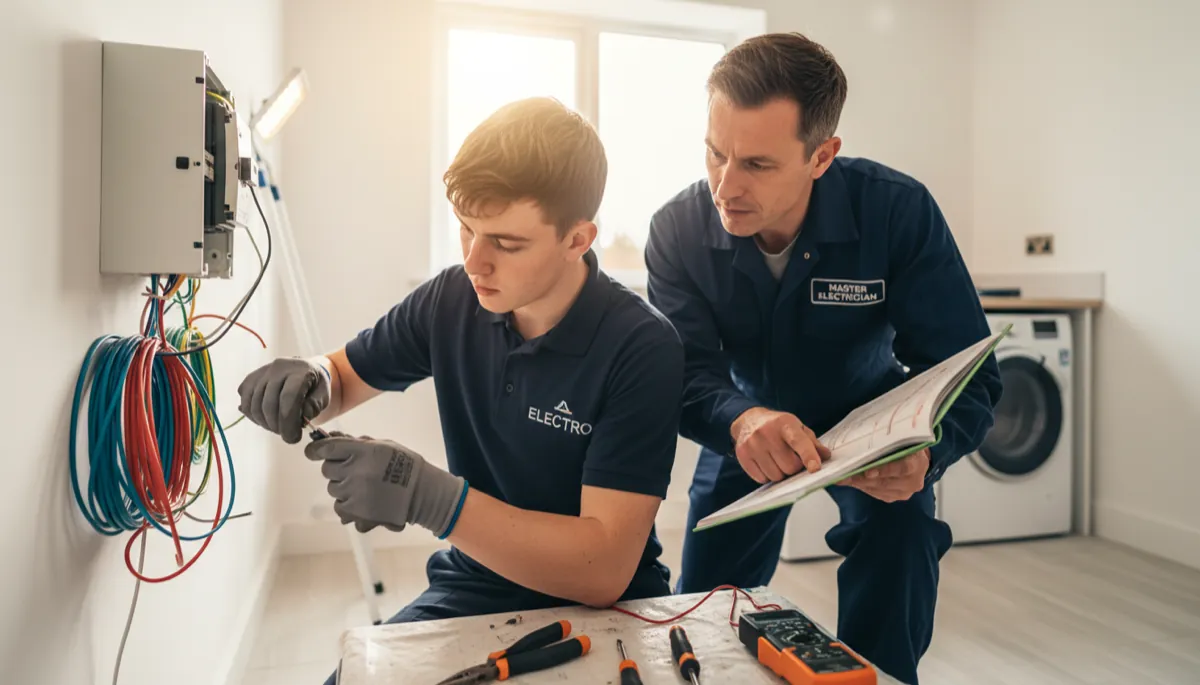
The NVQ (National Vocational Qualification) Level 3 in Electrical Installation is assessed in the workplace, not in a classroom. An assessor observes you carrying out real jobs and signs off your competence over time.
You can’t sit the AM2 — and therefore can’t get an ECS Gold Card — without completing your NVQ Level 3. It’s the practical counterpart to the City & Guilds theory qualifications.
The NVQ is what apprentices work toward during their apprenticeship. If you’re taking the adult learner route, you’ll need to arrange your own workplace assessments alongside your college training.
The AM2 Assessment
AM2 stands for Achievement Measurement 2. It’s an independently invigilated practical test run by the JIB (Joint Industry Board) and SET (Summit Skills Enrolment and Training).
The assessment lasts about eight hours across two days. You’re given a set of tasks to complete in a mock installation scenario: containment, wiring, testing, and fault diagnosis. Assessors mark you against set criteria — they don’t tell you what to do, and there’s no instructor present.
Passing the AM2 is the final step to becoming a qualified electrician. Without it, you can’t apply for your ECS Gold Card.
Resit costs: If you don’t pass first time, a resit costs around £250. The AM2 has a meaningful fail rate, so preparation matters — most training providers offer AM2 prep days specifically for this reason.
ECS Gold Card
The ECS (Electrotechnical Certification Scheme) Gold Card is the recognised proof that you’re a qualified electrician in the UK. Most large construction sites, main contractors, and housing developers won’t let you work on site without one.
To get an ECS Gold Card you need:
- NVQ Level 3 in Electrical Installation (or equivalent)
- AM2 pass
- 18th Edition (BS 7671) certification
- A valid CSCS Health and Safety test pass
The Gold Card costs £30 per year to renew and is valid for five years. After five years, you apply for a renewal. JIB administers the scheme — you apply online via the ECS website.
If you’re still training, you can hold an ECS Apprentice card (blue) and then a Trainee Electrician card (red) as interim cards while you complete your qualifications.
18th Edition Wiring Regulations (BS 7671)
The 18th Edition is the current version of the IET Wiring Regulations (BS 7671 2018 + Amendment 2). Every practising electrician in the UK must hold a current 18th Edition certificate — it’s not a career qualification but a knowledge update you need to keep your ECS card and join any approved contractor scheme.
The previous 17th Edition became obsolete in 2019. The 18th Edition introduced changes to surge protection devices, Arc Fault Detection Devices (AFDDs), and EV charging requirements, among others.
The course typically runs over two days at a training centre, followed by a City & Guilds exam. Cost is usually £400–£600. Training providers include City & Guilds approved centres, ECA Training, and NICEIC Approval Services.
You don’t need the 18th Edition to start training, but you need it before you can work commercially.
City & Guilds 2391-52: Inspection and Testing
The 2391-52 (Inspection and Testing) qualification covers the theory and practice of inspecting existing electrical installations and producing Electrical Installation Condition Reports (EICRs).
It’s not required to become a qualified electrician, but it opens up a significant income stream. Under the Electrical Safety Standards in the Private Rented Sector (England) Regulations 2020, landlords in England are legally required to have an EICR carried out every 5 years. Scotland and Wales have similar requirements. There are approximately 2.7 million private landlords in England alone, according to the Ministry of Housing, Communities and Local Government.
Without the 2391, you can’t sign off an EICR. You can assist with one under supervision, but you can’t issue the report. Most electricians running their own business find this qualification pays for itself quickly.
The course typically takes three to five days, with a combined theory and practical assessment. Cost ranges from £600 to £1,200 depending on the training centre.
Part P and Competent Person Schemes
Part P of the Building Regulations covers electrical work in dwellings (houses and flats). Under Part P, domestic electrical work must either:
- Be notified to local authority Building Control, which can add £200–£300 per job in fees and delays, or
- Be carried out by someone registered with a Competent Person Scheme (CPS), who self-certifies the work.
Joining a CPS is how most self-employed electricians operate legally without notifying Building Control on every domestic job.
The main Competent Person Schemes for electricians in England and Wales are:
| Scheme | Annual Fee (approx.) | Notes |
|---|---|---|
| NICEIC Domestic Installer | £300–£450 | Most widely recognised |
| NAPIT | £300–£450 | Popular with smaller contractors |
| ELECSA | £300–£400 | Part of the NICEIC Group |
| Stroma Certification | £250–£400 | Growing scheme |
In Scotland, the equivalent approved contractor scheme is operated by SELECT (the electrical trade association for Scotland). Commercial work has different notification requirements — for most commercial jobs, you don’t need a Competent Person Scheme, but your work must still comply with BS 7671.
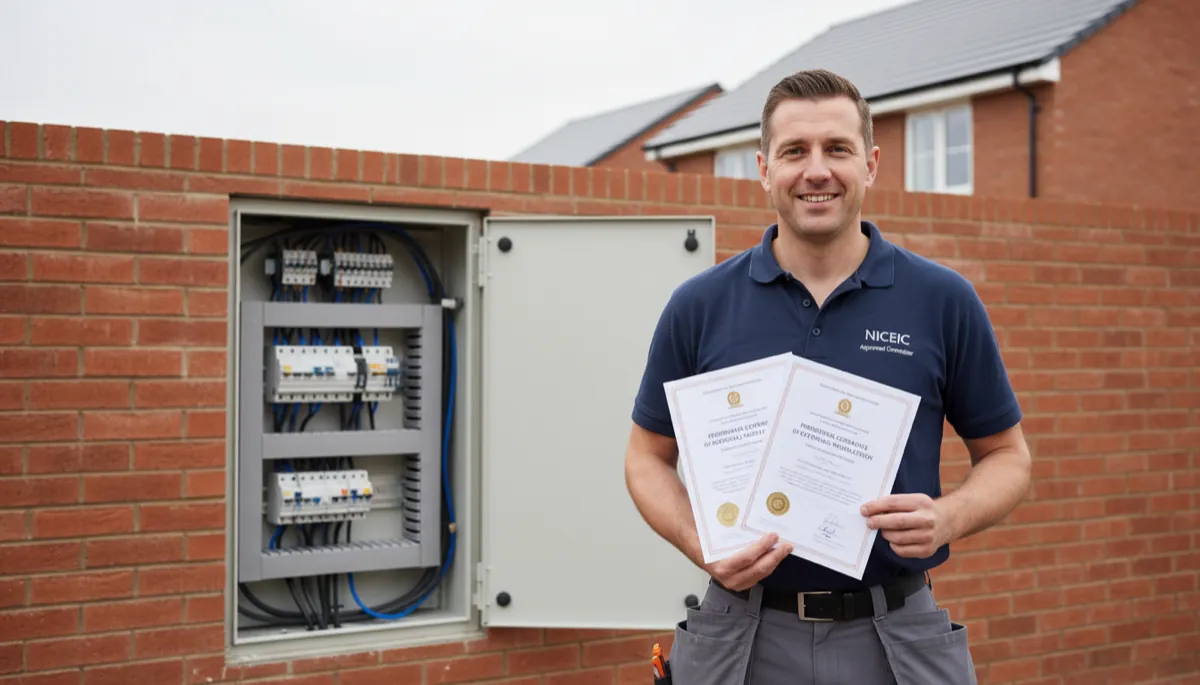
NICEIC registers over 26,000 approved electrical contractors across the UK, according to NICEIC’s published membership data. Both NICEIC and NAPIT require you to hold a current 18th Edition and NVQ Level 3 (or equivalent), and both carry out annual assessment visits to check your work quality.
Membership fees vary based on whether you’re a domestic installer, an approved contractor, or a full approved scheme member. The assessment visit is included in most scheme fees.
Do You Need All of These?
Depends on what you want to do.
To work for someone else on a construction site: ECS Gold Card + 18th Edition is the minimum. Your employer will likely also want you to have the 2391 if inspection work is on the cards.
To be self-employed doing domestic work: NVQ Level 3 + AM2 + 18th Edition + NICEIC or NAPIT membership + ECS Gold Card. This is the standard package for a self-employed electrician.
To inspect and certify installations: Add the 2391-52. Without it, you can do the work but you can’t sign off the EICR.
For commercial work: The requirements are less prescriptive on the certification side, but your work must still comply with BS 7671 and you’ll need an ECS Gold Card for most sites.
Frequently Asked Questions
How do I become a certified electrician in the UK? The standard route is: City & Guilds 2365 Level 2 and 3 → NVQ Level 3 → AM2 assessment → ECS Gold Card application. You also need the 18th Edition wiring regulations certificate. Total time is typically 3–4 years via apprenticeship or 2–3 years via the adult learner route.
Do you need the 2391 for an ECS Gold Card? No. The 2391 is not required for the ECS Gold Card. You need it separately if you want to carry out and sign off EICRs (Electrical Installation Condition Reports). Many electricians add it once they’re qualified and working.
How much does it cost to become a qualified electrician in the UK? The full adult learner route typically costs between £5,000 and £12,000 in training fees, depending on the provider and whether you study full-time or part-time. This covers City & Guilds 2365 Level 2 and 3, NVQ assessment, AM2, and 18th Edition. Via apprenticeship, most costs are funded by the employer and government.
What is Part P and does every electrician need to register? Part P is the part of Building Regulations that covers domestic electrical work. You don’t have to register with a Competent Person Scheme — you can notify Building Control directly on each job instead — but most self-employed domestic electricians join NICEIC or NAPIT because it’s cheaper and faster than per-job notifications.
Is NICEIC registration mandatory? No, NICEIC registration is not mandatory under UK law. But without it (or another Competent Person Scheme), you must notify Building Control for each domestic job. Many clients and letting agents also specifically ask whether you’re NICEIC or NAPIT registered, so it’s effectively essential for most domestic electricians running their own business.
Building Your Electrical Business After Qualification
Once you’re qualified and registered, the next priority is making sure people can find you. Around 88% of people search online before booking a tradesperson, according to Google’s Local Consumer Insights data. A professional website showing your NICEIC or NAPIT badge, your service area, and your contact details makes a significant difference to how many jobs land with you versus a competitor.
For more on how electricians present their credentials online, see our guides to web design for electricians and public liability insurance for electricians.
Digital Tradies builds websites specifically for electricians: NICEIC badge placement, tap-to-call on mobile, service area pages, and local SEO foundations. It costs from £49/month with no upfront fee and goes live within 3 days. If you’re newly qualified or setting up on your own, it’s worth getting started before you need the work rather than after.