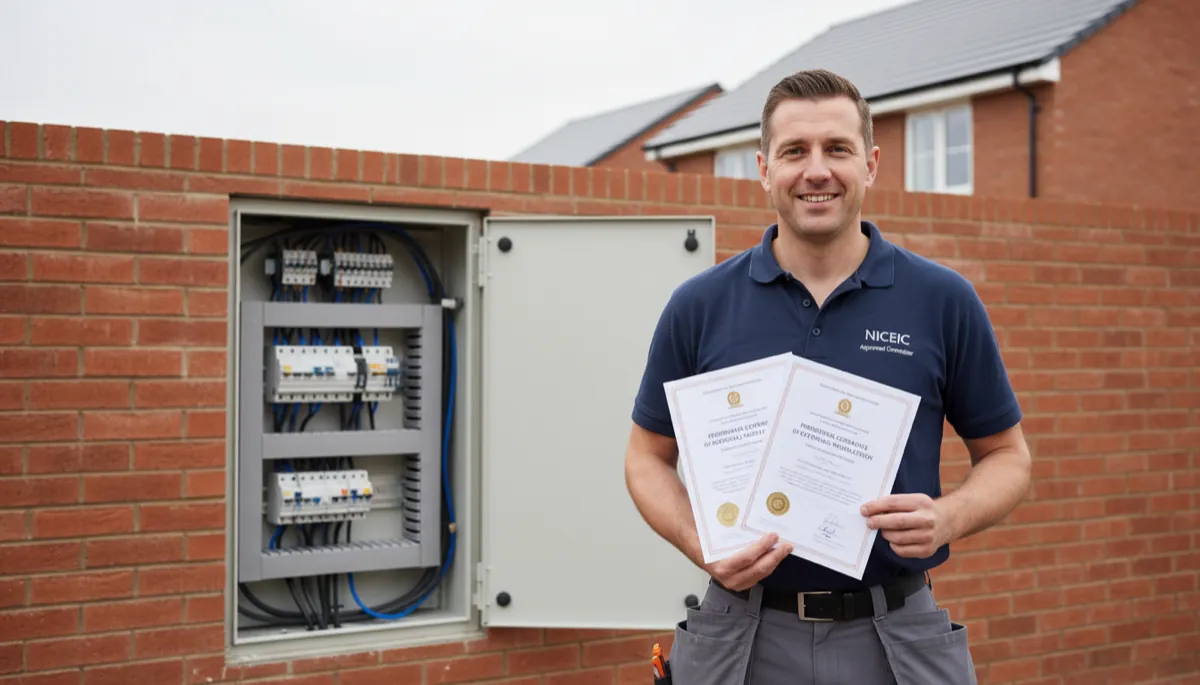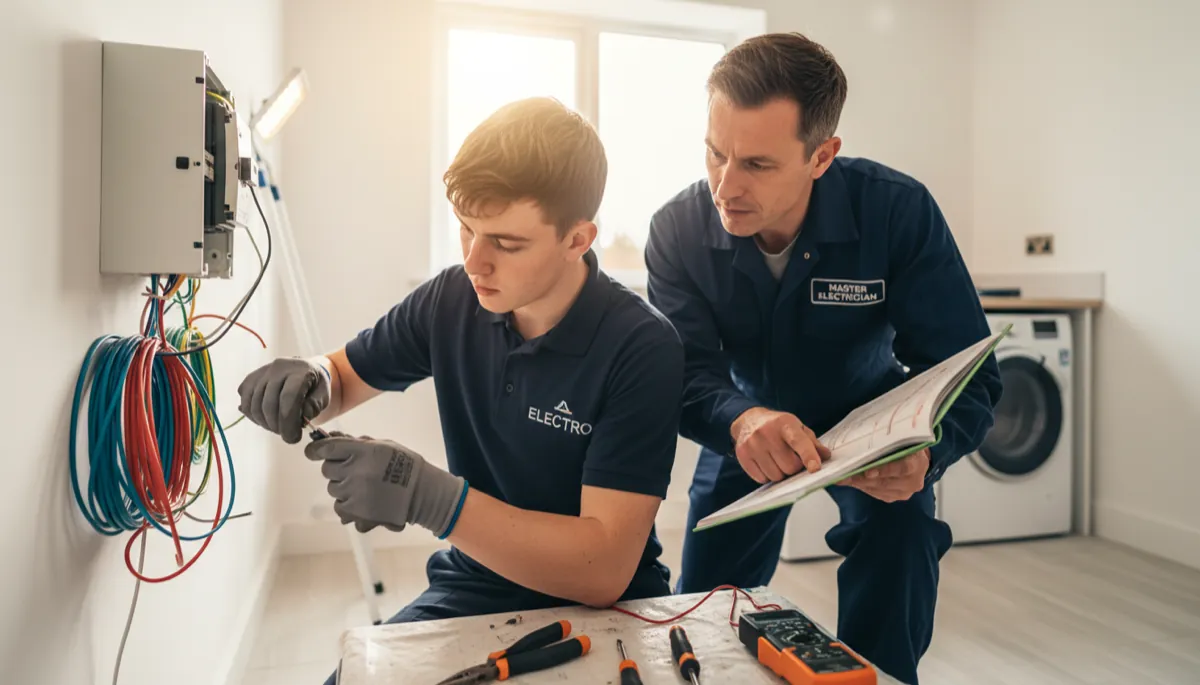
An electrician apprenticeship in the UK typically lasts four years. You work for an electrical contractor five days a week, attend college one or two days a week, and get paid throughout. At the end, you hold a Level 3 qualification and can apply for your ECS Gold Card — the card that lets you work unsupervised on UK construction sites.
This guide is for people who’ve decided the apprenticeship route is right for them and want to know exactly what it involves, what it pays, and how to get one.
Key Takeaways
- Duration: 42 to 54 months (the apprenticeship standard is Level 3, equivalent to A-level)
- Pay: starts around £7.55–£9/hour in year one; rises to £15–£18/hour by year four at most firms
- College: one to two days per week — typically at a Further Education college near your employer
- End Point Assessment: the AM2 practical test is your final hurdle — you sit it once your training provider and employer sign you off as ready
- Age: there’s no upper age limit — thousands of people start electrical apprenticeships in their 20s, 30s, and beyond
What the Apprenticeship Standard Covers
The apprenticeship you’ll work toward is the Installation and Maintenance Electrician Level 3 Apprenticeship Standard — the one managed by the Institute for Apprenticeships and Technical Education and funded through the government’s apprenticeship levy system.
Over four years, you’ll typically work toward:
| Stage | Qualification | When |
|---|---|---|
| Years 1–2 | City & Guilds 2365 Level 2 Diploma in Electrical Installations | First two years |
| Years 3–4 | City & Guilds 2365 Level 3 Diploma in Electrical Installations | Final two years |
| Throughout | NVQ Level 3 in Electrical Installation (on-site evidence portfolio) | Ongoing |
| End | AM2 practical assessment (End Point Assessment) | Final year |
The government funds up to £23,000 per apprentice through the Education and Skills Funding Agency (ESFA), according to the Find Apprenticeship Training service on GOV.UK. Your employer covers the rest — or, if they’re in the apprenticeship levy system, it comes from that.
What the Day-to-Day Looks Like
Most weeks follow a straightforward pattern: four days on-site with your employer, one day at college.
On-site work varies depending on what your employer does. You might work on domestic rewires in week one, commercial fit-outs in week two, and industrial maintenance work later in the year. That variety is deliberate — the NVQ requires evidence across different types of installation.
College days cover the theory side: electrical science, wiring regulations, circuit design, health and safety, and inspection and testing. Your college will be registered with City & Guilds or a similar awarding body.
In terms of the split, you’re required to spend a minimum of 20% of your working hours on off-the-job training — which is where the college component comes in. According to the Education and Skills Funding Agency, this 20% is a non-negotiable part of every apprenticeship standard.
Electrician Apprentice Pay by Year
Pay is one of the first things people ask about — and the answer is better than many expect.
The minimum apprentice rate for 2025/26 (as of April 2025) is £7.55/hour, set by the government. But most electrical contractors pay above this, especially after the first year.
Many firms follow the Joint Industry Board (JIB) recommended rates for apprentices, which are calculated as a percentage of the adult electrician rate:
| Year | JIB Recommended Rate | Approximate Weekly Pay (40hrs) |
|---|---|---|
| Year 1 | ~40% of adult rate | £320–£380/week |
| Year 2 | ~55% of adult rate | £430–£520/week |
| Year 3 | ~70% of adult rate | £540–£640/week |
| Year 4 | ~90% of adult rate | £680–£780/week |
Note: actual pay varies by employer and region. London-based firms typically pay more. The JIB rates are recommendations — some contractors pay above them, some stick to the minimum. Always check what a firm offers before accepting.
By year four, you’re earning close to the adult rate — which gives you a solid platform to either keep working for your employer or go self-employed.
How to Find an Electrician Apprenticeship
The three most reliable routes:
1. GOV.UK Apprenticeship Portal The official Find an Apprenticeship service (apprenticeships.gov.uk) lists live vacancies from registered employers across England. You can filter by location and sector. This is the most complete public source and is updated regularly.
2. Direct approach to electrical contractors Many firms take on apprentices without ever posting a vacancy online. Dropping a CV into local electrical contractors — or calling ahead to ask whether they take apprentices — can open doors that aren’t visible on job boards. The Electrical Contractors’ Association (ECA) and NICEIC both maintain directories of registered electrical firms.
3. Training provider referrals Some FE colleges have relationships with local electrical firms and can make introductions. If you’ve already enrolled on a pre-apprenticeship electrical course, your college may help place you with an employer.
What Employers Look For
For most apprenticeship roles, you’ll need:
- 5 GCSEs at grade 4 (C) or above, including Maths and English — Science is useful but not always essential
- Practical aptitude — some employers run short assessments to check your comfort with tools and problem-solving
- Right to work in the UK
What actually sets applicants apart is attitude. Electrical contractors report that the two things they care most about are reliability and a willingness to learn. You don’t need to know how to wire a circuit on day one — that’s what the training is for.
When writing your application or covering letter:
- Be specific about why you want to work in the trade (not just “I like working with my hands”)
- Mention any relevant work experience — even a weekend helping a local tradesman counts
- Keep it short and direct — one page is enough
The End Point Assessment (AM2)
The AM2 is the practical test you sit near the end of your apprenticeship. It’s run independently — not by your college or employer — and tests whether you can actually do the job to industry standard.
The assessment covers:
| Component | What It Tests |
|---|---|
| Installation exercise | Practical installation to a given specification |
| Inspection and testing | Diagnosing faults, testing circuits, completing documentation |
| Fault diagnosis | Identifying and rectifying pre-set faults |
| Health and safety | Safe working throughout |
You sit the AM2 once your training provider and employer agree you’re ready. Most apprentices sit it in their fourth year. You can resit if you don’t pass first time, though it’s worth going in well-prepared — the pass rate for fully prepared candidates is high.
Frequently Asked Questions
How long does an electrician apprenticeship take in the UK? Most electrician apprenticeships take four years — specifically 42 to 54 months under the Level 3 Installation and Maintenance Electrician standard. The timeline depends on your progress and employer. Some apprentices who’ve done pre-apprenticeship qualifications may complete in the lower end of that range.
Is 25 too old for an electrician apprenticeship? No. There’s no upper age limit for apprenticeships in the UK — apprentices can be any age over 16. Many people start electrical apprenticeships in their late 20s or 30s as a career change. The pay scales apply the same way regardless of your age.
Is there a shortage of electricians in the UK? Yes. The Electrical Contractors’ Association (ECA) has reported sustained skills shortages in the sector, driven partly by an ageing workforce and the growing demand for EV charging installation and solar panel work. That means qualified electricians coming out of apprenticeships are entering a market where skilled labour is in demand.
What’s the quickest way to become a qualified electrician? The fastest realistic route for most people is the adult learner path — attending college full-time, completing theory in 18 months, then doing your NVQ on-site. But this route costs £5,000–£12,000 in course fees. The apprenticeship route takes longer (four years) but you’re paid throughout and the qualifications are fully funded. For most school leavers, the apprenticeship is the better option financially.
What Happens After You Qualify
Once you’ve passed the AM2 and completed the NVQ, you can apply for the ECS Gold Card — the industry standard card that proves you’re a qualified, competent electrician.
From there, most newly qualified electricians either:
- Stay employed with their apprenticeship employer (or move to a firm paying adult rates)
- Go self-employed and start taking on domestic work directly
If you go self-employed, you’ll need to join a Competent Person Scheme — either NICEIC or NAPIT — to self-certify Part P work (domestic electrical installations). Membership costs roughly £300–£600/year but allows you to sign off your own jobs without calling in a building control inspector.
The demand for self-employed electricians across the UK is consistent. Whether you focus on domestic rewires, EV charger installations, or commercial maintenance, there’s enough work to build a sustainable business.
A professional website helps — customers searching for electricians in their area expect to find one online. If you’re thinking about going self-employed after your apprenticeship, setting up a website from the start is worth considering early. Digital Tradies builds websites for electricians from £49/month, no upfront cost, live in 3 days.
Internal Links
- Electrician qualifications UK
- How to become an electrician in the UK
- Electrician hourly rate UK 2026
- SEO for electricians