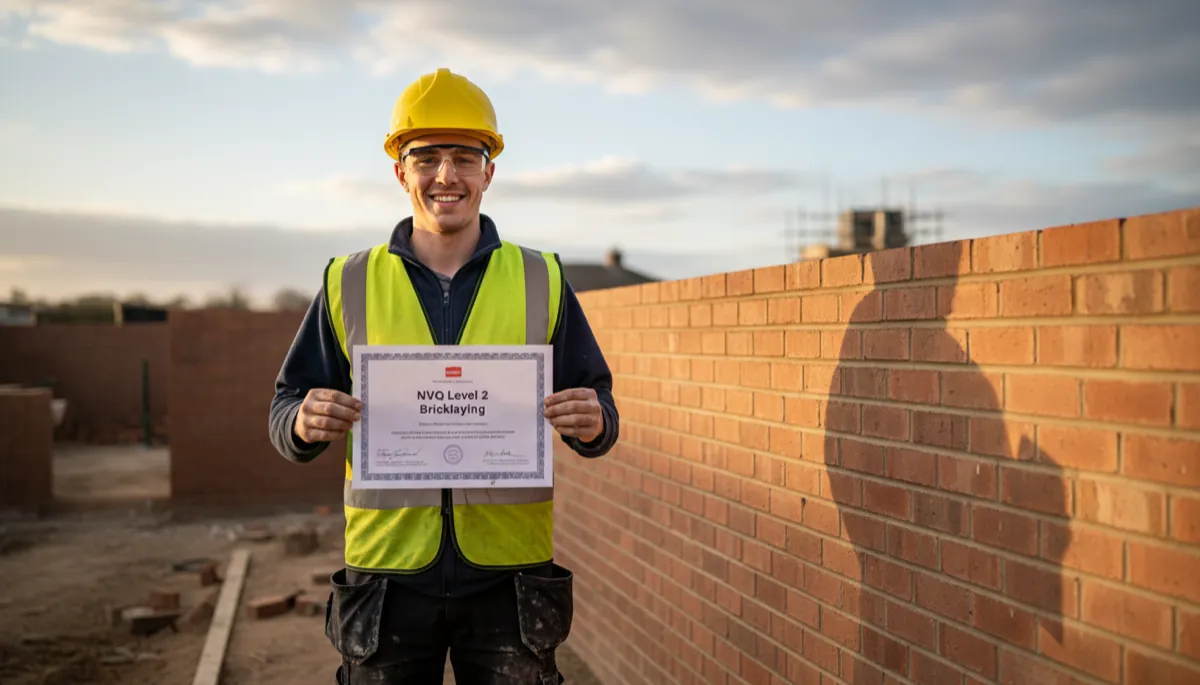
There’s no single licence you need to call yourself a builder in the UK. But that doesn’t mean qualifications don’t matter — most commercial sites won’t let you through the gate without a [CSCS card](/blog/cscs-card-explained/), clients increasingly ask for proof of training, and schemes like FMB membership require a minimum standard of competence.
This guide covers what qualifications actually count for builders in 2026, how to get them, and what they cost — whether you’re starting out or looking to formalise skills you already have.
Key Takeaways
- The CSCS card is the most important credential for site access — a Blue Skilled Worker card requires a relevant NVQ Level 2 or 3
- There’s no legal requirement for builders to hold formal qualifications, but most main contractors and commercial sites demand proof
- An NVQ Level 2 in Construction Operations is the standard entry-level qualification for general builders and labourers
- CITB (Construction Industry Training Board) funds and oversees training across most construction trades
- Routes vary: apprenticeship (school leavers), adult NVQ (existing workers), or CITB-funded short courses — all lead to the same card
- FMB membership requires documented competence, which usually means an NVQ or equivalent
Why Qualifications Matter for Builders
Building doesn’t work like gas engineering or electrical work, where you need a specific licence to operate legally. There’s no [Gas Safe Register](/blog/gas-safe-registration-explained/) equivalent for brickwork, plastering, or groundworks.
But qualifications still open and close doors in practice.
Site access: Most large commercial sites, housing developers, and main contractors require a valid CSCS card before you can set foot on site. A 2025 survey by the Construction Leadership Council found that over 90% of UK principal contractors require CSCS cards for site workers. Without one, you’re locked out of a significant share of available work.
Directory listings: Checkatrade and similar platforms ask for qualifications and insurance details as part of vetting. Holding an NVQ makes the verification process smoother.
FMB membership: The Federation of Master Builders (FMB) requires members to demonstrate trade competence. Most members hold relevant NVQs. FMB’s Approved members list is a common search tool for homeowners looking for vetted builders.
Insurance: Some liability insurers offer better rates to builders who hold formal qualifications, particularly for structural and groundworks contracts.
The CSCS Card: What Each Colour Means
The Construction Skills Certification Scheme (CSCS) runs the card scheme that most UK sites recognise. There are different cards for different levels of qualification.
| Card Colour | Who It’s For | Qualification Required |
|---|---|---|
| Red (Trainee) | Apprentices and those in training | Enrolled in a relevant qualification |
| Green (Labourer) | Site labourers and operatives | CSCS Health, Safety and Environment test + basic training |
| Blue (Skilled Worker) | Qualified tradespeople | NVQ Level 2 or 3 in a relevant trade |
| Gold (Supervisor/Advanced) | Experienced tradespeople or supervisors | NVQ Level 3 or 4, relevant supervisory qualification |
| Black (Manager) | Site managers and project managers | NVQ Level 6 or 7, management qualification |
| White (Professionally Qualified) | Surveyors, architects, engineers | Degree-level professional qualification |
For most self-employed builders doing domestic extensions, renovations, or groundworks, the Blue Skilled Worker card is the target. It requires completing an NVQ at Level 2 or 3 in a relevant construction trade.
The CSCS Health, Safety and Environment test is required for all card types. It costs £22.50, is sat at a Pearson Vue test centre, and must be passed before you can apply for any CSCS card. It covers construction-site hazards, working at height, electrical safety, manual handling, and similar topics. The test takes about 45 minutes.
NVQ Qualifications for Builders
NVQs (National Vocational Qualifications) are the workplace-based qualifications that lead to a CSCS card. Unlike classroom exams, they’re assessed on real jobs — an assessor visits your site and signs off your competence over time.
The relevant NVQs for builders depend on what type of work you do:
| Trade Area | NVQ | Level | Leads To |
|---|---|---|---|
| General building/groundworks | NVQ in Construction Operations | Level 2 | Blue CSCS card |
| Bricklaying | NVQ in Bricklaying | Level 2 | Blue CSCS card |
| Site management | NVQ in Construction Site Supervision | Level 3 | Gold CSCS card |
| Project management | NVQ in Construction Contracting Operations | Level 6 | Black CSCS card |
Who assesses you? Assessors are provided by training organisations like Able Skills, or through CITB-accredited training centres. Assessment visits happen on your actual job sites — you don’t need to go anywhere special.
How long does it take? A Level 2 NVQ typically takes 12 to 18 months for someone already working in the trade. It can be done alongside normal work, as it’s assessed on your actual jobs. An apprentice doing the same qualification alongside a college programme would take 2 to 3 years.
How much does it cost? Costs vary by provider, but an NVQ Level 2 for an existing worker typically runs £800 to £1,500 in training and assessment fees. For apprentices, costs are covered by employer levy contributions and government funding (95% government-funded for small employers).
Apprenticeship Route
An apprenticeship combines paid on-the-job training with part-time college study. It leads to the same NVQ outcome as the adult route, but is primarily designed for school leavers aged 16–24.
The Construction Multi-Skilled Operative Apprenticeship (Level 2) or the Bricklayer Apprenticeship (Level 2) are the most common entry points for general builders.
According to CITB’s published data, there were approximately 6,200 new construction apprenticeship starts in England in 2024/25 — down from a 2019 peak but recovering steadily post-pandemic.
Funding: Employers with a payroll over £3 million pay into the Apprenticeship Levy, which covers apprenticeship training costs. Smaller employers contribute 5% of training costs, with the government covering the remaining 95% under the co-investment model. Apprentices earn a wage throughout — minimum £7.55/hour in 2026, though most construction employers pay significantly more.
Duration: 2 to 3 years typically, depending on the specific standard and the apprentice’s progress.
CITB: The Industry Training Board for Construction
The Construction Industry Training Board (CITB) is the government-recognised employer-led body that funds construction training in the UK. If you work in construction, you’re probably already paying into CITB via the construction industry levy — and you can claim money back for approved training.
CITB levy: If your annual payroll exceeds £120,000 and your work qualifies as construction, you’ll pay into the CITB levy. The rate in 2026 is 0.35% for direct employees and 1.25% for labour-only subcontractors.
Grants: CITB pays grants back to levy-paying employers for approved training. For an NVQ Level 2 or 3 completed through a CITB-approved centre, the grant is currently £2,500 per apprentice for Level 2 completions.
Short courses: CITB also funds Health & Safety short courses (Working at Height, Confined Spaces, Manual Handling), first aid, and site supervisor training. Levy-paying employers can get these at reduced or zero cost through CITB Skills & Training Fund grants.
For small self-employed builders who don’t pay the levy, CITB’s Smart Fund offers grants for approved training regardless of levy status — worth checking if you’re planning to get your NVQ as a sole trader.
Other Routes to Certification
AQA and NOCN units: Some training providers offer individual unit-based certifications rather than full NVQs. These don’t lead directly to a CSCS Blue card but can form part of a wider portfolio of evidence.
Assessment of Prior Learning (APL): If you’ve been working in building for years without formal qualifications, an APL route allows an assessor to sign off your existing competence without starting a full NVQ from scratch. APL is faster — typically 6 to 12 months — and costs less than a full NVQ programme. Not all awarding bodies offer it; ask providers specifically.
FMB membership: Joining the Federation of Master Builders isn’t a qualification, but it signals competence and gives clients reassurance. The FMB vets members’ qualifications and insurance, and Approved members appear in the FMB’s public directory. Membership costs around £235 to £615 per year depending on your turnover.
Frequently Asked Questions
Do builders need a licence to work in the UK? No. Unlike gas engineers or electricians, there’s no legal licence required to work as a builder in the UK. However, most commercial sites and main contractors require a valid CSCS card, and domestic clients increasingly ask for proof of qualifications and insurance.
What CSCS card does a self-employed builder need? Most self-employed builders doing skilled trade work — bricklaying, groundworks, structural alterations — should aim for the Blue Skilled Worker card, which requires an NVQ Level 2 or 3 in a relevant trade plus the CSCS Health, Safety and Environment test (£22.50).
How much does an NVQ Level 2 cost for a working builder? Expect to pay between £800 and £1,500 for an NVQ Level 2 through a private training provider if you’re already working in the trade. CITB grants can offset costs for levy-paying employers. An Assessment of Prior Learning route is often cheaper if you have several years of documented experience.
Can I get a CSCS card without an NVQ? A Green Labourer card doesn’t require an NVQ — just the CSCS Health, Safety and Environment test and sometimes a Level 1 Health & Safety award. But a Green card limits the work you can be assigned on site. For skilled building work, you’ll need the Blue card, which requires an NVQ.
How long does it take to get qualified as a builder? A working builder getting an NVQ Level 2 through the workplace assessment route typically takes 12 to 18 months. An apprenticeship takes 2 to 3 years but is better supported financially. APL routes can be faster — sometimes 6 months — for experienced workers with documented evidence.
Building a Business That Reflects Your Skills
Getting qualified is one part of running a credible building business. The other is making sure potential clients can find you and see your work before they call.
Most homeowners search online before hiring a builder — and a professional website showing your qualifications, insurance, and past projects builds confidence before you’ve even spoken. Digital Tradies builds websites for UK builders from £49/month, with no upfront cost and sites going live within three days. If you’re investing in your qualifications, it’s worth making sure clients can see them.
Find out more at digitaltradies.com/get-started.
Related reading:
- Builder Day Rate UK 2026: How Much to Charge
- Builder Hourly Rate UK 2026
- Public Liability Insurance for Builders