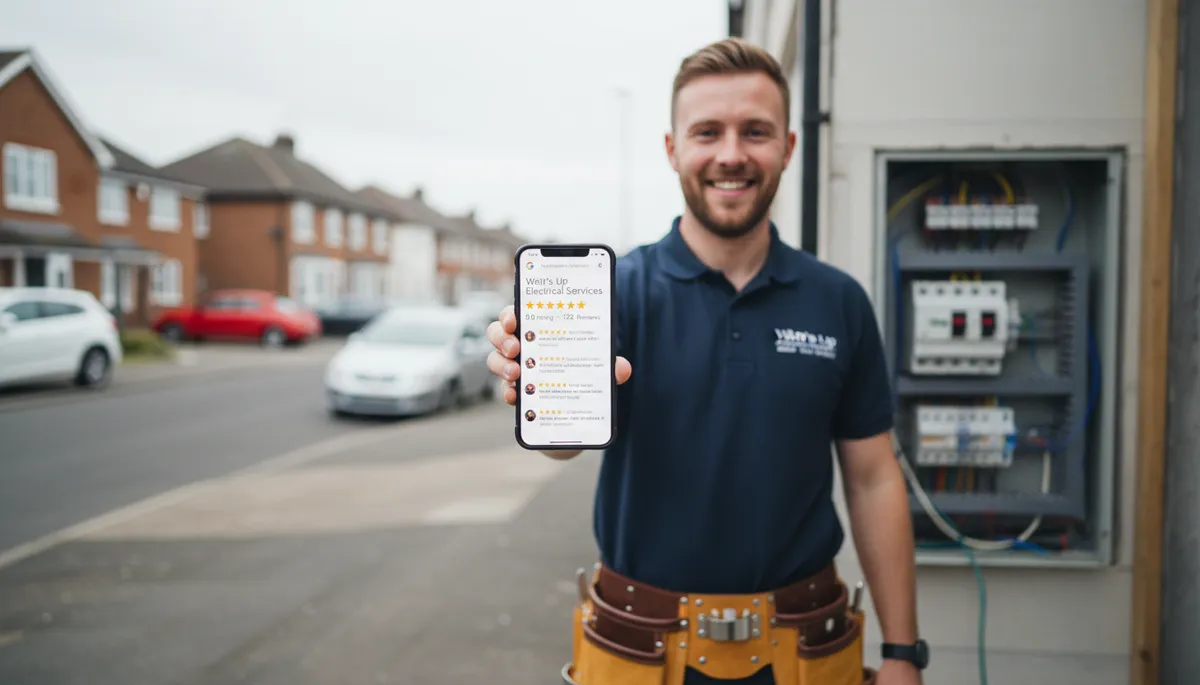
Electricians who rely on Checkatrade and word of mouth find those channels get unpredictable. A difficult review, a slow season, or a competitor who suddenly appears at the top of Google can cut enquiries fast. SEO gives you a lead source you own — one that keeps working whether you’re on the tools or not.
SEO for electricians means making your business appear in Google when people nearby search for electrical work. That covers everything from fuse board upgrades and full rewires to EICR inspections, EV charger installation, and emergency callouts. This guide focuses on what actually moves the needle for electricians specifically — not generic SEO advice that applies to any trade.
Key Takeaways
- Your Google Business Profile controls your map pack ranking — it’s free and the highest-impact place to start
- EICR searches from landlords are legally driven and repeat-buying: rank for them once and you’ll get regular scheduled work
- Your NICEIC or NAPIT registration is an active SEO signal — claim your member directory page and mention Part P on your website
- EV charger installation searches carry high job values — according to the Society of Motor Manufacturers and Traders (SMMT), over 381,000 pure electric cars were sold in the UK in 2024, with home charger demand growing in step — and this niche isn’t yet dominated by big agencies outside major cities
- 35+ Google reviews puts most independent electricians ahead of their local competition
- A website with separate pages for each major service consistently outranks single-page sites in local results
What Is Electrician SEO?
SEO (Search Engine Optimisation) for electricians is the process of making your business appear when people search for electrical work on Google. It covers your Google Business Profile, your website, your customer reviews, and how you appear in trade directories. Unlike paying per lead on Checkatrade or similar platforms, SEO builds over time and keeps delivering without an ongoing spend.
The Searches That Pay Best for Electricians
Different electrical searches have very different intent. Knowing which ones lead to booked jobs helps you focus your effort.
| Search type | Examples | Intent |
|---|---|---|
| Emergency | ”electrician [town] today”, “emergency electrician near me”, “tripped fuse board” | Needs someone now |
| Certification required | ”EICR [town]”, “landlord electrical inspection [area]”, “electrical safety certificate” | Booking a specific job |
| High-value installs | ”EV charger installation [town]”, “consumer unit upgrade [area]”, “house rewire [city]“ | Getting quotes, high spend |
| Part P specific | ”Part P registered electrician [area]”, “NICEIC electrician near me” | Wants verified tradesperson |
| Research | ”how much does an EICR cost UK”, “do I need an EICR as a landlord” | Early stage, price checking |
EICR work from landlords is worth targeting specifically. According to GOV.UK, landlords in England must arrange an electrical inspection at least every five years under the Electrical Safety Standards in the Private Rented Sector Regulations 2020, and must provide tenants with a copy of the report within 28 days. That legislation created steady, recurring demand — landlords with multiple properties need several done and return every five years. Rank for “EICR [your town]” and you’ve got a pipeline of scheduled work.
Your Google Business Profile
Your Google Business Profile (GBP) is what appears in Google Maps and the local pack — the three businesses shown under the map when someone nearby searches for an electrician. It’s free and it’s the single most important thing you can set up.
What to do:
- Claim your profile at business.google.com — video verification works faster than a postcard
- Set your primary category as Electrician, with secondary categories including Electrical Installation Service and EV Charging Station Contractor
- List every town, postcode area, and surrounding village you cover
- Add at least 10 photos: fuse board upgrades, EV charger installs, socket work, your van
- Write a description mentioning your certifications, main services, and coverage area
- Use the Services section to list EICR, consumer unit replacement, EV charger installation, rewiring, and emergency callouts
- Post occasional updates — profiles with regular activity rank more consistently
Your Registration Is an SEO Asset
Part P registration through NICEIC, NAPIT, or ELECSA isn’t just a compliance requirement — it’s an active ranking signal.
Homeowners search specifically for “NICEIC electrician [area]” and “Part P registered electrician near me” because they know electrical work on notifiable installations needs to comply with Building Regulations. Having unregistered work done can cause problems when selling a house or making an insurance claim. People know this, so they look for it explicitly.
According to the NICEIC, the scheme registers domestic installer businesses across the UK, and its contractor search tool is indexed by Google — ranking independently for searches like “NICEIC electrician [area]”. Electricians with complete member profiles can show up twice: once on the scheme’s own results page, and again in the Google local pack.
What to do:
- Log into your NICEIC or NAPIT member area and complete your contractor profile — name, contact details, service areas, website link
- Display your registration scheme logo and certificate number on your website and GBP
- Mention Part P explicitly on service pages for consumer unit replacement, rewiring, and new circuits
Build a Website With the Right Pages
Your GBP handles map pack rankings. Your website handles the organic results below the map and captures people searching for specific services rather than just “electrician [town]”. For larger jobs — rewires, EV chargers, consumer unit replacements — customers usually visit a website before they call.
The service pages worth building:
| Page | Target searches |
|---|---|
| EICR / electrical inspection | ”EICR [town]”, “landlord electrical inspection”, “electrical safety certificate” |
| Consumer unit replacement | ”fuse board upgrade [town]”, “consumer unit replacement [area]”, “RCD upgrade” |
| EV charger installation | ”EV charger installation [town]”, “home EV charger [area]”, “OZEV approved installer” |
| Full rewire | ”house rewire [town]”, “full rewire [area]”, “rewiring cost UK” |
| Emergency electrician | ”emergency electrician [town]”, “24 hour electrician near me” |
| General electrical | Homepage — “electrician [town]”, “local electrician [area]” |
You don’t need 2,000 words per page. A clear description of what’s included, the areas you cover, and your phone number at the top does the job. Real photos of your work beat stock images every time.
For a detailed look at what a good electrical contractor website includes, see our guide on web design for electricians.
Build Reviews Consistently
Electricians with 30+ Google reviews at 4.8 stars consistently outrank those with fewer, even when the lower-reviewed electrician has a better website. Reviews signal to Google that real customers in that area trust you — and they signal the same thing to prospective customers before they call.
How to get more reviews:
- Text customers the day you finish the job: “Glad we got that sorted. If you’ve got a moment, a Google review would really help us out — here’s the link: [link]”
- Generate your direct review link from your GBP dashboard and keep it saved as a note on your phone — makes it quick to paste when texting
- Respond to every review. Your responses are visible and show prospective customers how you handle feedback
- Aim for 3–4 new reviews per month — a steady rate over 12 months is more valuable than a burst of 30 in one go
A text message sent the same day works far better than asking in person at the end of a job. Keep it casual, keep it short, and make the link one tap to follow.
Directories Worth Getting Listed In
Directory listings tell Google your business is real and locally operating. They also send direct leads from homeowners using those platforms.
Priority listings for electricians:
| Directory | Why it matters |
|---|---|
| NICEIC contractor search | Free for members — homeowners specifically search here for Part P work |
| NAPIT contractor directory | Same for NAPIT members — high-trust leads from homeowners who know what they’re looking for |
| ELECSA member search | Free for ELECSA-registered installers |
| Checkatrade | High traffic from homeowners looking for electricians — leads are shared but volume is real |
| Rated People | Direct quote requests sent to your inbox |
| Yell.com | DA 78, dofollow backlink, helps build your website’s domain authority |
| TrustATrader | Popular with homeowners researching local tradespeople |
| FreeIndex | Free citation that contributes to Google’s local trust signals |
Keep your business name, phone number, and website URL identical across every listing. If you’re listed as “J Smith Electrical” on one platform and “J Smith Electrical Services Ltd” on another, those inconsistencies dilute the local authority signals Google uses to verify you.
Frequently Asked Questions
What is electrician SEO? Electrician SEO is the process of making your electrical business appear when people search Google for electricians in your area. It covers your Google Business Profile, your website, customer reviews, and listings in trade directories. Done consistently, it generates enquiries without paying per lead or per click.
How long does SEO take to work for an electrician? Your Google Business Profile can show results within a few weeks of being fully completed and verified. Organic website rankings for service pages typically take 3–6 months depending on competition in your area. Smaller towns and rural areas move faster than major cities like Birmingham, Manchester, or Leeds, where more electricians are competing.
Do I need to be NICEIC or NAPIT registered to rank on Google? You don’t need certification to rank, but it gives you a clear advantage. Homeowners actively search for “NICEIC electrician [area]” and “Part P registered” — and your member directory listing on those platforms ranks independently. Unregistered electricians can’t use those search terms or those directory pages.
Is SEO better than Checkatrade for electricians? They work differently. Checkatrade gives you access to homeowners quickly but you’re competing with other electricians on the same page and paying for the privilege. Google SEO means customers find you directly — no competitors next to you, no platform fee. The two complement each other: Checkatrade builds volume early while Google SEO builds long-term.
What’s the most valuable SEO opportunity for electricians right now? EICR searches from landlords are one of the most valuable, because landlords are legally required to book these every five years and often have multiple properties. EV charger installation is growing fast and carries high job values — and it’s not yet dominated by big agencies outside major cities. A service page for each puts you in front of high-intent searches that most of your local competitors aren’t targeting.
Getting found on Google consistently starts with a professional website that’s built to rank. Digital Tradies builds websites for UK electricians from £49/month — no setup fee, live in 3 days, and optimised for local search from the start. See how it works.