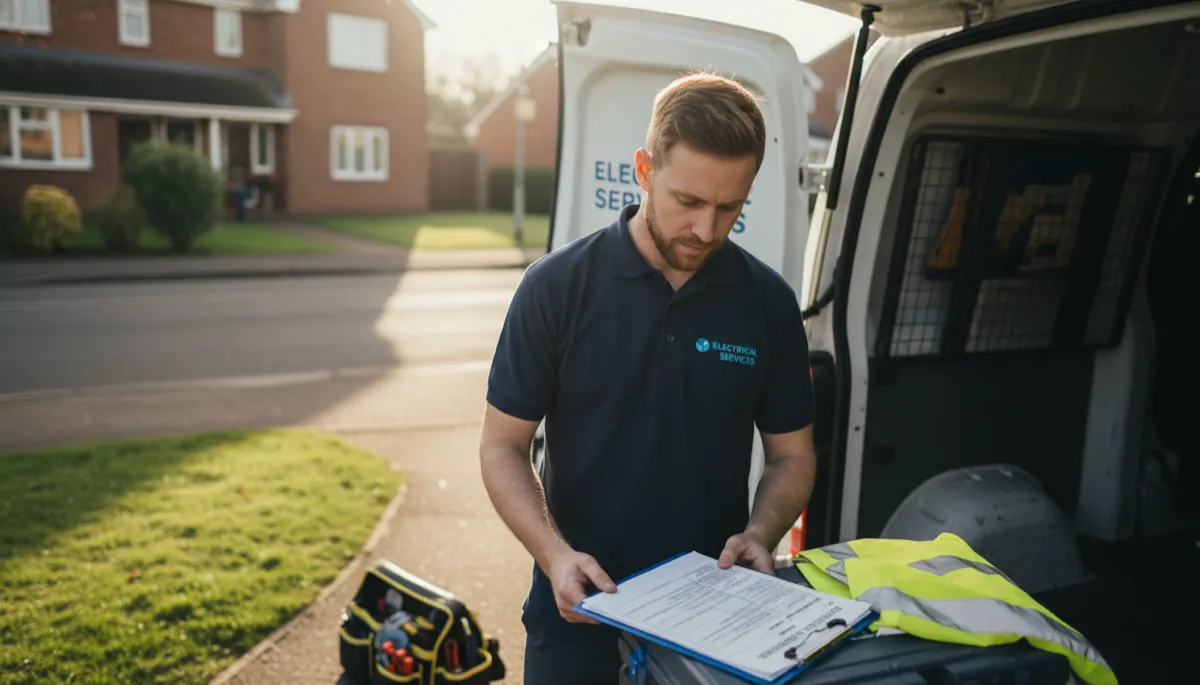
Public liability insurance for electricians covers you if a client or member of the public suffers injury or property damage because of your work. Electrical faults can cause fires that destroy entire properties. A wiring error might not show up for months — and when it does, the claim lands on you. Without PLI, you pay that bill personally.
This guide explains what PLI covers for electricians, what it costs, how much cover you need, and what other insurance a self-employed electrician should carry.
Key Takeaways
- Public liability insurance is not a legal requirement for electricians under UK law, but NICEIC, NAPIT, and SELECT all require members to hold valid PLI as a condition of registration
- Sole traders typically pay between £150 and £450 per year for £1 million PLI, depending on the type of work and annual turnover
- Electrical fires are among the most expensive third-party claims — faulty wiring can cause structural damage to an entire property, with claims reaching six figures in serious cases
- PLI does not cover your tools, your van, injuries to your own employees, or the cost of correcting defective workmanship
- If you employ staff or use labour-only subcontractors who work exclusively for you, employers’ liability insurance is a legal requirement under the Employers’ Liability (Compulsory Insurance) Act 1969
Does an Electrician Need Public Liability Insurance?
No UK law specifically requires electricians to hold public liability insurance. The legal obligation that does exist is employers’ liability — but only if you employ people.
In practice, operating without PLI closes off significant portions of the market:
- Scheme membership — NICEIC, NAPIT, and SELECT all require valid PLI as a condition of membership. Without it, you lose your registration and your ability to self-certify electrical work under the Part P competent person scheme
- Domestic clients — Homeowners increasingly ask for proof of insurance before work starts, especially on larger jobs like full rewires or consumer unit upgrades
- Letting agents and property managers — Most insist on a minimum of £2 million PLI for any contractor working on managed properties
- Commercial contracts — Any commercial or public sector job will require proof of cover before you’re allowed on site
- Checkatrade and similar platforms — These directories require valid PLI to create or maintain a listing
So while it’s technically optional, most electricians find that working without PLI effectively removes them from a large chunk of available work.
What Does Public Liability Insurance Cover for Electricians?
PLI responds to third-party claims — that’s injuries or damage suffered by someone who isn’t you or your employee. For electricians, fire and electrocution risks make the potential claims severe.
| Scenario | Covered? |
|---|---|
| Faulty wiring causes a fire that damages the client’s home | Yes |
| Client receives an electric shock from work you’ve completed | Yes |
| You accidentally damage a neighbour’s property during installation | Yes |
| A third party is injured by unsecured cables or tools left on site | Yes |
| Your tools are stolen from the client’s property | No — needs tools and equipment insurance |
| One of your workers is injured on site | No — needs employers’ liability insurance |
| A wiring fault you installed causes a fire six months later | Depends — check for “completed works” cover |
| A client claims your EICR report missed a serious fault | No — this is a professional indemnity claim |
Completed works cover matters particularly for electricians. Standard PLI only covers incidents that happen while you’re on site. Without completed works cover, a fire that starts from faulty wiring you installed — discovered weeks or months after the job — may not be covered. Check your policy carefully, and if it’s not included as standard, ask for it specifically.
What Does Public Liability Insurance Not Cover?
PLI is specifically about third-party claims. It won’t cover:
- Your own tools and equipment — If your tools are stolen from a client’s property or your van, you need a separate tools and equipment policy
- Your van — A standard motor trade policy or commercial vehicle policy is required
- Injuries to your employees — Employers’ liability insurance is legally required if you have staff
- Defective workmanship — If you need to redo a job at your own cost because it was done incorrectly, PLI doesn’t cover that. Some policies include “defective workmanship” cover as an add-on, but read the small print
- Professional advice errors — If you design an electrical system that’s specified incorrectly, that’s a professional indemnity claim, not a PLI claim
How Much Does Public Liability Insurance Cost for Electricians?
Costs vary based on your turnover, the type of work you do, and the level of cover you need. As a rough guide for UK electricians in 2026:
| Situation | Typical Annual Cost |
|---|---|
| Sole trader, domestic work, up to £100k turnover | £150 – £300/year |
| Sole trader, mix of domestic and commercial | £250 – £450/year |
| Small firm (2-4 employees), domestic work | £400 – £800/year |
| Industrial or high-voltage work | Higher — get specialist quotes |
Monthly payment options are available from most providers, typically adding 10-20% to the annual cost. Paying annually is usually cheaper if you can manage the upfront amount.
Prices are affected by:
- Type of electrical work — Domestic rewires carry different risk profiles to industrial installations
- Annual turnover — Higher turnover usually means higher premiums
- Claims history — Any previous claims will push your premium up
- Cover level — £1 million, £2 million, £5 million, or £10 million options are available
How Much Cover Do Electricians Need?
The standard levels you’ll see are £1 million, £2 million, £5 million, and £10 million. The right amount depends on what you’re doing:
- Domestic work only — £1 million is the minimum. Some clients and platforms require £2 million, so it’s worth getting £2 million as standard
- Commercial work — Most commercial contracts require at least £2 million, and many specify £5 million
- Public sector or local authority contracts — Usually £5 million or £10 million is required
- Large or complex installations — Consider £5 million regardless of the client type
For most self-employed electricians doing general domestic and light commercial work, £2 million is a sensible baseline — it meets most client requirements without significantly inflating the premium.
What Other Insurance Does a Self-Employed Electrician Need?
PLI is the foundation, but it’s rarely enough on its own. According to GOV.UK, employers’ liability insurance is a legal requirement for any business with employees, with a minimum cover of £5 million.
| Insurance Type | Who Needs It | Legal Requirement? |
|---|---|---|
| Public liability insurance | All self-employed electricians | No (but scheme membership requires it) |
| Employers’ liability insurance | Anyone with employees or labour-only subcontractors | Yes — from £5 million |
| Tools and equipment insurance | Anyone with valuable tools | No |
| Commercial vehicle insurance | If you use a van for work | Yes (standard motor insurance doesn’t cover commercial use) |
| Professional indemnity insurance | If you design or specify systems | No, but recommended |
| Personal accident insurance | Sole traders with no sick pay | No |
Professional indemnity deserves a mention because it’s often overlooked by electricians. If you produce technical drawings, specify systems, or advise on electrical design — and something goes wrong with that advice — PLI won’t respond. A client who suffers financial loss from a badly specified system could pursue a professional indemnity claim. If this is part of your work, it’s worth getting PI cover alongside your PLI.
Where to Get Electrician Public Liability Insurance
Most major business insurance providers offer trade-specific policies. A few worth comparing:
- Rhino Trade Insurance — trades-focused, instant online quotes
- NICEIC Insurance — aimed specifically at NICEIC members, tailored to electrical work
- Tradesman Saver — competitive pricing for sole traders and small firms
- AXA Business Insurance — wider insurer with electrical contractor cover
- Compare the Market / Simply Business — comparison tools to check multiple providers at once
Get at least three quotes. Premiums vary more than you’d expect for identical cover levels. Check the policy terms carefully, particularly around completed works and what’s excluded.
FAQ
Does an electrician need public liability insurance by law? No, there’s no UK law that requires electricians to hold PLI. However, NICEIC, NAPIT, and SELECT require it for scheme membership, and most clients — especially commercial and letting agents — won’t hire you without it. In practice, it’s a commercial necessity rather than a legal one.
How much is public liability insurance for an electrician? Most self-employed electricians doing domestic work pay between £150 and £450 per year for £1–2 million cover. Commercial or industrial electricians, or those with higher turnovers, will pay more. Getting three quotes is the quickest way to find the best rate for your specific situation.
What insurance do I need as a self-employed electrician? At minimum: PLI (required by your scheme), commercial vehicle insurance for your van, and tools insurance. If you employ anyone, employers’ liability is legally required. If you design systems or provide technical specifications, professional indemnity is worth adding.
Does PLI cover electrical fires caused by my work? PLI covers third-party damage, so if a fire causes damage to a client’s property while you’re on site, yes. For fires that start after you’ve left, you’ll need “completed works” cover — this is a separate clause that isn’t always included by default. Check your policy and ask specifically for it if it’s not there.
Does NICEIC require public liability insurance? Yes. NICEIC membership requires electricians to hold valid public liability insurance as a condition of registration. The same applies to NAPIT and SELECT (the Scottish equivalent). If your PLI lapses, your scheme membership is at risk.
Most electricians running a legitimate business will end up with PLI anyway — scheme membership leaves no choice. The decision is really about how much cover to get and whether to layer in additional policies like tools insurance or professional indemnity.
If you’re shopping around, use comparison tools to check several providers at once, read the completed works clause carefully, and go for at least £2 million cover as a baseline. It costs slightly more than £1 million but meets a wider range of client requirements without much extra premium.
For more on running a professional electrical business, see our guide to how electricians can get more local jobs online and why a professional website matters for tradespeople. If you’re looking to get a website that builds trust with potential clients, see how Digital Tradies can help.