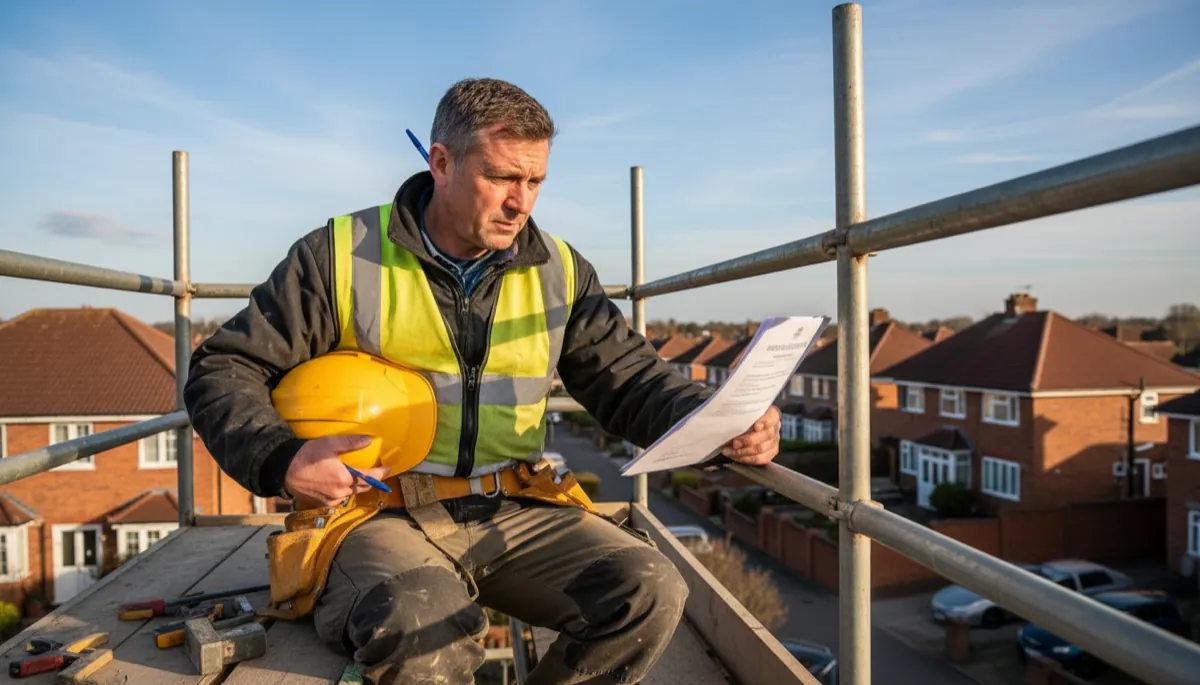
Public liability insurance for roofers covers you if a third party — a client, neighbour, or member of the public — suffers injury or property damage because of your work. Roofing is one of the highest-risk trades in the UK, and claims in this sector regularly run into tens of thousands of pounds. Without cover, you carry that cost personally.
This guide covers what PLI actually covers for roofers, how much it costs, how much cover you need, and what other policies belong alongside it.
Key Takeaways
- Public liability insurance is not a legal requirement for roofers — but most clients, contractors, and trade platforms will refuse to hire you without it
- Roofers pay higher premiums than most tradespeople because of the working-at-height risk profile; typical costs range from £200 to £700 per year for sole traders
- Most domestic roofing jobs require at least £1 million in cover; commercial contracts typically demand £2 million or £5 million
- PLI doesn’t cover your tools, your van, or injuries to your own employees — separate policies cover those
- According to the Health and Safety Executive (HSE), falls from height are the single biggest cause of fatal injuries in UK construction — this is why roofer premiums are higher than most other trades
Does a Roofer Have to Have Public Liability Insurance?
No UK law requires roofers to hold public liability insurance. It’s not a statutory obligation in the way employers’ liability insurance is (which is legally required if you employ anyone).
In practice, operating without it creates serious problems:
- Domestic clients — Many homeowners ask for proof of insurance before you set foot on their property. No certificate, no job.
- Commercial and industrial contracts — Almost every commercial site will require a minimum level of PLI as a contractual condition.
- Scaffolding firms — Some scaffolding contractors won’t erect without seeing your insurance certificate first.
- Trade directories — Checkatrade, Rated People, and similar platforms require valid PLI to maintain your listing.
- Local authority and housing association work — These contracts often specify a minimum of £5 million cover.
Without PLI, you’re effectively cut off from a large part of the available work.
What Does Public Liability Insurance Cover for Roofers?
PLI covers claims made against you by third parties. In roofing work, the most common scenarios are:
| Scenario | Covered? |
|---|---|
| A slate or tile falls and injures a passer-by | Yes |
| Scaffolding or equipment damages a neighbour’s property | Yes |
| A client or family member trips over materials at ground level | Yes |
| Debris from your work damages a vehicle parked below | Yes |
| Your completed work leaks and damages a client’s ceiling | Depends — needs “completed works” cover |
| Your tools are stolen from site | No — needs tools insurance |
| One of your workers falls and is injured | No — needs employers’ liability |
Completed works cover matters particularly for roofers. Standard PLI covers incidents while you’re on site. Completed works cover extends that protection to claims that arise after the job is done — for example, a flashing repair that failed six months later and let water into the property. Not all policies include this as standard; check before you buy.
What Does Public Liability Insurance Not Cover for Roofers?
The exclusions are worth understanding clearly:
- Your own tools and materials — Covered under a separate tools and equipment policy
- Your vehicle — Covered under commercial van insurance (standard motor insurance doesn’t cover business use)
- Injuries to your employees or labour-only subcontractors — Covered under employers’ liability insurance
- Your own injuries — Covered under personal accident insurance
- Deliberate acts — Never covered
- Work outside your declared scope — If you describe yourself as a general roofer but take on specialist work like industrial roofing or cladding, you may not be covered. Always declare the actual work you do.
- Height work without appropriate safety measures — Policies can exclude or void claims where The Work at Height Regulations 2005 have not been followed. Using the right equipment and following safe working practices isn’t just a legal obligation — it’s a condition of your cover.
How Much Does Public Liability Insurance Cost for Roofers?
Roofing consistently attracts higher premiums than most other trades. This is a direct reflection of the risk profile: working at height, heavy materials, and significant third-party exposure from falling objects and scaffold operations.
| Roofer Type | Typical Annual Premium |
|---|---|
| Self-employed sole trader, domestic roofing | £200 – £450/year |
| Small limited company (2–4 workers) | £400 – £800/year |
| Specialist or flat roofing (EPDM, GRP, liquid) | £350 – £600/year |
| Industrial or commercial roofing | £600 – £1,500+/year |
According to Simply Business, tradespeople working at height pay on average 30–50% more for PLI than ground-based trades doing similar turnover. A general builder might pay £200 per year for £1 million cover; a roofer doing the same turnover will typically pay £280–£350.
Factors that affect your premium:
- Cover level — £1m, £2m, or £5m
- Type of roofing work — Flat roofing, lead work, and industrial roofing are rated differently to general tiling
- Annual turnover — Higher turnover increases your premium
- Number of workers — More workers means more exposure
- Claims history — Previous claims push your rate up
- Use of scaffolding vs ladders — Some insurers ask how you access the roof
How Much Cover Do Roofers Need?
| Type of Work | Recommended Minimum Cover |
|---|---|
| Small domestic repairs and re-roofing | £1 million |
| Larger domestic projects or new-build roofing | £2 million |
| Commercial, industrial, or main contractor work | £5 million |
| Local authority, housing association, or public sector | £5–10 million (check contract) |
The most common mistake is buying the minimum £1 million policy and then winning a commercial contract that requires £2 million or £5 million. You’ll either have to upgrade mid-year at extra cost or walk away from the job.
If you’re doing mostly domestic work, £1 million is usually enough. If you want to be in the running for commercial work, starting at £2 million keeps your options open.
What Other Insurance Do Roofers Need?
PLI is the foundation, but a proper insurance setup for a self-employed roofer includes more:
| Insurance Type | Who Needs It | Legal Requirement? |
|---|---|---|
| Public liability | All roofers | No — but practically essential |
| Employers’ liability | Anyone with employees or labour-only subcontractors | Yes — minimum £5 million |
| Tools and equipment | Anyone with tile cutters, angle grinders, ladders on site | No |
| Commercial van insurance | Anyone using a van for work | Yes (standard motor won’t cover business use) |
| Personal accident | Sole traders especially | No — but important without sick pay |
| Contract works insurance | Larger roofing contracts | No — but often required by main contractors |
| Height safety equipment cover | Scaffold boards, access equipment | Included in some tools policies |
Employers’ liability deserves emphasis. According to the Health and Safety Executive (HSE), if you have a single employee — or if labour-only subcontractors work exclusively for you — you’re legally required to hold employers’ liability insurance at a minimum of £5 million. The penalty for operating without it is up to £2,500 per day.
Working at Height and Your Insurance
Roofing is classified as working at height under The Work at Height Regulations 2005. This matters for your insurance in two ways:
-
Compliance is a condition of cover. Insurers can refuse to pay claims if safe working practices weren’t followed. This includes using appropriate access equipment, ensuring scaffolding is properly erected and inspected, and having competent workers on site.
-
Higher claims values. The HSE reports that falls from height account for around 40% of all fatal injuries in the UK construction industry. When claims do happen on roofing sites, they tend to be serious — and serious claims drive higher premiums for the whole trade.
Maintaining your safety record — no near-misses, no claims — is the single biggest thing you can do to keep your premiums down over time.
Where to Get Public Liability Insurance as a Roofer
Comparison sites — Simply Business, comparethemarket.com, and Go.Compare all offer roofer-specific PLI. Useful for getting multiple quotes at once.
Specialist trade insurers — Tradesman Saver, Trade Direct Insurance, and NFU Mutual specialise in trades and understand roofing risks better than generalist insurers. Often worth comparing their quotes against comparison sites.
Trade body schemes — The National Federation of Roofing Contractors (NFRC) offers insurance schemes for members, sometimes at preferential rates. If you’re not already a member, it’s worth investigating.
What to check in any policy:
- Does it include completed works cover?
- Does it specifically cover height work and the type of roofing you do?
- Is there a clear claims line available out of hours?
- Can you get a mid-year upgrade if you win a contract requiring higher cover?
Get at least three quotes. Premiums for the same level of cover vary significantly between providers.
Frequently Asked Questions
Should roofers have public liability insurance? Yes — while it’s not a legal requirement, operating without it is a serious commercial risk. Most clients, contractors, and trade platforms require proof of valid PLI before hiring. Given the working-at-height risk profile of roofing, a single uninsured claim could result in a life-changing financial loss.
How much does public liability insurance cost for roofers? Sole traders doing domestic roofing typically pay between £200 and £450 per year for £1 million cover. Commercial or specialist roofing, or having employees, pushes costs higher. Roofers generally pay 30–50% more than ground-based tradespeople doing similar turnover, due to the working-at-height risk.
What insurance does a roofer need? At minimum: public liability insurance. If you have employees or labour-only subcontractors who work exclusively for you, employers’ liability is legally required at £5 million minimum. Tools insurance and commercial van insurance round out a basic setup. Personal accident cover is worth considering as a sole trader with no sick pay entitlement.
Does PLI cover a leaking roof after I’ve left site? Not under standard PLI. Standard policies cover incidents that happen while you’re working. If a completed repair later fails and causes water damage, you need “completed works” cover — which is often an add-on or included in specialist roofing policies. Always check the policy schedule before you buy.
The Bottom Line
Public liability insurance isn’t legally required for roofers, but it’s a practical necessity. Without it, you’ll lose contracts, lose directory listings, and carry full financial exposure on every job. Given that working at height means the consequences of an incident can be severe, the annual premium is a straightforward business expense.
Get quotes from a comparison site and at least one specialist trade insurer, check the policy covers height work specifically, and confirm whether completed works cover is included or available.
If you’re building a serious roofing business, a professional website is the next step. It shows clients you’re legitimate, helps you appear in local Google searches, and lets people find you when they need a roofer in their area. Find out how we build websites for roofers or get started today.