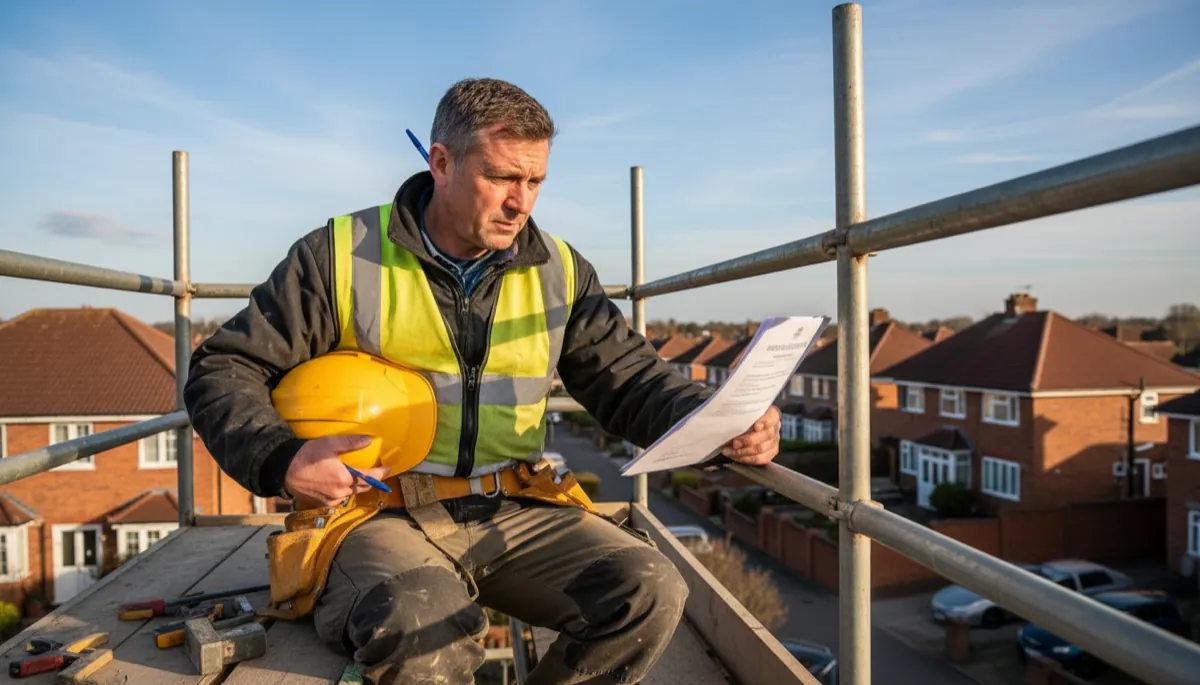
Roofing is one of the UK’s highest-risk trades. Falls from height kill more construction workers each year than any other single cause — and if one of your roofers is seriously injured on site, employers liability insurance is the policy that pays. If you employ anyone while roofing — even one labourer, an apprentice, or a subcontractor who works solely for you — this insurance is a legal requirement. Operating without it costs £2,500 for every day you’re uninsured.
This guide covers exactly who needs employers liability (EL) insurance as a roofer, what it actually covers, how subcontractor arrangements affect your obligations, and what you should expect to pay in 2026.
Key Takeaways
- Employers liability insurance is legally required under the Employers’ Liability (Compulsory Insurance) Act 1969 if you employ anyone working on your behalf
- The legal minimum cover is £5 million, though most policies provide £10 million as standard
- The Health and Safety Executive (HSE) can fine you £2,500 per day for operating without valid cover
- Roofing accounts for a disproportionate share of UK workplace fatalities — the Work at Height Regulations 2005 place legal duties on employers, and EL insurance backs them up financially
- Labour-only subcontractors who work exclusively for your roofing business may count as employees for insurance purposes — this is where many roofers get caught out
- Combined EL and public liability packages for sole-trader roofers typically cost £400–£900 per year
What Is Employers Liability Insurance?
Employers liability (EL) insurance covers your legal costs and compensation payouts if an employee is injured or develops an illness as a result of working for you. On a roofing job, that means someone who falls from a pitched roof, is hit by falling materials, or develops a long-term injury from years of heavy lifting.
It’s a separate product from public liability insurance (PLI). PLI protects you if a client, neighbour, or passer-by is injured or has their property damaged. EL protects your workers.
If you employ people and carry out roofing work, you almost certainly need both.
Do Roofers Legally Need Employers Liability Insurance?
Yes — if you employ anyone. The Employers’ Liability (Compulsory Insurance) Act 1969 makes EL insurance a legal obligation for UK businesses that have employees. The HSE enforces this and carries out inspections. A valid EL certificate must be available for inspection at all times — either displayed on your premises or accessible electronically.
| Situation | EL Insurance Required? |
|---|---|
| Sole trader, working alone on every job | No |
| Sole trader with subbies who work across multiple roofing businesses | Usually no |
| Sole trader using labour-only subcontractors who work only for you | Likely yes — check with insurer |
| Limited company, director only, no staff | Often exempt — confirm with HSE |
| Any roofing business with one or more employees | Yes |
| Business employing apprentices or trainees | Yes |
| Business using seasonal or part-time site workers | Yes |
| Family members working on your jobs | Yes, in most cases |
If you’re unsure whether a specific working arrangement triggers the legal requirement, contact your insurer or check the HSE’s employer guidance at hse.gov.uk.
What Does EL Insurance Cover for Roofers?
EL insurance pays out when an employee is injured, becomes ill, or dies as a direct result of their work for you. The cover includes your legal costs (defending a claim even if it’s found to be groundless) and any compensation awarded.
For roofers, the risks that generate claims include:
| Scenario | Covered? |
|---|---|
| Employee falls from a pitched roof or flat roof | Yes |
| Employee is struck by falling tiles, slates, or tools | Yes |
| Employee is injured when scaffolding collapses or shifts | Yes |
| Employee develops musculoskeletal damage from heavy lifting | Yes |
| Employee is injured moving or erecting access equipment | Yes |
| Injury caused entirely by the employee’s own deliberate recklessness | Usually no — though insurer may still handle the defence |
| Employee’s personal tools or vehicle | No — separate cover needed |
According to the Health and Safety Executive, falls from height remain the single largest cause of fatal injuries in UK construction — accounting for 40–50% of construction fatalities in recent years. Roofing sits at the sharper end of that risk profile.
Roofing-Specific Risks That Drive EL Claims
The Work at Height Regulations 2005 place legal duties on employers to plan and supervise all work at height, use appropriate equipment, and take precautions against falls. But even with proper precautions in place, accidents happen.
Falls from pitched and flat roofs are the most common source of serious EL claims in roofing. These often involve slipping on wet tiles, misjudging roof edges, or edge protection failing. A serious fall claim — spinal injury, head injury, or fatality — can reach six figures. EL insurance covers that payout.
Injuries from falling materials are the second most common. When tiles, slates, or tools fall from height and hit workers below, the resulting claims combine EL (if a roofer is hit) and PLI (if a member of the public is hit).
Manual handling injuries accumulate over time. Roofers carry heavy loads repeatedly — tiles, felt, battens, equipment. Long-term back, knee, and shoulder injuries can generate claims years after the fact. EL policies can cover historic claims from the period the policy was in force, which is why EL documentation should be retained for 40 years after policies end.
Respiratory risks are less visible but real. Working with older bitumen felt, cutting materials without dust protection, or encountering asbestos in older roofs can generate occupational disease claims. According to HSE, 12,000 workers die each year from occupational lung disease related to past exposures at work. EL insurance covers claims where illness is linked to working conditions.
The Subcontractor Question
This is where many roofing businesses get caught out. The assumption is that subcontractors aren’t employees — so EL doesn’t apply. That’s not always true.
The key distinction is labour-only subcontractors (LOSCs). If a subcontractor works primarily or exclusively for your business, uses your tools and materials, and follows your working methods, they may be classified as a deemed employee for insurance purposes — even if they’re self-employed for tax purposes.
If you use LOSCs who work only for you, your EL insurer needs to know. Policies that exclude LOSCs may leave you exposed if one of them is injured on your job.
Bona fide subcontractors — those who supply their own tools, work for multiple clients, and take on financial risk themselves — are generally outside your EL obligation. But the line isn’t always obvious. When in doubt, declare all working arrangements to your insurer and let them confirm the position in writing.
How Much Does Employers Liability Insurance Cost for Roofers?
Roofing is classified as a higher-risk trade, and premiums reflect that. Most roofers buy EL as part of a combined package with public liability insurance.
| Business Type | Typical Annual Cost (EL + PLI Combined) |
|---|---|
| Sole trader, working alone or with occasional subbies | £400 – £900 |
| Small team of 2–4 employees | £700 – £1,500 |
| Established roofing business, 5+ staff | £1,500 – £3,500+ |
Factors that affect your premium include:
- Claims history — any previous EL or PLI claims will increase your premium
- Turnover and payroll — higher revenue means higher exposure, which means higher premiums
- Types of work — high-pitch roofing, flat roofing, commercial vs domestic all carry different risk profiles
- Subcontractor use — including LOSCs increases the risk profile
Roofing premiums are typically higher than comparable ground-level trades. The elevated fall risk is the main driver — insurers price that in.
Shop around between specialist trade insurers rather than going to a general business insurer — the premium difference for the same cover can be significant. Tradesman Saver, AXA Business, Simply Business, and Zurich all offer dedicated roofing packages.
Keeping Your EL Certificate Valid
A few practical points that roofers often overlook:
- Your EL certificate must show a minimum indemnity limit of £5 million — most policies default to £10 million, which is the standard buyers should expect
- The certificate must be available for inspection by HSE at any time
- If your insurer changes, make sure there’s no gap in cover — even a single day without valid cover is technically a breach
- Keep all EL certificates for 40 years after the policy expires — occupational disease claims can arise decades after exposure
Frequently Asked Questions
Do I need employers liability insurance if I’m a sole trader doing roofing work alone? No — if you genuinely work alone with no employees, EL insurance isn’t a legal requirement. But the moment you bring in anyone to work on your jobs — a labourer, an apprentice, a family member — the legal obligation kicks in. Check with your insurer if you use subcontractors to make sure they’re correctly classified.
What’s the difference between employers liability and public liability insurance for roofers? Employers liability covers claims made by your workers if they’re injured or made ill because of their work for you. Public liability covers claims made by third parties — clients, neighbours, passers-by — if they suffer injury or property damage linked to your work. Most roofers need both. They’re usually sold together.
How long do I need to keep employers liability insurance documents? The EL (Compulsory Insurance) Regulations 1998 previously required certificates to be displayed, but the rules changed in 2008 to allow electronic records. However, you should retain all EL documentation for at least 40 years — occupational disease claims can emerge long after the insured period ends.
Is employers liability insurance different for roofing companies versus sole traders? The legal requirement is the same — if you employ people, you need EL cover. The premium differs based on payroll size, turnover, and the scale of your operation. Limited companies with multiple employees will pay significantly more than a sole trader with a single apprentice.
Can I use one EL policy across different roofing jobs and clients? Yes — an annual EL policy covers your employees regardless of which job or client site they’re working on, as long as the work type is within the scope of the policy. Always confirm that your policy covers all the types of roofing work you carry out.
Getting Your Cover in Place
If you’re setting up a roofing business or haven’t reviewed your cover recently, getting the right EL policy should be near the top of your list. Roofing is a sector where the risks are real, the claims are substantial, and the legal consequences of operating uninsured are immediate.
Start by getting quotes from specialist trade insurers who understand roofing. Be transparent about the types of work you do, the number of people you use, and how you classify your subcontractors. A policy that doesn’t reflect your actual working arrangements won’t protect you when it matters.
A well-run roofing business backed by the right insurance is also one that’s easier to market — customers and main contractors increasingly ask for proof of EL cover before work starts. If you’re building your roofing business and looking to present it professionally online, Digital Tradies builds websites for tradespeople from £49/month with no upfront cost. A professional site with your insurance details and credentials visible can make a real difference when competing for larger contracts.
Related reading:
- Public Liability Insurance for Roofers
- SEO for Roofers: How to Get Found on Google
- What Should a Tradesman Website Include?