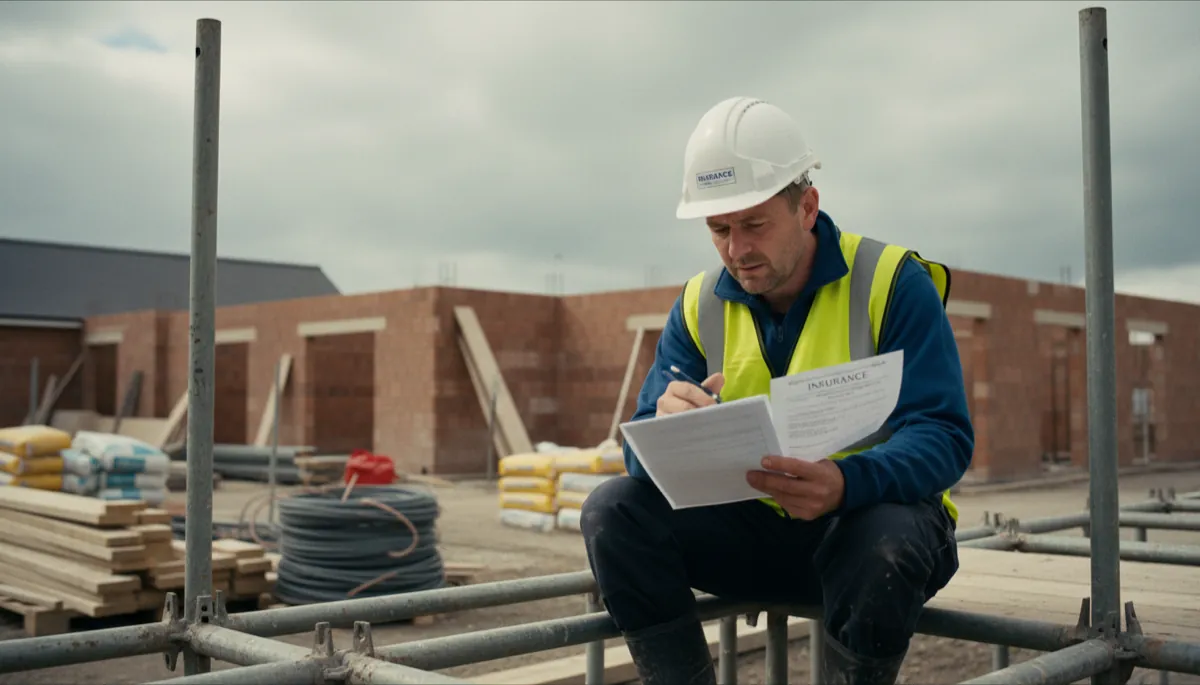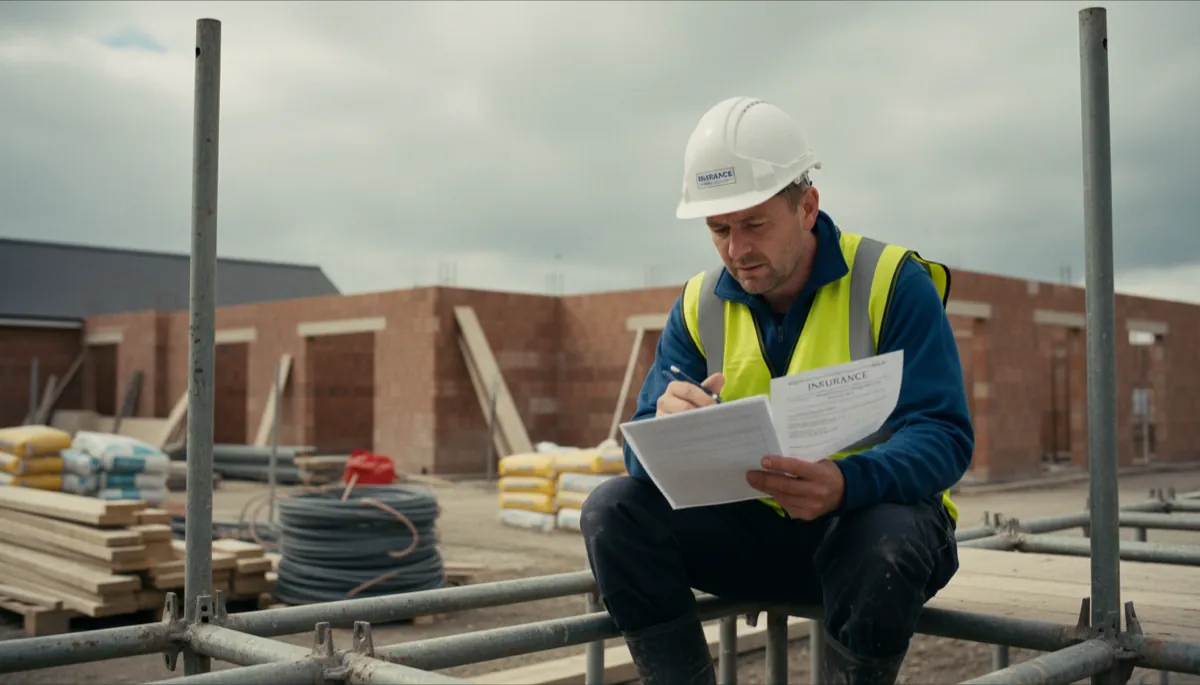
If you run a building business and employ anyone — full-time, part-time, or even a family member helping out on site — employers liability insurance is a legal requirement. Operating without it when it’s required costs £2,500 for every day you’re uninsured. On a construction site, the stakes are high enough that insurers and clients take this seriously.
This guide covers who legally needs employers liability (EL) insurance as a builder, what it covers, how the CIS subcontractor rules affect you, and what you should expect to pay.
Key Takeaways
- Employers liability insurance is legally required under the Employers’ Liability (Compulsory Insurance) Act 1969 if you employ anyone, including apprentices, part-timers, and labour-only subcontractors who work exclusively for you
- The legal minimum cover is £5 million, though most policies default to £10 million
- The fine for operating without valid cover is £2,500 per day
- Construction accounts for around 25% of all UK workplace fatalities despite employing only 5% of the workforce — making EL cover genuinely meaningful, not just a box-tick
- Labour-only subcontractors (LOSC) who work solely for your business may legally count as employees for insurance purposes — this trips up a lot of building firms
- Combined EL and public liability packages typically cost builders £300–£700 per year for sole traders; multi-employee firms pay more based on payroll
What Is Employers Liability Insurance?
Employers liability insurance covers your legal costs and compensation payouts if an employee is injured or develops an illness as a result of working for you. It’s distinct from public liability insurance, which protects you if a client, visitor, or member of the public is injured or suffers property damage.
On a building site, both policies matter. PLI covers the client whose kitchen floods when a pipe is accidentally breached. EL covers the labourer who breaks their back falling from an unsecured scaffold.
Do Builders Legally Need Employers Liability Insurance?
Yes — if you employ anyone. The Employers’ Liability (Compulsory Insurance) Act 1969 makes EL insurance a legal obligation for most UK businesses that have employees. The Health and Safety Executive (HSE) enforces this and can carry out inspections on site.
| Situation | EL Insurance Required? |
|---|---|
| Sole trader, working alone on site | No |
| Sole trader using subbies who work for multiple businesses | Usually no |
| Sole trader using labour-only subcontractors (who work only for you) | Likely yes — check with your insurer |
| Limited company, director only, no staff | Often exempt — confirm with HSE |
| Any business with one or more employees | Yes |
| Business employing apprentices or trainees | Yes |
| Business using part-time or seasonal site workers | Yes |
| Business where family members work for you | Yes, in most cases |
A valid EL certificate must be displayed on your premises (or accessible electronically) for anyone to see. If HSE asks to see it and you can’t produce one when it’s required, you’re liable for the daily fine.
What Does EL Insurance Cover for Builders?
EL insurance pays out when an employee is injured, falls ill, or dies as a direct result of their work for you. Building and construction involves genuine physical hazards — this isn’t theoretical.
| Scenario | Covered? |
|---|---|
| Employee falls from scaffolding or a roof | Yes |
| Employee develops silicosis from cutting concrete without adequate respiratory protection | Yes |
| Employee is hit by a reversing vehicle or plant machinery on site | Yes |
| Employee injures their back from repeatedly lifting heavy materials | Yes |
| Employee is injured by a power tool malfunction | Yes |
| Injury caused entirely by the employee’s own reckless conduct | Usually no — though your insurer may still have to defend the claim |
| Employee’s own tools or vehicle | No — needs separate cover |
According to the Health and Safety Executive, falls from height, being struck by moving objects, and contact with machinery are the three most common causes of fatal injuries in UK construction. An EL policy is the financial protection that sits behind your health and safety procedures — not a replacement for them.
Construction Risks and Why EL Cover Matters
Construction has a disproportionate fatality rate. According to HSE’s Fatal Injuries in Great Britain 2024/25 report, the construction industry accounts for approximately 25% of all workplace fatalities despite employing around 5% of the UK workforce. In the same period, over 50,000 non-fatal injuries were reported in the sector.
The main hazards that generate EL claims on building sites:
Falls from height — Scaffolding, ladders, roofs, and elevated platforms. CDM Regulations 2015 place legal duties on contractors to prevent falls, but accidents still happen. When they do, EL insurance covers the compensation claim.
Dust and respiratory disease — Cutting brick, block, and concrete produces silica dust. Long-term exposure causes silicosis — a progressive and incurable lung disease. According to the British Occupational Hygiene Society, construction workers face significantly elevated risk of occupational lung disease compared to the general working population.
Manual handling injuries — Carrying blocks, lifting roof trusses, moving bags of cement. Musculoskeletal injuries are among the most common causes of long-term absence in construction.
Plant and vehicle movements — Being struck by reversing plant or vehicles is one of the leading causes of construction fatalities. On busy sites with multiple contractors, the risk is compounded.
Subcontractors, the CIS Scheme, and EL Insurance
This is the area where many building firms get caught out. The CIS (Construction Industry Scheme) is a tax arrangement between subcontractors and contractors — but CIS registration does not automatically mean someone is self-employed for insurance purposes.
The question for EL insurance is whether the person working for you is genuinely independent or effectively an employee in all but name. HMRC uses a similar test, but insurers and courts apply their own criteria:
- Do they work exclusively for your business (or predominantly so)?
- Do they use your tools and equipment?
- Do you tell them when, where, and how to work?
- Is there a substitution clause — can they send someone else in their place?
Labour-only subcontractors (LOSCs) — who supply their own labour but use your materials, tools, and equipment — are typically treated as employees by insurers. If you use LOSCs regularly, your EL policy must cover them.
Bona fide subcontractors — who work for multiple businesses, supply their own materials and tools, and set their own working arrangements — are generally not counted as employees. They should carry their own EL insurance.
If you’re unsure how your subs are classified, speak to your insurer before assuming you’re covered (or not covered). The worst time to find out you have a gap is when a claim lands.
How Much Does Employers Liability Insurance Cost for Builders?
Cost depends on how many people you employ, your turnover, the type of building work you do, and your claims history.
| Business Type | Typical Annual EL Cost |
|---|---|
| Sole trader with 1-2 employees, domestic work | £200–£400 |
| Small firm, 3-5 employees, mixed residential/commercial | £400–£700 |
| Firm with 6-10 employees, higher-risk work (structural, roofing) | £600–£1,200+ |
| Multi-site contractor with 10+ employees | £1,000–£3,000+ |
Most EL policies are sold alongside public liability insurance as a combined package. For a small building firm, a combined EL and PLI policy typically costs £400–£900 per year. Specialist cover for high-risk work (demolition, structural steelwork, work at significant height) costs more.
Factors that increase your premium:
- Higher turnover or payroll
- Work at height above 3 metres regularly
- Groundworks, demolition, or structural alteration
- Previous claims — especially injury claims
- Employing workers in higher-risk roles (scaffolders, roof workers)
What to Look for in a Builder’s EL Policy
Not all EL policies are equivalent. When comparing options:
Check the indemnity limit. The legal minimum is £5 million, but most decent policies default to £10 million. Given that construction injury claims — particularly those involving serious permanent disability or fatality — can run into seven figures, £5 million cover may be insufficient for a growing firm.
Check subcontractor coverage. Make sure your policy explicitly states how LOSCs are treated. Some policies require you to declare the number of subcontractors; others cover them automatically under a blanket LOSC clause.
Check the retroactive date. If you switch insurers, check that your new policy covers claims arising from past work — not just incidents that occur after the policy starts.
Check for HSE legal defence costs. If HSE investigates an incident and takes enforcement action, your legal costs can be substantial. Many EL policies include criminal defence cover for HSE prosecutions — confirm this before you buy.
Insurers that regularly provide builder EL cover include Simply Business, AXA, Hiscox, and Direct Line for Business. Comparing quotes via a broker who specialises in construction cover is worth doing — they’ll understand LOSC classification and site-specific risks better than a generalist platform.
Frequently Asked Questions
Does a sole trader builder need employers liability insurance? If you work alone with no employees, subcontractors, or helpers, you’re generally exempt. The moment you bring anyone in to work for you — including a family member, apprentice, or labour-only subcontractor who works exclusively for your business — you need to check whether EL insurance is required. The Employers’ Liability (Compulsory Insurance) Act 1969 is clear on this: if you employ, you must insure.
What is the minimum employers liability insurance cover for builders? The legal minimum is £5 million per claim. In practice, most standard policies provide £10 million in cover. For larger contracting businesses, main contractors and clients often require £10 million as a contractual condition before you can work on their sites.
Who is exempt from employers liability insurance in construction? Sole traders with no employees. Limited companies where the sole director is the only employee and owns at least 50% of the company’s shares. Family businesses where all employees are direct family members and the business is not incorporated. If in doubt, the HSE website has an exemption checker.
Do I need employers liability insurance for CIS subcontractors? It depends on how they work. Bona fide subcontractors who are genuinely self-employed — working for multiple businesses, supplying their own tools, setting their own hours — are generally not your employees for EL purposes. Labour-only subcontractors who work exclusively for you, use your equipment, and follow your instructions are more likely to be treated as employees. Your insurer can help you classify them correctly.
What happens if I don’t have employers liability insurance and someone gets injured? You face a fine of £2,500 per day for operating without cover. Beyond that, if an employee makes a successful injury claim against you, you’re personally liable for the full compensation amount — which in serious construction injury cases can run to hundreds of thousands of pounds.
Getting Your Building Business Online
Sorting your insurance is one of the fundamentals of running a building business properly. A professional website does the same job for your reputation — it shows clients you’re established, insured, and worth calling.
Digital Tradies builds websites specifically for tradespeople from £49/month with no upfront cost. You’re live in 3 days and own the files after 12 months. If you’re growing your building business and need a stronger online presence, take a look at what’s included.
Related reading: Public Liability Insurance for Builders | Do Builders Need a Website? | Builder websites