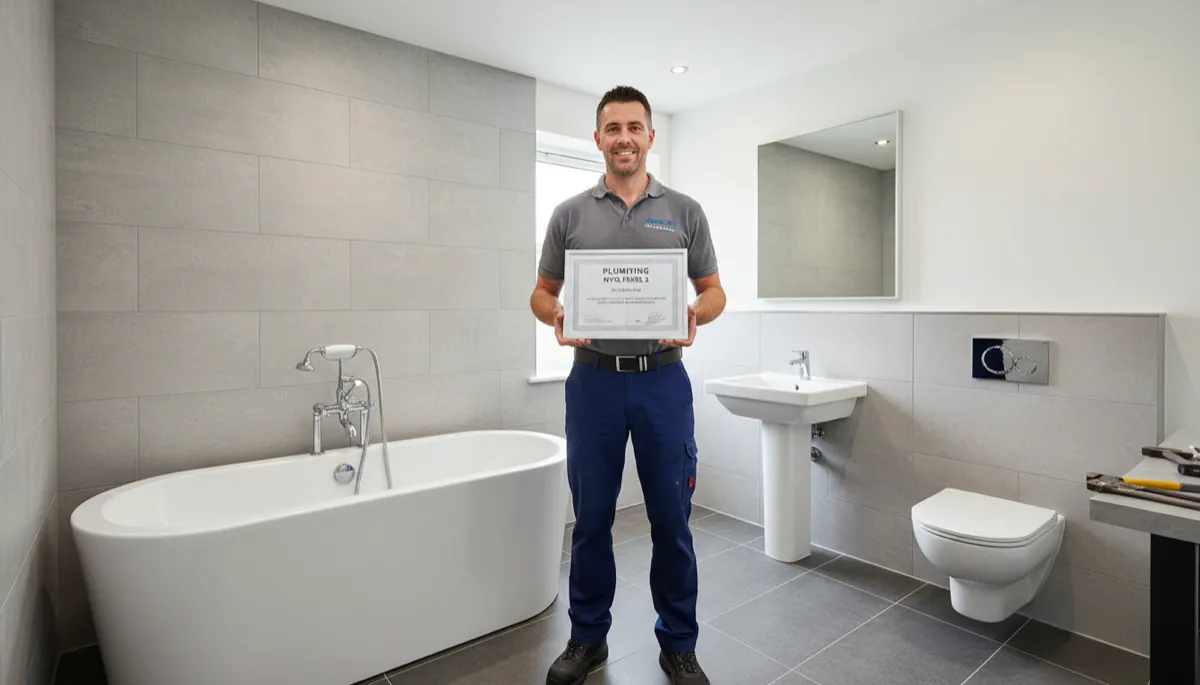
There’s no single licence that makes someone a qualified bathroom fitter in the UK. You can start installing bathroom suites without any formal credentials. But the moment you touch the water supply, install an unvented cylinder, or wire in an electric shower — specific legal requirements kick in. Get those wrong and you’re not just uninsured; you’re in breach of Building Regulations.
This guide covers the qualifications that matter for bathroom fitters in 2026: what’s legally required, what’s worth getting for your business, and the fastest routes to earning each one.
Key Takeaways
- There’s no general licence required to fit bathrooms in the UK — but several specific tasks within bathroom fitting are legally restricted
- NVQ Level 2 or 3 in Plumbing and Domestic Heating Technology is the industry standard — it opens the door to [CSCS card](/blog/cscs-card-explained/) access
- G3 certification is a legal requirement under Building Regulations before working on unvented hot water cylinders
- Part P certification (or a building regulations notification) is required for most electrical work in bathrooms
- The WRAS (Water Regulations Advisory Scheme) approval on products and installer competence matters for water fittings compliance
- A CSCS Blue Card is effectively required to access commercial sites and many residential contracts
Bathroom Fitter Qualifications at a Glance
| Qualification | Issuing Body | Required For | Legally Mandatory? |
|---|---|---|---|
| NVQ Level 2 Plumbing | City & Guilds / EAL | Qualified status, CSCS card | No, but industry expected |
| NVQ Level 3 Plumbing | City & Guilds / EAL | Self-employment, complex installs | No, but expected by insurers |
| G3 Unvented Hot Water | BPEC / Logic4Training | Pressurised cylinders (Megaflo etc.) | Yes (Building Regs) |
| Part P Electrical | NICEIC / NAPIT / ELECSA | Wiring electric showers, fan circuits | Yes (Building Regs) |
| Gas Safe / ACS | Gas Safe Register | Gas appliances (if applicable) | Yes |
| CSCS Blue Card | CSCS / CITB | Commercial site access | No, but effectively required |
| CIPHE Membership | CIPHE | Professional recognition | No |
| WaterSafe Approval | WaterSafe | Consumer trust scheme | No, but recommended |
Does a Bathroom Fitter Need to Be Qualified?
For the core work — removing an old suite, fitting a new bath, toilet, basin, and shower tray — no. There’s no UK law that prevents an unqualified person from doing that work in a domestic property.
But three situations create real legal exposure for unqualified fitters:
Unvented hot water cylinders: Under Approved Document G of the Building Regulations, anyone who installs or commissions an unvented hot water system must be competent under a recognised scheme. Without G3 certification, touching a Megaflo or similar pressurised cylinder is a Building Regulations breach. Insurance won’t cover the job, and if something goes wrong — an explosion, a flood — you’re personally liable.
Electrical work in bathrooms: Bathrooms are a “special location” under Part P of the Building Regulations. Installing or modifying electrical circuits in a bathroom — including electric showers, shaver sockets, extractor fans on a new circuit, and downlights — requires either joining a competent person scheme or notifying building control per job.
Gas connections: If you’re connecting a new gas hob or gas fire as part of a bathroom or wet room build, that work must be carried out by someone on the Gas Safe Register. There’s no workaround.
NVQ in Plumbing: The Core Qualification
Most bathroom fitters hold an NVQ in Plumbing and Domestic Heating Technology, issued by City & Guilds or EAL (Excellence, Achievement & Learning). It’s not a bathroom-specific qualification — it covers all domestic plumbing — but it’s the route that opens up CSCS access, insurance coverage, and professional credibility.
NVQ Level 2 covers the basics: cold and hot water systems, drainage, and standard sanitary installations. This is typically the level achieved through the first two years of an apprenticeship.
NVQ Level 3 goes further: complex heating systems, pressurised installations, and the kind of multi-room bathroom projects that make up the bulk of self-employed work. Most insurers and lead platforms (Checkatrade, Rated People) expect Level 3 as a minimum for a sole-trading bathroom fitter.
Routes to an NVQ
Apprenticeship: The Plumbing and Domestic Heating Technician Level 3 Apprenticeship Standard is a four-year programme. It’s funded — employers with a payroll under £3 million have 95% of training costs covered by the government under the apprenticeship levy rules. You earn a wage throughout. This is the main funded route for people entering the trade.
On-site NVQ assessment: Experienced fitters who’ve been working for years but never formalised their credentials can pursue an NVQ through portfolio assessment. An assessor visits you on live jobs, observes your work, and signs off evidence against the qualification criteria. No college attendance required.
Part-time college course: Some fitters study one day a week alongside employment. Course length varies by provider — typically two to three years for Level 3 through this route.
G3: Unvented Hot Water Systems
The G3 certification is the one qualification every bathroom fitter should hold. Unvented hot water cylinders are standard in modern bathrooms and new builds. Without G3, you can’t legally install them — which rules out a significant portion of bathroom refits.
G3 covers:
- How pressurised systems work
- Temperature and pressure relief valves, expansion vessels, and thermal stores
- What can go wrong and the risks of failure
Most providers deliver it as a one- to two-day course followed by a theory and practical assessment. According to BPEC and Logic4Training — two of the main UK providers — course costs typically run from £300 to £450 depending on location and provider (2026 rates).
Once you hold G3, you can self-certify unvented hot water work under Part G of the Building Regulations without notifying building control. That saves your clients time and makes you a more attractive choice over fitters who don’t hold the certificate.
Approved G3 training centres include BPEC Approved Centres, Logic4Training, Plumbing Courses UK, and City & Guilds approved providers.
Part P: Electrical Work in Bathrooms
Bathrooms are classified as a “special location” under BS 7671 (IET Wiring Regulations). This means more restrictive rules apply — and most electrical work in a bathroom is notifiable under Part P of the Building Regulations 2010.
Notifiable bathroom electrical work includes:
- Installing a new electric shower circuit
- Adding or modifying lighting circuits
- Installing shaver sockets or heated towel rails with electrical connections
- Wiring a new extractor fan circuit
To carry this out legally, you need to join a competent person scheme — the main ones for bathroom fitters are NICEIC, NAPIT, and ELECSA. Each requires an assessment of your electrical knowledge. Registration typically costs around £300–£600 per year for a sole trader.
The alternative — notifying building control per job and having the work inspected — costs around £200 per notification and delays handover. For a bathroom fitter doing regular installs, competent person scheme membership pays for itself quickly.
If you’re not comfortable with electrical work and don’t want to get qualified, the practical solution is subcontracting bathroom electrical connections to a registered electrician. Most bathroom fitters with a regular electrician contact do exactly this.
CSCS Card for Bathroom Fitters
A CSCS Blue (Skilled Worker) card is effectively required for any bathroom fitter working on commercial sites, new-build developments, or housing association contracts. The card signals that you’ve passed the CITB Health, Safety & Environment (HS&E) test and hold a relevant NVQ.
| CSCS Card Type | Who It’s For | NVQ Required |
|---|---|---|
| Green (Labourer) | General labourers | No NVQ — CSCS HS&E test only |
| Blue (Skilled Worker) | Qualified tradespeople | NVQ Level 2 minimum |
| Gold (Experienced Worker) | Supervisory roles | NVQ Level 3 or equivalent |
The CITB HS&E test costs £22.50 for the online version and £26 for the paper-based version in 2026. The CSCS card itself costs £36 and is valid for five years.
Without a CSCS Blue Card, site managers on commercial projects will typically turn you away at the gate. For domestic work, it’s optional — but showing it to clients signals professionalism.
WaterSafe: The Consumer Trust Scheme
WaterSafe is a free-to-search database of approved plumbers and bathroom fitters who’ve been vetted against the Water Fittings Regulations. Membership requires proof of qualification (NVQ Level 2 or equivalent) and current public liability insurance.
It’s not legally required — but WaterSafe-approved installers appear in searches made by homeowners who’ve been told by water companies to use an “approved” contractor. Water fittings work (anything connected to the mains supply) must comply with the Water Fittings Regulations 1999, and WaterSafe membership signals that compliance to clients without them needing to check your certificates.
Application is made through your regional water company. Some water companies list only WaterSafe-approved contractors to customers reporting water-related issues — making membership a genuine source of referrals.
CIPHE: Professional Membership
The Chartered Institute of Plumbing and Heating Engineering (CIPHE) offers professional membership tiers for plumbers and bathroom fitters. CIPHE membership is not a legal requirement, but it carries weight with domestic clients who do their research and appears prominently on comparison sites.
Membership grades start at Affiliate (no qualifications required — just paid registration) and progress to Member (MCIPHE) for those with NVQ Level 3 and industry experience. Annual membership fees range from around £120 to £195 depending on grade.
Checklist: Qualifications by Business Type
For a bathroom fitter doing domestic-only work (no commercial sites):
- NVQ Level 2 or 3 in Plumbing and Domestic Heating Technology
- G3 certification (strongly recommended — most bathrooms involve hot water)
- Part P competent person scheme membership, OR regular electrician contact for subcontracting
- Public liability insurance (minimum £1 million, most fitters carry £2–5 million)
- WaterSafe registration (recommended, free via water company)
For a bathroom fitter working on commercial or new-build sites:
- NVQ Level 3 minimum
- CSCS Blue Card (CITB HS&E test + NVQ Level 2+)
- G3 certification
- Part P or subcontractor arrangement for electrical work
- Public liability insurance (£5 million minimum on most commercial contracts)
- CIPHE membership (for tenders and framework contracts)
If you want to offer gas connection work:
- ACS gas qualifications (CCN1 as core category, plus relevant appliance categories)
- Active Gas Safe Register membership
Frequently Asked Questions
Do I need qualifications to fit a bathroom in the UK? There’s no general licence required to install a bathroom suite in the UK. However, specific elements — unvented hot water cylinders, electrical circuits, and gas connections — each have legal requirements. A bathroom fitter without G3 certification and Part P coverage is legally restricted from completing a significant portion of modern bathroom installs.
How long does it take to become a qualified bathroom fitter? The main route is through a Plumbing and Domestic Heating Technician Level 3 Apprenticeship, which takes four years. Experienced fitters can qualify faster through NVQ portfolio assessment — typically six to twelve months depending on how quickly an assessor can observe sufficient evidence. G3 and Part P competent person scheme registration can each be completed in a few days of training plus an assessment.
What does G3 certification cost? G3 courses typically cost between £300 and £450 in the UK, depending on the provider and location. BPEC, Logic4Training, and City & Guilds approved centres all deliver it. The course itself runs one to two days, followed by a theory and practical assessment. It’s a one-off cost that lets you legally install unvented hot water systems indefinitely.
Can an unqualified person do tiling in a bathroom? Yes. Wall and floor tiling has no licensing requirements in the UK. Anyone can tile a bathroom without qualifications. NVQ Level 2 in Wall and Floor Tiling (delivered by City & Guilds or NOCN) is available for fitters who want the formal credential, but it’s not required for domestic work.
Is WaterSafe membership worth it? For bathroom fitters doing domestic work, yes. WaterSafe membership is free and places you on a searchable database used by homeowners and water companies. The main requirement is NVQ Level 2 (or equivalent) and valid public liability insurance — things a qualified fitter should already have. The referrals from water company recommendations alone can justify the admin.
Building Your Bathroom Fitting Business
Qualifications are the foundation — they protect you legally and signal credibility to clients. The next step is making sure potential customers can actually find you. Most bathroom fitters at the start rely on word-of-mouth, but a professional website changes that: you show up in local Google searches, clients can see your work before calling, and you look established rather than someone who just started out.
Digital Tradies builds professional websites for tradespeople from £49/month, with no upfront cost and a three-day turnaround. If you’re building out your business alongside your qualifications, it’s worth looking at.