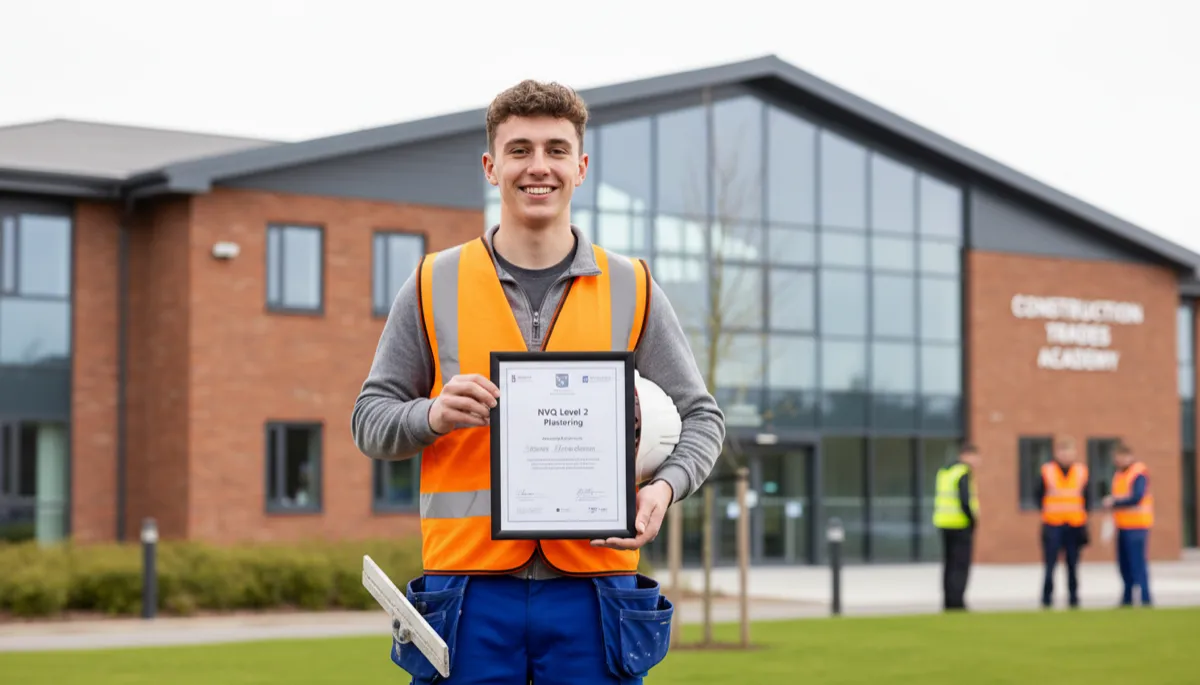
There’s no law in the UK that prevents someone from picking up a hawk and trowel and calling themselves a plasterer — but that only takes you so far. Without formal credentials, commercial sites won’t admit you, [CSCS card](/blog/cscs-card-explained/) checks will flag you immediately, and a growing number of domestic clients now verify trades before booking. The industry benchmark is NVQ Level 2 in Plastering, and this guide explains what that means, what it costs, and how to get there whether you’re starting out or already working in the trade.
Key Takeaways
- NVQ Level 2 in Plastering (Interior or Solid) is the core qualification recognised across the UK construction industry
- The CITB Health, Safety & Environment (HS&E) test costs £22.50 online or £26 paper-based in 2026 — required before applying for any CSCS card
- A CSCS Blue (Skilled Worker) card costs £36, is valid for five years, and requires a completed NVQ Level 2 as a minimum
- The Level 2 Plasterer Apprenticeship Standard typically takes two years and covers both solid plastering and dry lining
- Experienced plasterers without paper qualifications can achieve NVQ Level 2 through on-site portfolio assessment with no college needed
- Interior and exterior plastering are recognised as different specialisms — most plasterers start with interior
Do Plasterers Need to Be Qualified?
No legal requirement exists in the UK for plasterers to hold a qualification before working commercially. Anyone can offer plastering services to the public without certification.
In practice, three situations make qualifications effectively essential:
Commercial and new-build construction sites: Almost every commercial site in the UK uses the CSCS card scheme. Site managers check cards at the gate. A CSCS Blue Skilled Worker card requires NVQ Level 2 as a minimum — without it, you can’t get through. Unqualified plasterers are locked out of the commercial and new-build market entirely.
Main contractors and building firms: Larger builders who subcontract plastering work will typically require proof of qualification before bringing a plasterer onto their supplier list. CSCS Blue plus NVQ is the standard entry requirement.
Domestic clients who check: More homeowners now look up tradespeople before booking. Checkatrade, TrustATrader, and similar platforms display CSCS status and qualifications. A plasterer without any credentials is competing on price alone against those who can prove their competence.
The practical reality: sole traders on domestic referral work can get away without qualifications for some time. But growth — into commercial work, larger builders, or verified directories — requires them.
NVQ Options in Plastering
Plastering covers two distinct areas, each with its own NVQ pathway:
| Qualification | What It Covers | CSCS Card |
|---|---|---|
| NVQ Level 2 in Plastering — Interior Systems | Screeding, floor levelling, fibrous plasterwork, internal walls and ceilings | CSCS Blue card |
| NVQ Level 2 in Plastering — Solid Plastering | External render, tyrolean, pebbledash, external cladding systems | CSCS Blue card |
| NVQ Level 2 in Dry Lining | Stud partitions, suspended ceilings, drylining systems | CSCS Blue card |
| NVQ Level 3 in Plastering | Ornamental and fibrous plasterwork, restoration, heritage work | CSCS Gold card |
Most plasterers who work in domestic and general commercial plastering start with the Interior Systems NVQ. Those focused on new-build or external work will need Solid Plastering. Some plasterers hold both.
City & Guilds and NOCN are the most common awarding bodies for these qualifications in the UK. The qualifications are on the Regulated Qualifications Framework (RQF).
Entry Routes
Route 1: Apprenticeship
The Level 2 Plasterer Apprenticeship Standard is the main funded route into the trade. According to the Institute for Apprenticeships and Technical Education (IfATE), the standard typically takes 18 to 24 months to complete, combining paid on-the-job learning with off-the-job training at a college or approved training provider.
Employers with a payroll under £3 million benefit from 95% of apprenticeship training costs covered by the government — they pay the remaining 5%. Apprentices earn a wage throughout, at minimum the Apprenticeship National Minimum Wage (check GOV.UK for the current rate — it’s updated each April).
On completion, apprentices hold the NVQ Level 2 and qualify for a CSCS Blue card. The CITB runs the Construction Apprenticeship Matching Service to help match apprentices with employers.
Route 2: NVQ On-Site Assessment (for Experienced Plasterers)
Many plasterers have been working in the trade for years without formal certification. The NVQ on-site assessment route allows experienced plasterers to gain their qualification without returning to college.
An NVQ assessor observes you working on live plastering jobs, reviews a portfolio of evidence, and signs off units against the qualification criteria. The number of visits required depends on the assessor and how quickly you can demonstrate competency across all units.
Training providers and colleges across the UK offer this service. Costs typically range from £800 to £1,500 depending on the provider, though some CITB grant funding may be available to offset the cost.
Route 3: College Course
Part-time and full-time college plastering courses are available across UK further education colleges. A part-time plastering NVQ typically runs over one to two years alongside employment. Full-time pre-apprenticeship programmes are also available for school leavers entering the trade.
City & Guilds Level 2 Diploma in Plastering is commonly offered by FE colleges and forms part of the NVQ pathway.
The CSCS Card
The Construction Skills Certification Scheme (CSCS) card is the standard site access credential across UK construction. For plasterers, the relevant card is the CSCS Blue Skilled Worker card.
Getting Your CSCS Blue Card
| Step | What to Do | Cost |
|---|---|---|
| 1. Pass the CITB HS&E test | Book online at citb.co.uk or at an approved test centre | £22.50 (online) / £26 (paper) |
| 2. Complete NVQ Level 2 | Via apprenticeship, college, or on-site assessment | Varies |
| 3. Apply for CSCS Blue card | Apply at cscs.uk.com with NVQ certificate and test pass | £36 |
The CSCS Blue card is valid for five years. Renewal requires a valid CITB HS&E test pass (taken within the previous two years) and evidence of continued NVQ-level competence.
The CSCS Green Labourer card is available without an NVQ — just the HS&E test — but it only gets you onto sites as a labourer, not as a skilled plasterer.
Trade Bodies and Associations
Unlike some trades, plastering doesn’t have a mandatory registration scheme like Gas Safe or NICEIC. However, two organisations are worth knowing:
CITB (Construction Industry Training Board) — the industry training board that oversees apprenticeship funding, the HS&E test, and construction training grants. If you employ people or pay the CITB levy, you can claim back training grants. Information at citb.co.uk.
National Federation of Plastering Contractors (NFPC) — the main trade body for plastering contractors in the UK. Membership signals adherence to professional standards, which can reassure commercial clients and main contractors. The NFPC also provides CPD resources and technical guidance.
Costs Summary
| Qualification/Credential | Estimated Cost (2026) |
|---|---|
| CITB HS&E test (online) | £22.50 |
| CSCS Blue card | £36 |
| NVQ via apprenticeship | Government-funded (employer pays 5% of provider costs) |
| NVQ via college (part-time) | £500–£1,500 depending on provider |
| NVQ via on-site assessment | £800–£1,500 |
| NVQ Level 3 (advanced plastering) | £1,000–£2,000 |
Some CITB grant funding may be available for employed workers pursuing NVQs. Check the CITB website for current grant rates.
Once you’re qualified and working independently, you’ll also want to know what to charge. Our guide to plasterer day rates in the UK covers typical prices for skim, render, and full-room plastering work.
Qualifications for Dry Lining
Dry lining — installing stud walls, ceilings, and drylining systems — is a related but distinct specialism from wet trades plastering. If you work across both, you’ll need separate NVQs for each.
The NVQ Level 2 in Dry Lining follows the same routes as plastering qualifications and results in a CSCS Blue card. The Level 2 Dry Lining Apprenticeship Standard is separately listed on the IfATE website.
Some plasterers operating in the new-build sector hold both plastering and dry lining NVQs, covering the full interior scope of a build from structural partitioning through to skim coat finish.
Frequently Asked Questions
Do I need qualifications to start plastering? No formal qualification is required by law to start working as a plasterer in the UK. However, you can’t get a CSCS Blue Skilled Worker card — which most commercial and new-build sites require — without completing NVQ Level 2. For domestic work on referral, unqualified plasterers do operate, but growth into commercial work requires credentials.
How long does a plastering NVQ take? Via apprenticeship, typically 18 to 24 months. Via on-site assessment for experienced plasterers, the timeline depends on how quickly you can demonstrate competency to your assessor — often 3 to 9 months if you’re already competent. Part-time college courses usually take one to two years alongside work.
Can I get a CSCS card without doing an NVQ? You can get a CSCS Green Labourer card with just the CITB HS&E test, but it only covers labouring roles. To work as a skilled plasterer with a CSCS Blue card, you need a completed NVQ Level 2 in Plastering.
What’s the difference between solid plastering and interior systems? Solid plastering (also called wet trades plastering) covers external render, pebbledash, and tyrolean finishes. Interior systems covers internal walls, ceilings, screeding, and fibrous plasterwork. Most domestic plasterers focus on interior work. External render is a separate NVQ pathway.
Is there a plastering equivalent to Gas Safe or NICEIC? No. There’s no mandatory registration scheme for plasterers — unlike gas engineers or electricians, plasterers don’t need to join a competency scheme to work legally. The CSCS card and NVQ are the main professional credentials, with NFPC membership as an optional trade body sign-off.
Building Your Plastering Business
Qualifications get you on site. A professional online presence gets you the domestic work that fills the gaps between larger contracts. If you’re curious how other trades approach credentials, our guides to plumber qualifications and builder qualifications cover similar routes through CITB-backed frameworks.
Most homeowners looking for a plasterer search Google first. A professional website with your credentials, photos of completed work, and genuine reviews from past clients converts those searches into enquiries. Plasterers with a well-built website consistently outperform those relying on word-of-mouth alone for new customer acquisition.
Digital Tradies builds websites for plasterers from £49/month with no upfront cost — live in three days. It’s one less thing to sort while you’re focused on building your qualification and your customer base.