Pricing a roofing job correctly is one of the most important skills a self-employed roofer can develop. Quote too low and you lose money. Quote too high without justification and you lose the job. Get it right and you build a profitable business that can absorb bad weather, material price spikes, and the odd job that runs over.
This guide walks through how to price roofing work from the ground up — from a small ridge tile repair to a full pitched roof replacement — covering materials, labour, overheads, markup, and how to present your quote professionally.
Key Takeaways
- Always separate materials and labour in your quote calculation, even if you present a single total price to the customer
- A common mistake is forgetting overheads: insurance, van costs, tools, and admin eat into margin fast
- Most self-employed roofers should target a minimum 20–30% gross margin on labour and materials combined — the roofer hourly rate guide covers how to build your base rate from costs upwards
- Fixed-price quotes suit jobs where scope is clear; time-and-materials suits assessments, emergency work, and jobs where hidden damage is likely
- According to the National Federation of Roofing Contractors (NFRC), roofing materials costs increased significantly between 2022 and 2025 — always check current supplier prices before quoting
Why Roofing Jobs Are Hard to Price
Most trades have fairly predictable jobs. Roofing doesn’t.
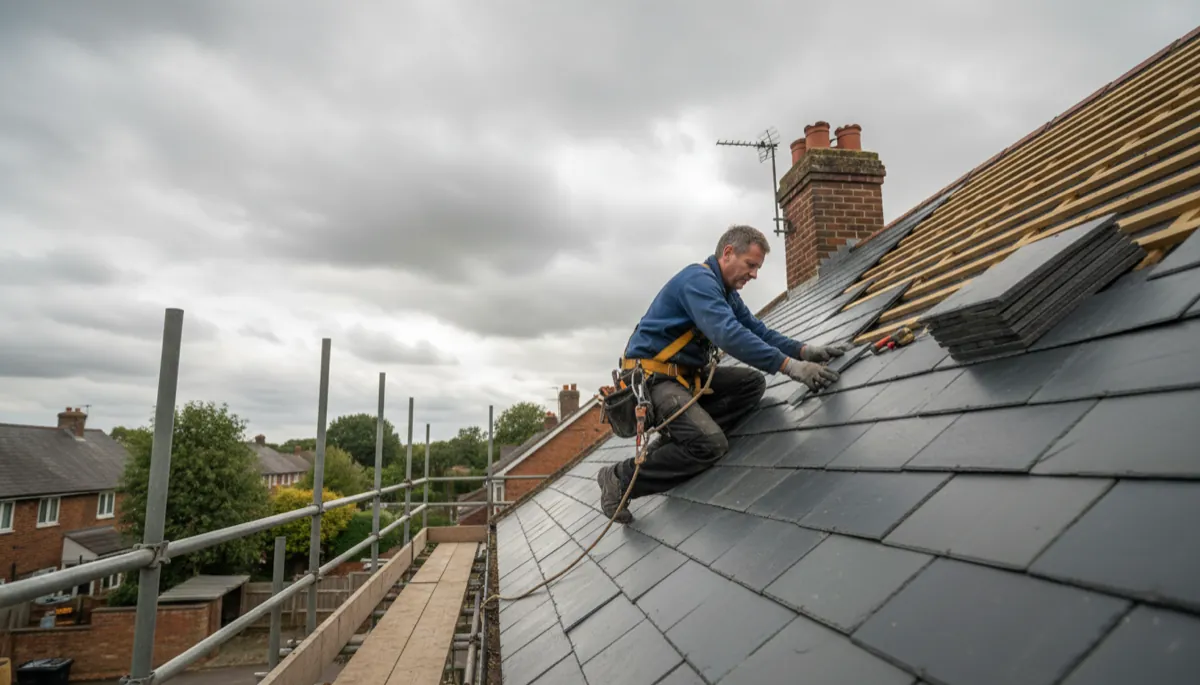
You’re dealing with variable material quantities (every roof is different), potential hidden damage you only discover once work starts, scaffolding costs that fluctuate, and weather risk that affects how long the job takes. A pitched roof replacement that looks like a four-day job from the ground can easily run to six once you’re up there and find rotten timber or failing lead work.
The roofers who price accurately don’t guess — they have a system. Here’s how to build one.
Step 1: Break Every Job Into Three Cost Buckets
Before you put a price on paper, break the job into three buckets:
| Cost Bucket | What It Covers |
|---|---|
| Materials | Tiles, slates, felt, batten, ridge caps, lead, screws, fixings, mortar |
| Labour | Your time and any subcontractors or labourers you bring in |
| Overheads | Scaffold, skip, van, insurance, tools, admin time, waste disposal |
Most roofers only think about materials and labour. Overheads are where the money quietly disappears.
Step 2: Calculate Material Costs Accurately
Start by measuring properly. For pitched roof work, you need the actual roof area, not the floor area — the pitch multiplies the surface you’re working on.
A simple formula: multiply the floor area by a pitch factor.
| Roof Pitch | Pitch Factor |
|---|---|
| 15° (shallow) | 1.04 |
| 22.5° (standard) | 1.08 |
| 30° (steep) | 1.15 |
| 45° (very steep) | 1.41 |
So a 50m² floor area on a 30° pitch = 50 × 1.15 = 57.5m² of actual roof area.
For a concrete interlocking tile roof, you’d need roughly 10–11 tiles per m². At £1–£2 per tile from a builder’s merchant, that’s £575–£1,265 in tiles alone for this example — before felt, batten, ridge, or fixings.
Always add 10% for wastage and breakages when calculating tile quantities. Cutting around hips, valleys, and dormers chews through material fast.
Current approximate UK material costs (April 2026, ex-VAT):
| Material | Approximate Cost |
|---|---|
| Concrete interlocking tiles | £1.00–£2.00 each |
| Natural slate (Welsh/Spanish) | £2.50–£6.00 per slate |
| Roofing felt (35m roll) | £30–£60 per roll |
| Treated roofing batten (3.6m length) | £2.50–£4.50 |
| Lead flashing (code 4, per m) | £15–£25 |
| Mortar (25kg bag) | £5–£9 |
| Ridge tiles | £3–£8 each |
Always get a current price from your merchant before quoting. Material prices have fluctuated significantly since 2022, and margins evaporate quickly if your quote is based on last year’s costs.
Step 3: Price Your Labour Honestly
Labour is where roofers most often undersell themselves. The mistake is pricing the time you’d like it to take, not the time it realistically will.
Start with your daily rate. If you’re working solo, what do you need to clear per day to make the business worthwhile? Most self-employed roofers in the UK target £200–£350/day depending on experience and region. London and the South East sit toward the top of that range; rural areas and the North typically at the lower end. For a full breakdown of what to set as your daily rate, see the roofer day rate guide.
For a full pitched roof replacement on a typical three-bedroom semi, here’s a realistic labour breakdown:
| Task | Time (Solo Roofer) |
|---|---|
| Strip old tiles and dispose | 1 day |
| Check/replace any rotten battens or boards | 0.5–1 day |
| Lay new felt and batten | 1 day |
| Tile the main sections | 1.5–2 days |
| Ridge, hips, valleys, and lead work | 1–1.5 days |
| Total | 5–6.5 days |
At £250/day, that’s £1,250–£1,625 in labour. Add a labourer for loading and passing tiles up and the job might run faster, but you’re paying their day rate too (typically £130–£180/day).
Always build in contingency time for roofing work. Hidden damage — rotten rafters, failed felt, substandard previous repairs — is common on older properties. A 10–15% time contingency on any substantial job is reasonable.
Step 4: Add Scaffold and Other Site Costs
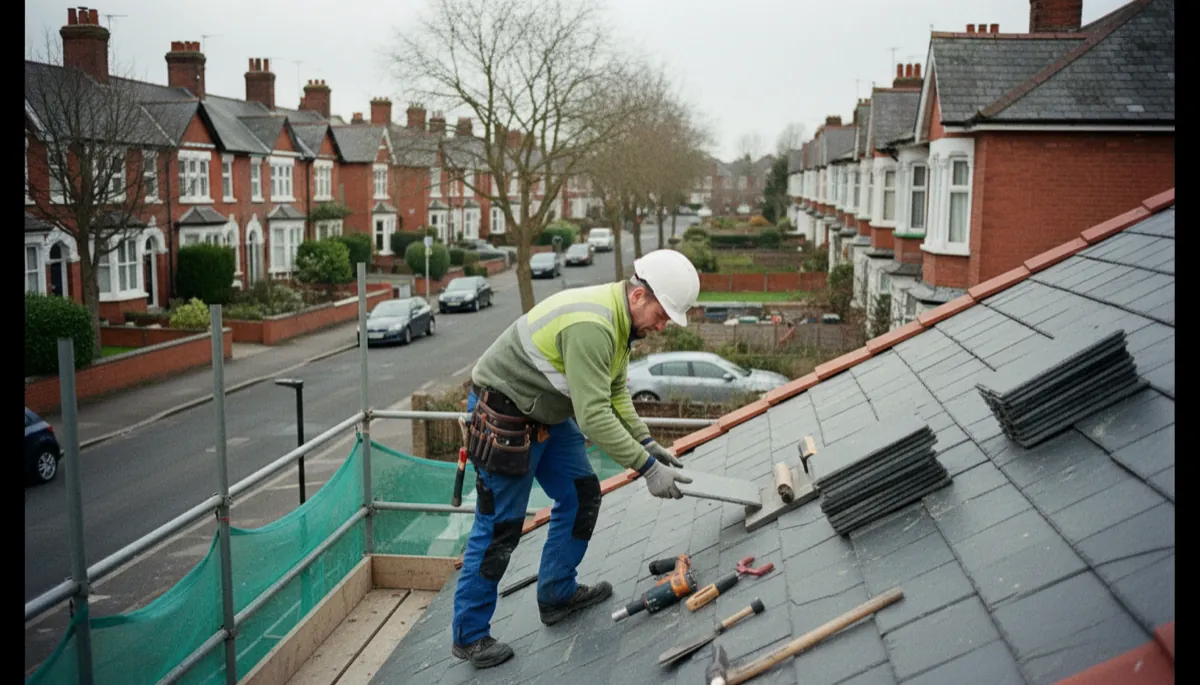
Scaffold is a major cost that many roofers either forget or underquote. In most cases, domestic roofing work above single-storey height legally requires it — the Work at Height Regulations 2005 are clear on this.
Scaffold hire for a typical semi-detached typically costs £600–£1,500 for a two-week hire, depending on the size of the property and the scaffolding company. Erection and dismantling is usually included in that figure.
Other site costs to factor in:
| Item | Typical Cost |
|---|---|
| Scaffold hire (2-week, 3-bed semi) | £600–£1,500 |
| Skip hire (roofing waste) | £200–£400 |
| HERAS fencing or safety netting | £50–£150 |
| Mechanical tile lift (large jobs) | £100–£250/day |
Don’t absorb these costs into your margin. They go straight into the quote as a line item or factored into your total.
Step 5: Apply Your Markup
Once you have total costs (materials + labour + site), apply your markup. This is not profit — it’s margin that covers overheads, slow periods, bad debts, and risk.
| Markup | Notes |
|---|---|
| 10–15% | Too low for roofing — leaves no buffer for overruns |
| 20–25% | Minimum sustainable for most self-employed roofers |
| 30–40% | Realistic for experienced roofers with strong reputation |
A worked example:
- Materials: £2,800
- Labour (5 days): £1,250
- Scaffold: £900
- Skip: £250
- Total costs: £5,200
- 25% markup: £1,300
- Quote to customer: £6,500
That £1,300 covers insurance, van running costs, tools, the days where weather stops play, and — if you’re lucky — a bit of actual profit.
Fixed Price vs Time-and-Materials
For most domestic roofing jobs where the scope is clear, a fixed price is what customers expect and what wins work. It removes uncertainty for them and positions you as a professional.
Time-and-materials works better for:
- Emergency call-outs where you can’t fully assess the damage until you’re on the roof
- Roof surveys followed by repair work where extent is unknown
- Jobs on very old properties where finding additional problems is likely
If you suspect hidden damage on a fixed-price job, build that risk into your price or use a conditional clause: “Price assumes timber structure is sound. Any rotten timbers will be quoted separately on discovery.”
What to Include in a Roofing Quote
A professional written quote doesn’t just list a price — it defines the scope clearly, which protects you as much as the customer.
Your quote should cover:
- Scope of work — exactly what you’re doing (e.g., strip and re-tile rear elevation, new felt and batten throughout, re-point ridge)
- Materials specification — tile type, colour, manufacturer (customers sometimes argue about this later)
- What’s excluded — timber repairs, lead replacements if beyond original scope, anything you can’t assess from ground level
- Scaffold and skip — whether included or to be arranged separately
- Timeframe — start date and estimated duration
- Payment terms — most roofers take 20–30% upfront on larger jobs, remainder on completion
- Guarantee — how long you’ll stand behind your workmanship
According to the Federation of Master Builders (FMB), disputes between tradespeople and customers most commonly arise from scope disagreements — where the customer thought something was included and the tradesperson didn’t. A detailed written quote prevents most of these.
Common Pricing Mistakes to Avoid
Quoting from the ground. Get on the roof or at minimum use a ladder to inspect. What looks like a simple tile repair from below can be a whole section of failed felt once you’re up there.
Not accounting for access. A terraced house with a tight rear passage, or a property next to a busy road, adds time and scaffold costs. Factor these in.
Using last year’s material prices. Tile and slate prices, lead, and labour all move. Check current prices with your merchant before each quote.
Pricing to match a competitor you haven’t seen. “The other roofer quoted £4,000” tells you nothing about what they’re actually doing. Quote the job properly and explain your price.
Forgetting VAT. If you’re VAT-registered, your quotes should clearly state whether prices are inclusive or exclusive of VAT. Getting this wrong creates real problems.
Building a Professional Online Presence
Winning roofing quotes is easier when your business looks credible before you even turn up. If you’re also looking to bring in more work to quote in the first place, the how to get more roofing work guide covers that in detail. A professional website does more than show your contact number — it lists your qualifications, shows past work, displays reviews, and gives customers confidence to choose you over the roofer who just has a Facebook page.
Digital Tradies builds websites for UK roofers from £49/month, no upfront cost, live in 3 days. It’s one of the easier ways to make sure your business looks as professional as your quotes.
Frequently Asked Questions
How much should I charge to tile a roof in the UK? For a full re-tile on a typical three-bedroom semi, total costs to the customer typically run from £5,500 to £9,000 including scaffold, materials, and labour. The wide range reflects property size, tile specification, roof complexity, and regional labour rates. Always quote based on a proper site assessment rather than using national averages as a shortcut.
Should I charge for a roofing quote? Most UK roofers provide written quotes free of charge. For complex jobs — large commercial properties, detailed surveys with a written condition report — charging a survey fee of £75–£150 is reasonable and positions you as a specialist. For standard domestic work, a free quote is the norm and expected.
How do I calculate how many tiles I need for a roof? Measure the actual roof area (not floor area) by multiplying the floor footprint by the pitch factor for your roof angle. Add 10% for wastage and cutting. Then check the tile manufacturer’s coverage rate — most concrete interlocking tiles cover around 10–11 tiles per m², while smaller plain tiles run to 60+ per m².
What’s a fair markup on roofing materials? Most self-employed roofers add 20–30% to materials cost. This reflects the time spent sourcing, transporting, and managing materials, and provides a buffer against price changes between quote and job. Marking up materials is standard trade practice — it’s part of how the job is priced.
How do I handle price increases after quoting? The best approach is to include a quote validity period — typically 30 days. State in your written quote that prices are subject to change after this date. For jobs where there’s a significant gap between quote and start (common for large re-roofing in busy periods), you can revisit material costs before committing to a start date.