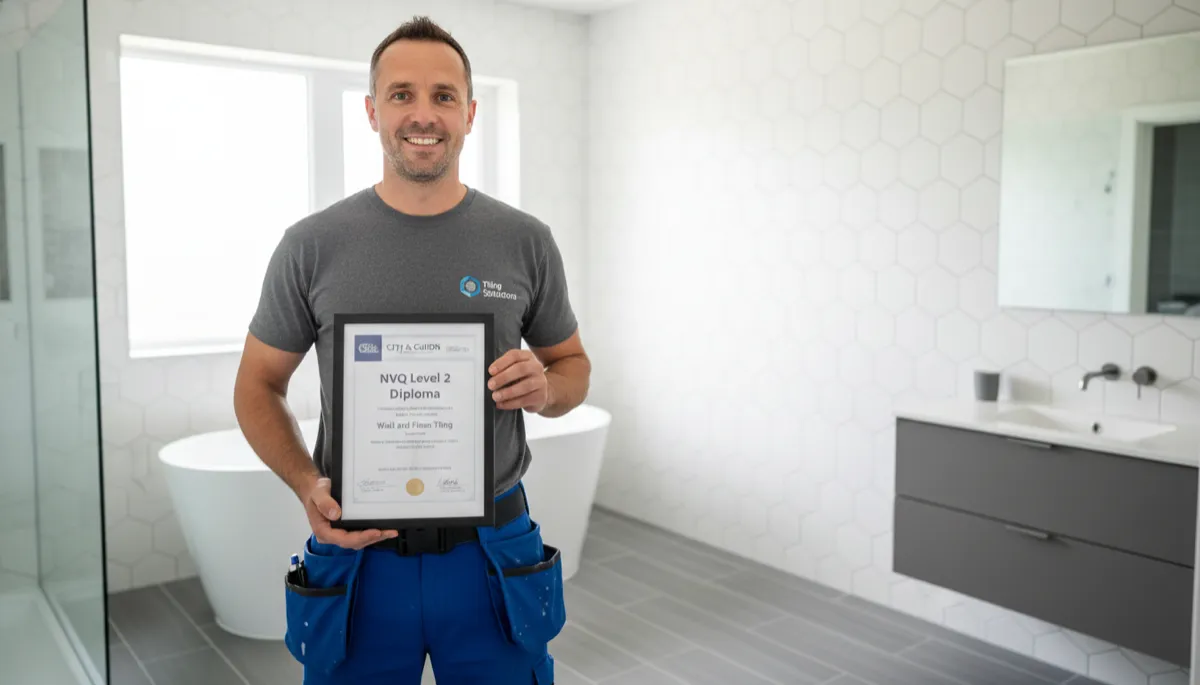
There’s no UK law that stops you picking up a trowel and tiling someone’s kitchen — but without formal credentials, you can’t get a CSCS Blue card, commercial sites won’t let you through the gate, and domestic clients who do a quick check will find nothing to reassure them. The industry standard is NVQ Level 2 in Wall and Floor Tiling, and this guide covers what that means in practice, what it costs, and the fastest route to getting there.
Key Takeaways
- NVQ Level 2 in Wall and Floor Tiling is the core qualification recognised by UK employers, main contractors, and commercial clients
- The CSCS Health, Safety & Environment (HS&E) test costs £22.50 online or £26 paper-based in 2026 — required before any CSCS card application
- A CSCS Blue (Skilled Worker) card costs £36 and is valid for five years
- The Level 2 Wall and Floor Tiling Apprenticeship Standard typically takes two years and is the main funded route
- The Tile Association (TTA) is the main UK trade body for tilers — membership signals vetted, insured, and qualified
- Experienced tilers can qualify through an NVQ on-site assessment without going back to college
Do Tilers Have to Be Qualified?
No. There’s no legal requirement to hold a qualification before working as a tiler in the UK.
But that only gets you so far. Three situations make qualifications effectively essential in practice:
Commercial and construction sites: Almost every commercial site in the UK operates CSCS card checking. A CSCS Blue Skilled Worker card requires NVQ Level 2 as a minimum. Without it, site managers turn you away at the gate — no exceptions.
Domestic clients doing their research: More homeowners now look up tradespeople before booking. TTA membership and CSCS credentials come up on background checks and appear on Checkatrade and similar directories. Without them, you’re competing on price alone against qualified tilers.
Insurance: Some public liability insurers will ask about qualifications when quoting, particularly if you’re working on specialist areas like wet rooms, swimming pools, or listed buildings. Holding a recognised qualification keeps premiums straightforward.
So while unqualified tilers do work — particularly on domestic referral jobs — those without credentials find their options narrow quickly once they try to grow beyond word-of-mouth.
Entry Routes
Route 1: Apprenticeship
The Level 2 Wall and Floor Tiling Apprenticeship Standard is the primary funded route into the trade. It typically lasts two years and combines paid on-the-job work with off-the-job training at a college or approved training provider.
According to the UK government’s apprenticeship funding rules, employers with a payroll under £3 million have 95% of training costs covered by the government — the employer covers the remaining 5%. You earn a wage throughout. There’s no upper age limit for starting an apprenticeship.
On completion, you’ll hold the NVQ Level 2 Diploma in Wall and Floor Tiling and qualify for a CSCS Blue card.
Route 2: Direct Entry + NVQ Assessment
Many tilers start as labourers, work alongside experienced tilers for a few years, and then pursue their NVQ through a portfolio assessment rather than a college course.
An NVQ assessor visits you on live jobs, observes your work, and signs off evidence against the qualification criteria. This suits tilers who are already competent but don’t hold paper qualifications. You still need to pass the CITB HS&E test before applying for your CSCS card.
Route 3: Part-Time College Course
Some tilers study for their NVQ through a part-time college programme — typically one day a week alongside employment. This route takes longer than an apprenticeship (often two to three years) but works well for adults who can’t secure an apprenticeship placement.
The NVQ Qualification Pathway
| Step | Qualification | Who Provides It | Typical Cost |
|---|---|---|---|
| 1 | CITB Health, Safety & Environment Test | CITB-accredited test centres | £22.50–£26 |
| 2 | NVQ Level 2 in Wall and Floor Tiling | City & Guilds, NOCN, or approved NVQ assessment services | £400–£1,200 |
| 3 | CSCS Blue (Skilled Worker) Card | CSCS via cscs.uk.com | £36 per card (5 years) |
| 4 | NVQ Level 3 in Wall and Floor Tiling (optional) | City & Guilds, NOCN | £600–£1,800 |
| 5 | CSCS Gold (Advanced Craft) Card | CSCS, requires NVQ Level 3 | £36 per card (5 years) |
Source: CSCS published card fees 2026; CITB published test fees 2026; City & Guilds qualifications catalogue.
The NVQ Level 2 covers the knowledge, skills, and behaviours expected of a competent tiler across standard floor and wall tiling scenarios. You’ll be assessed on surface preparation, layout planning, adhesive and grout selection, and the installation of ceramic, porcelain, and natural stone tiles to BS 5385 standards.
CSCS Cards for Tilers
| Card Colour | What It Means | Requirements |
|---|---|---|
| Red (Trainee) | In training, working towards NVQ Level 2 | Enrolled on an apprenticeship or NVQ programme |
| Blue (Skilled Worker) | Fully qualified tiler | NVQ Level 2 + CITB HS&E test |
| Gold (Advanced Craft) | Supervisory or advanced specialism | NVQ Level 3 + CITB HS&E test |
| Black (Manager) | Site management role | Relevant management or supervisory qualification |
All CSCS cards cost £36 and are valid for five years. The CITB HS&E test certificate is valid for two years — if it lapses, you’ll need to retake the test before renewing your card. Applications go through cscs.uk.com.
Additional Qualifications Worth Holding
Beyond the NVQ and CSCS card, several additional certificates come up regularly for tilers working on varied projects.
PASMA (Mobile Scaffold Towers) If you’re tiling on commercial sites above ground level, PASMA certification is expected. The one-day course typically costs £120–£180 and covers the safe erection, use, and dismantling of mobile scaffold towers.
WRAS-Compliant Wet Room Waterproofing Wet rooms and shower enclosures require tanking (waterproofing the substrate) before tiling. Installers working to British Standards should be familiar with WRAS-approved products and correct waterproofing methods. While there’s no formal WRAS certification for tilers specifically, demonstrating knowledge of tanking systems and correct installation to manufacturers’ specifications is increasingly expected for wet room work.
Manual Handling A short manual handling certificate is inexpensive and expected on most commercial sites. Worth holding as a standalone certificate rather than relying on site inductions.
Working at Height Regulations Awareness If any tiling work involves working at height — even on domestic jobs using ladders — you should understand the Working at Height Regulations 2005. Short awareness courses are available from most training providers at around £50–£80.
The Tile Association (TTA)
The Tile Association is the main UK trade body for the tiling industry. It represents manufacturers, distributors, and contractors across the sector.
For tiling contractors, TTA membership signals that you meet professional standards and hold appropriate qualifications and insurance. The TTA directory is used by architects, interior designers, and commercial clients to find qualified contractors for specified projects.
TTA Approved status requires that you hold current qualifications, hold valid public liability insurance, and meet the association’s standards of workmanship. The process involves an assessment and references from previous clients.
Individual membership fees depend on your business type and turnover. For sole traders and small contractors, the investment typically sits in the £100–£250 per year range. Check tiles.org.uk for current rates.
How Long Does It Take?
| Route | Time to NVQ Level 2 + CSCS Blue Card |
|---|---|
| Apprenticeship | Typically 2 years |
| Adult learner (part-time college + NVQ) | 2–3 years depending on contact hours |
| Experienced tiler (on-site NVQ assessment) | 6–12 months for portfolio and assessments |
The CITB HS&E test can be booked online and sat within a few days at a local test centre. That’s the quick part. The NVQ itself — whether through apprenticeship, college, or on-site assessment — is where the time varies. Assessment availability and portfolio sign-off are the usual bottlenecks.
NVQ Level 3 and Beyond
The NVQ Level 3 in Wall and Floor Tiling is aimed at tilers moving into supervisory roles or specialist work — complex mosaic installations, natural stone projects, heritage buildings, or large commercial contracts.
Level 3 leads to a CSCS Gold (Advanced Craft) card and opens doors to site supervisor positions and high-specification residential work where architects or designers are involved. It’s not required for everyday domestic or commercial tiling, but it’s worth considering for tilers who want to move up or specialise.
Building Your Tiling Business
Qualifications get you credentialled. Building a tiling business that generates consistent enquiries requires something else: visibility.
Most homeowners planning a bathroom renovation or kitchen tiling job search online first. They’re looking for photos of previous work, reviews, and a reason to call. A professional website gives you all three in one place — and it works while you’re on-site.
Digital Tradies builds websites for tilers from £49/month with no upfront cost, live in three days. If you’re getting work mainly through word-of-mouth and want to open up to online enquiries, take a look at what we include.
You might also find these useful:
Frequently Asked Questions
Do tilers need to be qualified in the UK? There’s no legal requirement to hold a qualification to work as a tiler in the UK. In practice, most commercial sites require a CSCS Blue card (which needs NVQ Level 2), and domestic clients increasingly look for credentials before booking. Unqualified tilers can work, but growth beyond domestic referral work becomes difficult without formal qualifications.
What is the NVQ Level 2 in Wall and Floor Tiling? The NVQ Level 2 in Wall and Floor Tiling is the industry-standard qualification for tilers in the UK. It covers surface preparation, layout and setting out, adhesive and grout selection, and tile installation to BS 5385 standards across ceramic, porcelain, and natural stone. Completing it qualifies you for a CSCS Blue Skilled Worker card. The NVQ is offered through City & Guilds, NOCN, and approved assessment centres.
How much does a tiler qualification cost? The CITB Health, Safety & Environment test costs £22.50 online or £26 paper-based. The NVQ Level 2 in Wall and Floor Tiling typically costs £400–£1,200 depending on the route (college programme, apprenticeship, or on-site assessment). A CSCS Blue card costs £36 and is valid for five years. Total outlay via the assessment route is roughly £450–£1,250 excluding any employer or funding contributions.
What is The Tile Association and should tilers join? The Tile Association (TTA) is the main UK trade body for the tiling industry, representing contractors, distributors, and manufacturers. TTA Approved contractor status requires current qualifications and appropriate insurance. Membership is recognised by architects and commercial clients and is worth considering for tilers targeting specification work or growing beyond domestic projects. Annual membership fees for sole traders typically sit at £100–£250. More information at tiles.org.uk.
Can I become a tiler without an apprenticeship? Yes. Many tilers enter the trade without an apprenticeship by working as a labourer alongside experienced tilers, building practical skills, and then pursuing their NVQ Level 2 through an on-site assessment. An NVQ assessor visits you on real jobs, observes your work, and signs off a portfolio of evidence against the qualification criteria. This route typically takes six to twelve months once you start the assessment process.