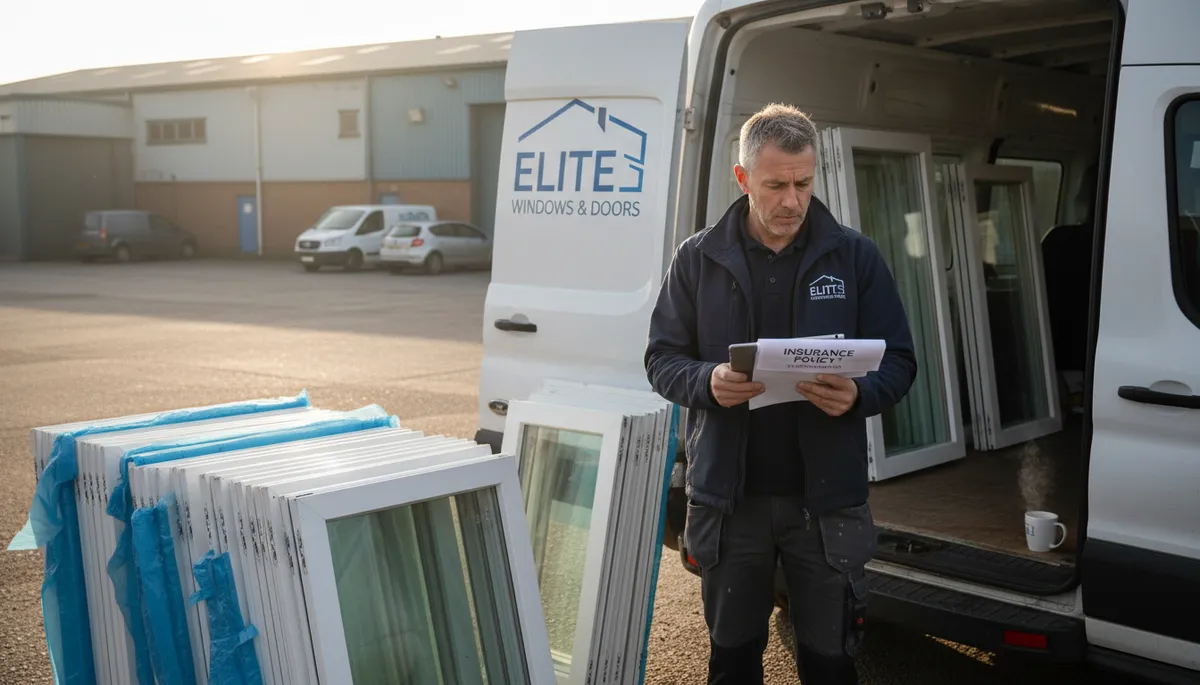
Public liability insurance for window fitters covers you if your work causes injury or damage to a client, neighbour, or third party. Window fitting carries risks that are easy to underestimate — glass breakage, working at height, damaged window reveals, and water ingress from poorly sealed frames can all lead to expensive claims. This guide covers what PLI actually covers, how much it costs, what level you need, and what else belongs in your insurance setup.
Key Takeaways
- PLI is not a legal requirement for window fitters, but most clients, contractors, and FENSA registration expect you to carry it
- Annual premiums for sole trader window fitters typically run from £90 to £300 per year depending on turnover and whether you work at height
- The most common claims involve glass breakage (causing injury or property damage) and water ingress from frame or seal failures discovered after installation
- Most sole traders start with £1 million cover; commercial contracts and main contractor work often require £2 million or £5 million
- PLI does not cover your tools, your van, or employees — those need separate policies
- If you’re FENSA-registered, some industry body requirements include confirmed PLI as part of your membership
Do Window Fitters Need Public Liability Insurance?
No UK law specifically requires window fitters to hold PLI. But in practice, working without it puts you in a difficult position:
- Domestic clients increasingly ask to see proof of insurance before work begins — particularly for higher-value jobs like conservatories, bi-fold doors, or large window replacements
- Main contractors and developers require subcontractors to carry their own PLI — if you’re fitting windows on a new build or development, you’ll need it to get on site
- Trade directories including Checkatrade, Rated People, and TrustATrader require valid PLI as part of their verification process
- FENSA membership — the Fenestration Self-Assessment Scheme — doesn’t mandate PLI directly, but many FENSA-registered companies expect any subcontractors or installers they use to carry it
- Commercial and public sector work typically specifies a minimum cover level in tender documents, often £2 million or more
Without PLI, a single claim for glass-related injury or water damage could cost thousands — and you’d be paying out of pocket.
What Does PLI Cover for Window Fitters?
PLI covers third-party claims made against you — injury or property damage caused by your work. For window fitters, the relevant scenarios are specific:
| Scenario | Covered by PLI? |
|---|---|
| A glass pane breaks during fitting and injures a bystander | Yes |
| A client slips on glass fragments or debris during or after the job | Yes |
| A poorly sealed frame allows water ingress, damaging interior walls | Yes (if discovered shortly after) |
| You accidentally damage a wall, window reveal, or plasterwork during installation | Yes |
| A window falls from height and damages a parked car or injures a passerby | Yes |
| Your tools are stolen from your van or the site | No — needs tools insurance |
| An employee or labourer is injured on site | No — needs employers’ liability |
| Your van is damaged | No — needs commercial vehicle insurance |
| A client is unhappy with the finish but there’s no physical damage | No — this is a dispute, not an insured event |
Completed works cover matters for window fitters. Standard PLI covers incidents that happen while you’re physically on site. A completed works extension covers claims arising after you’ve left — which is relevant if a frame seal fails weeks or months later and causes water damage. Check whether your policy includes this as standard or ask your insurer to add it.
What Are the Most Common PLI Claims for Window Fitters?
Window fitting generates claims that other trades don’t. The main ones to be aware of:
Glass breakage causing injury. Handling, cutting, and fitting glass — particularly large panes for bi-folds, sliding doors, and picture windows — creates real risk of breakage. A falling pane or sharp glass shard can cause serious injury. The cost of a personal injury claim can run to thousands, including medical costs, lost earnings, and pain and suffering.
Water ingress from failed seals. Poorly fitted or degraded frame seals allow water to penetrate around windows. This can affect window reveals, internal plasterwork, sills, and in terraced or semi-detached properties, adjoining walls. Water damage claims often appear weeks or months after installation — which is why completed works cover matters.
Damage to window reveals and surrounding structure. Removing old frames frequently involves taking out surrounding plasterwork, brickwork, or timber. Accidental damage to a client’s wall, sill, or internal decoration during the removal process is a common source of lower-value claims.
Dropped tools or materials. Window fitting often involves working at height — stepladders, scaffolding towers, or cherry pickers for upper storeys. A dropped tool, bracket, or window pane from height can damage property below or, worse, injure someone.
Damage to adjoining properties. In terraced and semi-detached houses, window work in one property can create problems next door — particularly if water ingress from a poorly fitted frame runs along a shared wall.
How Much Does PLI Cost for Window Fitters?
Premiums depend on your turnover, the type of work you do (domestic vs commercial), whether you work at height, and the level of cover you need. Here are realistic 2026 figures based on market data from providers including Simply Business, Rhino Trade Insurance, and Tradesman Saver:
| Window Fitter Type | Typical Annual Premium |
|---|---|
| Sole trader, domestic window replacement, up to £50k turnover | £90 – £180 |
| Sole trader, mixed domestic and commercial, regular working at height, £50k–£150k turnover | £150 – £280 |
| Sole trader with occasional labourer, higher turnover | £200 – £350 |
| Limited company with employees, larger commercial contracts | £300 – £650+ |
What affects your premium:
- Turnover — Higher turnover increases the premium; be accurate when declaring
- Working at height — Fitting upper-storey windows, installing windows in apartment blocks, or using scaffolding and access platforms typically increases your rate
- Type of glass — Large structural glazing and specialist glass (fire-rated, laminated, toughened) may be rated differently from standard double-glazing
- Completed works inclusion — Policies covering claims arising after you leave site may cost a little more
- Cover level — £1 million, £2 million, and £5 million limits carry different premiums
- Claims history — A prior claim increases renewal cost
The price difference between £1 million and £2 million cover is usually under £50 per year — and given how many contractors specify £2 million as their minimum, it’s rarely worth saving that small amount by taking the lower limit.
How Much Cover Do Window Fitters Need?
£1 million covers most sole traders doing domestic replacement window and door fitting. Most homeowners and smaller building contractors accept this level.
£2 million is increasingly required by larger building contractors, housing developers, and main contractors. If you’re fitting windows on a new build or as a subcontractor for a construction company, check their minimum before quoting.
£5 million is required for local authority work, social housing, and commercial property contracts. If you’re tendering for any public sector or large commercial fitting work, tender documents will specify this.
When starting out, £2 million is the safer default. The extra cost is modest, and it means you’re not caught short when a contractor asks for evidence of higher cover.
What Other Insurance Do Window Fitters Need?
PLI is one part of a complete insurance setup. Depending on your situation, you may also need:
Employers’ liability insurance — Legally required if you employ anyone, including some regular subcontractors. Minimum cover is £5 million by law, and fines for not holding it start at £2,500 per day. Our guide to employers’ liability insurance for tradespeople covers when it applies and how much it costs.
Tools and equipment cover — PLI won’t cover your glass cutters, drills, fitting tools, or specialist equipment if they’re stolen from your van or a job site. A full set of window fitting tools can run to £2,000–£4,000. Tools insurance is typically available as an add-on or standalone. See our tool insurance guide for what to look for.
Commercial van insurance — Standard car insurance doesn’t cover your van for business use. If you’re carrying window frames, glass, and tools, you need at least commercial-use cover. See our van insurance guide for tradespeople.
Public liability for working at height — Some standard PLI policies have exclusions or higher excess for work above a certain height. If you regularly fit windows on second floors or above using ladders or a tower scaffold, check your policy explicitly covers this. Some insurers require working at height to be declared and included at quote stage.
Frequently Asked Questions
Do window fitters legally need public liability insurance? No. UK law doesn’t require window fitters to hold PLI. However, most clients, contractors, and trade schemes expect it, and working on significant jobs without cover leaves you personally liable for any claims. In practice, it’s close to essential for most professional installers.
How much does PLI cost for a window fitter? A sole trader doing domestic window replacement can usually get £1 million of PLI for £90–£180 per year. Working at height, commercial work, and higher turnover push the premium higher. Get two or three quotes — prices vary significantly between providers.
What level of cover does a window fitter need? £1 million covers most domestic sole trader work. £2 million is typically required by construction companies and larger contractors. £5 million is needed for local authority and commercial contracts. When in doubt, £2 million is the safer starting point — the cost difference is small.
Am I covered if a window seal fails months after installation? Only if your policy includes completed works cover. Standard PLI covers incidents that occur while you’re physically on site. A completed works extension covers claims that arise after you’ve left — which matters for water ingress from frame or seal failures. Check your policy wording or ask your insurer specifically.
Does PLI cover glass breakage during fitting? Yes — third-party injury or property damage caused by broken glass during installation is typically covered. What it doesn’t cover is the cost of replacing the glass itself (that would be a materials cost) or damage to your own equipment.
Where to Get PLI as a Window Fitter
Most sole trader window fitters can get quotes and buy cover online quickly. Good starting points for 2026:
- Simply Business — Comparison across multiple insurers, well-suited to self-employed sole traders
- Rhino Trade Insurance — Specialist in trade cover, often competitive for window fitters and glaziers
- Tradesman Saver — Glazier and window fitter policies starting from around £55 per year
- AXA Business — Direct insurer with a dedicated glazier/window installer product
- Constructaquote — Trade-specific insurer with low policy excess options
Get at least two or three quotes. Premiums for the same level of cover can differ by £60 or more between providers.
PLI is one of those things you don’t notice when it’s in place — until the day you need it. Getting it sorted takes less than 20 minutes and runs in the background from there. If you’re also thinking about building a professional online presence for your window fitting business, Digital Tradies builds websites for tradespeople from £49/month — no upfront cost, live in three working days.