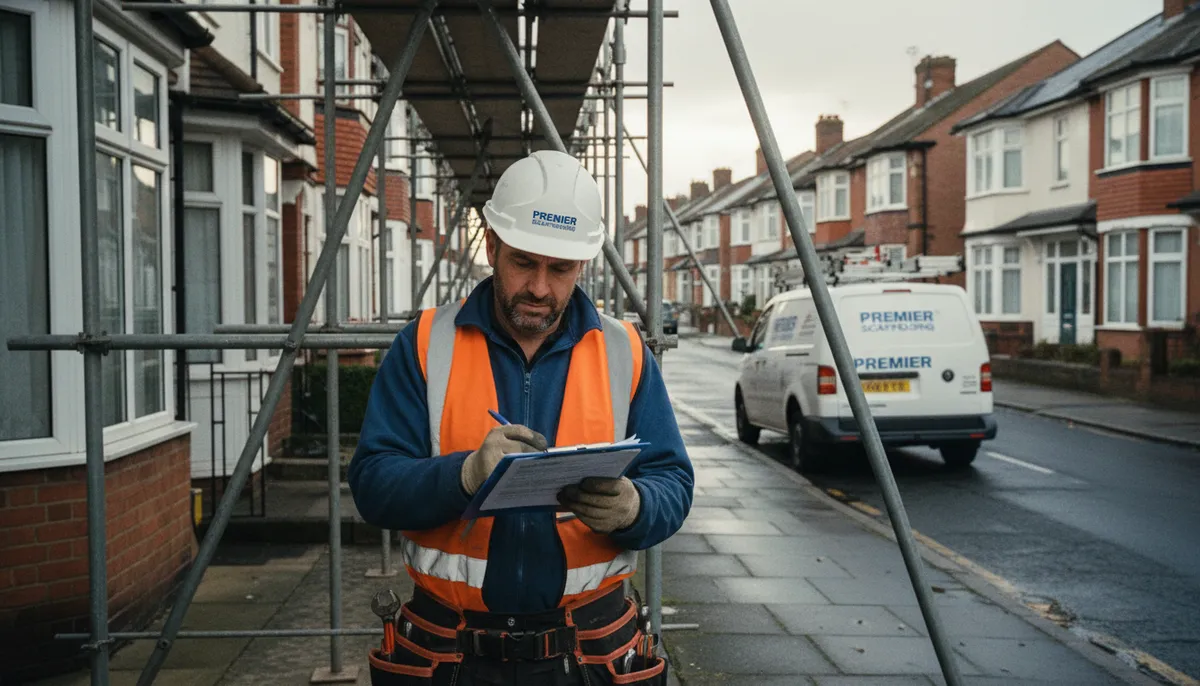
Public liability insurance for scaffolders covers you if your work causes injury or property damage to a third party — a client, a passing member of the public, or a neighbouring property. Scaffolding is one of the highest-risk trades in the UK: working at height with steel tubes and boards creates significant exposure if something goes wrong. This guide covers what PLI actually covers, how much you’ll pay, what cover levels main contractors expect, and what other policies a scaffolding contractor needs.
Key Takeaways
- PLI isn’t a legal requirement for scaffolders, but main contractors and construction sites almost always demand it before you set foot on site
- Scaffolding premiums are higher than most trades due to the working-at-height risk profile — typical annual premiums range from £500 to £2,000+
- Construction clients commonly require a minimum of £5 million PLI from scaffolding contractors; domestic work may only need £1m–£2m
- The National Access and Scaffolding Confederation (NASC) is the primary trade body and has guidance on minimum insurance requirements for members
- According to the Health and Safety Executive (HSE), falls from height remain the leading cause of fatal injuries in UK construction
- Employers’ liability insurance is a legal requirement the moment you take on any member of staff or labour-only subcontractor
Do Scaffolders Need Public Liability Insurance?
No law requires scaffolding contractors to hold PLI. But in practice, you’ll rarely work without it.
- Construction sites almost universally require PLI as a condition of entry. Main contractors have their own liability exposure and won’t allow uninsured subcontractors on site.
- Domestic clients booking scaffolding for a roof repair or loft conversion increasingly ask for proof of insurance. The potential damage from a scaffold collapse — to a vehicle, a neighbour’s property, or a person walking past — makes this a reasonable ask.
- NASC membership requires scaffolding companies to hold appropriate insurance. NASC accreditation is recognised by major contractors as a mark of professional standards.
- Working at Height Regulations 2005 place legal duties on employers and the self-employed to manage fall risks. PLI doesn’t replace those duties, but it protects you financially if a risk materialises into a claim.
- Local authority and public sector contracts almost always specify minimum PLI levels in their tender requirements.
The short version: you can operate without PLI, but you won’t get work on any serious contract.
What Does PLI Cover for Scaffolders?
PLI covers third-party claims — claims made against you by someone outside your business. For scaffolding contractors, the scenarios most likely to result in a claim include:
| Scenario | Covered by PLI? |
|---|---|
| A pedestrian is injured when a board falls from scaffold | Yes |
| Scaffolding collapses and damages a neighbouring vehicle | Yes |
| A client trips over your equipment on site | Yes |
| Scaffold erection damages a building’s cladding or render | Yes |
| A scaffold tube punctures a neighbour’s flat roof | Yes |
| Debris netting fails and materials fall onto a public area | Yes |
| Your tools are stolen from site or your van overnight | No — needs tools insurance |
| You or a worker is injured during erection or dismantling | No — needs personal accident or employers’ liability cover |
| A client disputes the quality of your scaffold design | No — this is a contract dispute; professional indemnity covers advice-based claims |
| Wear and tear on your equipment | No — needs plant and equipment insurance |
Completed works cover is worth confirming with your insurer. Standard PLI covers incidents while you’re on site. If a client makes a claim after you’ve finished and dismantled — for example, damage discovered to a roof structure that your scaffolding was attached to — a completed works extension covers that scenario.
How Much Does Public Liability Insurance Cost for Scaffolders?
Scaffolding carries a higher risk profile than most trades, which pushes premiums up compared to groundworks or interior trades. The high-risk, working-at-height nature of the work means specialist underwriters price scaffolding differently from most construction trades — expect to pay more than a painter or plasterer for equivalent cover levels. Typical annual costs for scaffolding contractors in the UK:
| Contractor Type | Annual Turnover | Approximate Annual Premium | Cover Level |
|---|---|---|---|
| Sole trader / small team | Under £100,000 | £500–£900 | £2m–£5m |
| Small company | £100,000–£300,000 | £800–£1,500 | £5m |
| Medium company | £300,000–£750,000 | £1,200–£2,500+ | £5m–£10m |
These are approximate figures based on typical market pricing. Your actual premium depends on:
- Annual turnover — the primary rating factor for most insurers
- Type of work — industrial scaffolding on power stations or petrochemical plants costs significantly more than residential work
- Claims history — a clean record makes a meaningful difference at renewal
- Cover level — £2m, £5m, and £10m policies are priced differently
- Staff numbers — more operatives means more exposure
- Geographic spread — some insurers charge more for nationwide contracts vs localised work
Getting quotes from specialist trade insurers — including Simply Business, Tradesman Saver, Rhino Trade Insurance, and Marsh Commercial — is the fastest way to find your specific premium. Scaffolding is a specialist risk, so going to a broker or insurer who understands the trade is worth doing rather than using a generic comparison site.
How Much Cover Do Scaffolders Need?
| Work Type | Typical Minimum Required |
|---|---|
| Domestic residential (private clients) | £1m–£2m |
| Commercial contracts / main contractor supply chain | £5m |
| Public sector, local authority contracts | £5m–£10m |
| Industrial sites (petrochemical, energy, nuclear) | £10m+ |
Most scaffolding companies operating in the commercial and construction sector work with £5 million as standard. If your tender documents specify a minimum, match it exactly — submitting a quote with lower cover than specified will usually disqualify you.
Some clients require combined single limit cover, which handles property damage and bodily injury claims from a single pool rather than separate sub-limits. Check this with your insurer when comparing quotes.
Other Insurance Scaffolding Contractors Need
PLI is the foundation, but it’s rarely the only policy a scaffolding business needs.
| Insurance Type | What It Covers | Required? |
|---|---|---|
| Employers’ liability | Injuries to employees and labour-only subcontractors | Yes, if you employ anyone |
| Plant and equipment insurance | Your tubes, fittings, boards, and lifting equipment | Recommended — scaffold kit is expensive |
| Tools cover | Handheld tools, power tools, testing equipment | Recommended |
| Personal accident / income protection | Your income if you’re injured and can’t work | Recommended for sole traders |
| Commercial vehicle / van insurance | Transit, flatbed, or lorry insurance including business use | Yes, if you have a company vehicle |
| Contractors all-risk / contract works | Materials and works in progress against accidental damage | For larger contracts |
Employers’ liability deserves a special mention. If a worker is injured during scaffold erection or dismantling — the highest-risk phases of the job — and you don’t have EL cover in place, you’re personally liable for the claim. The Employers’ Liability (Compulsory Insurance) Act 1969 makes EL a legal requirement if you employ staff. Fines for non-compliance start at £2,500 per day. For a full breakdown, see Employers’ Liability Insurance for Tradespeople.
Plant insurance is particularly relevant for scaffolders. Scaffold systems — tubes, fittings, boards, and access equipment — represent significant capital investment. A stolen or fire-damaged scaffold system can run into tens of thousands of pounds to replace. PLI won’t cover the loss of your own equipment.
According to the Health and Safety Executive (HSE), 51 workers were killed in the UK construction sector in 2023/24, with falls from height remaining the single largest cause of fatal injuries. Scaffolders work at the intersection of that risk — erecting and striking the very structures that enable height work across every other trade.
NASC and Industry Standards
The National Access and Scaffolding Confederation (NASC) is the main trade body for the scaffolding industry in the UK. NASC membership requires companies to demonstrate compliance with industry standards including SG4 (Preventing Falls in Scaffolding), TG20 (tube and fitting scaffolding guide), and appropriate insurance levels.
Many main contractors and framework clients specify NASC membership as a prequalification requirement. Being an NASC member demonstrates to clients that you operate to industry standards — and adequate insurance is part of that.
Alongside NASC, the CITB (Construction Industry Training Board) operates the [CSCS card](/blog/cscs-card-explained/) scheme. Scaffolders typically need a CITB-registered Scaffolding card (blue or gold depending on qualification level) to work on most construction sites. See the full CSCS card guide for more on how the scheme works.
Frequently Asked Questions
Do scaffolders need public liability insurance? PLI isn’t a legal requirement for scaffolders, but it’s effectively mandatory in practice. Main contractors, construction sites, domestic clients, and NASC membership all require you to have it. Operating without PLI means missing out on almost every commercial scaffolding contract.
How much does public liability insurance cost for a scaffolder? Scaffolding attracts higher premiums than most trades because of the working-at-height risk. Sole traders with turnover under £100,000 typically pay £500–£900 per year for £2m–£5m cover. Larger scaffolding companies pay £1,200–£2,500+ per year. Getting quotes from specialist trade insurers gives you the most accurate figure for your specific business.
How much PLI cover does a scaffolding contractor need? Most commercial scaffolding contracts require a minimum of £5 million PLI. Domestic work may only need £1m–£2m, but £5m is becoming standard across the industry. Always check the specific requirements in your contract or site induction documentation.
Is employers’ liability insurance compulsory for scaffolding companies? Yes, if you employ any staff — including labour-only subcontractors. The Employers’ Liability (Compulsory Insurance) Act 1969 makes it a legal requirement. Fines for not having it start at £2,500 per day. Sole traders with no employees are exempt.
What happens if a scaffold collapses and causes damage? A scaffolding collapse that damages a neighbouring property, vehicle, or injures a member of the public would be a PLI claim. Your insurer investigates, manages the claim, and covers costs up to your policy limit. Without PLI, those costs come directly out of your business. This is exactly the scenario PLI exists for.
Building a Scaffolding Business That Wins Contracts
Insurance is a foundation — clients expect you to have it, not a reason to choose you over a competitor. What wins contracts is professionalism, reliability, and being easy to do business with. A professional website helps on all three: it gives clients somewhere to send referrals, lets you show your NASC accreditation and insurance credentials upfront, and helps you appear in local search results when construction managers are looking for scaffolding contractors.
Digital Tradies builds websites for scaffolders and other tradespeople from £49/month — no upfront cost, live in 3 days.
This article is for general information only. Insurance products vary between providers — always read your policy wording carefully and consult a qualified insurance adviser if you’re unsure about your cover requirements.